Do you own an older Boeing 747 and are looking to improve the way it looks? Does your upper deck just look so small compared to the 747-300, 747-400 and especially the 747-8I? Well, do not worry… Boeing has a deal for you: the 747 Stretched Upper Deck (SUD). Well, I guess Boeing had a deal for you, since they aren’t in the business of doing this anymore.
The SUD gave airlines operating older -100 and -200 747 models, the ability to stretch the upper deck and increase the number of passengers flown. When plane spotting, it is typically easy to tell the difference from a 747-100/200 and the 747-300 by check out the stretched upper deck, but the SUD makes it a bit more complicated.
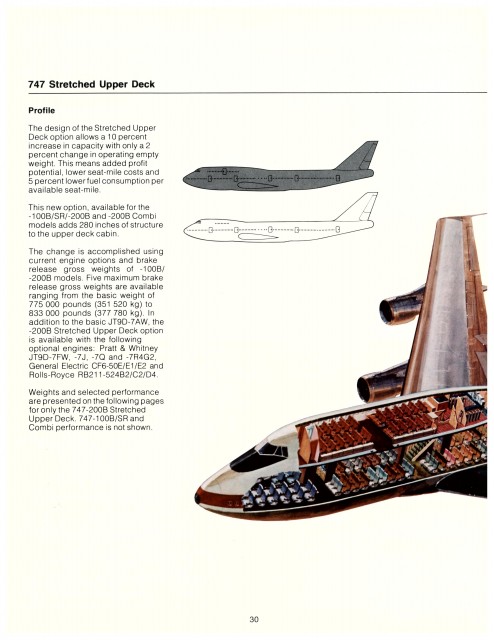
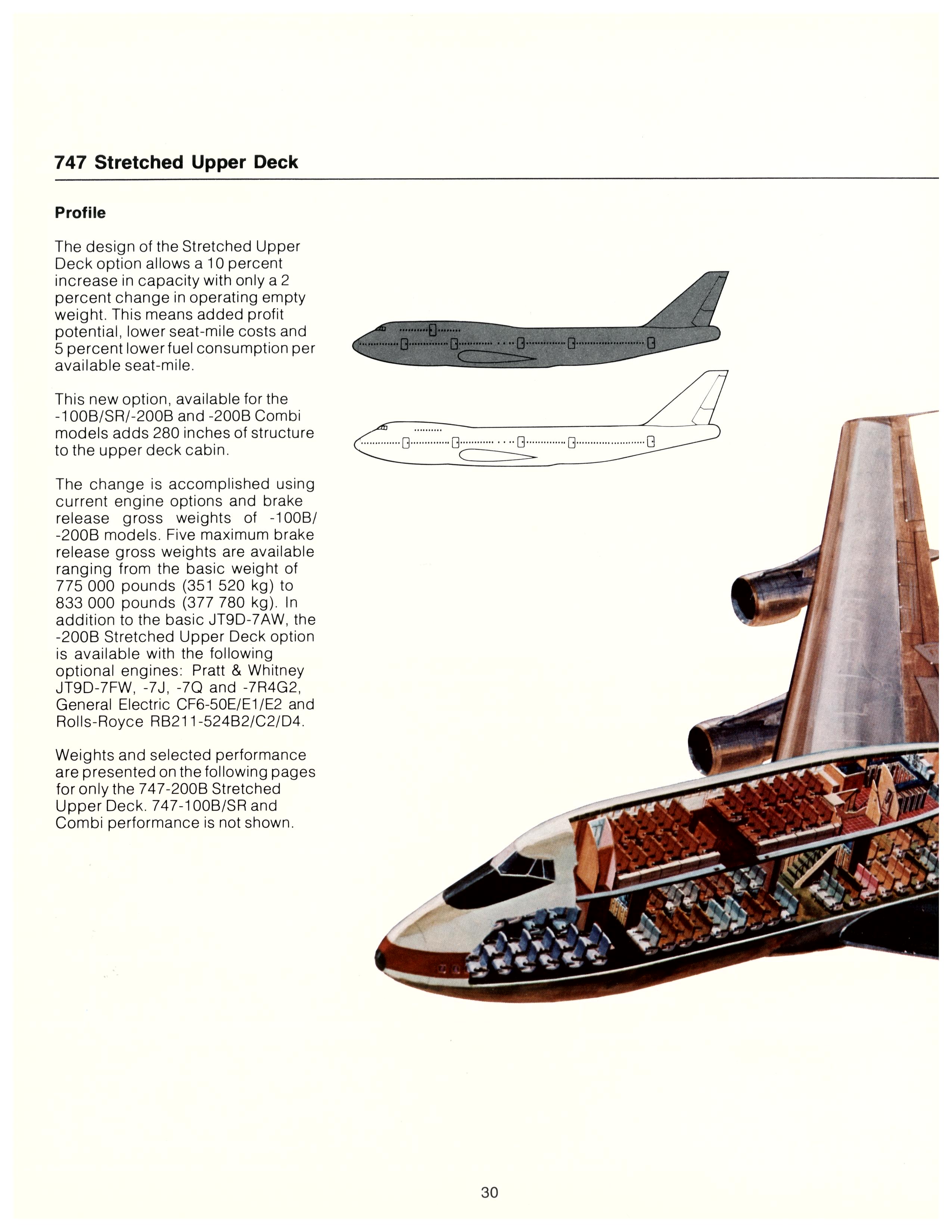
CLICK FOR LARGER: Information for airlines on the Boeing 747 Stretched Upper Deck. Image from Boeing.
From the image above: “The design of the Stretched Upper Deck option allows a 10 percent increase in capacity with only a 2 percent change in operating empty weight. This means added profit potential, lower seat-mile costs and 5 percent lower fuel consumption per available seat-mile.”
“This new option, available for the -100B/SR/-200B and -200B Combi models adds 280 inches of structure to the upper deck cabin.”
“The change is accomplished using current engine options and brake release gross weights of -100B/-200B models. Five maximum brake release gross weights are available ranging from the basic weight of 775,000 pounds (351 520 kg) to 833,000 pounds (377 780 kg). In addition to the basic JT9D-7AW, the -200B Stretched Upper Deck option is available with the following optional engines: Pratt & Whitney JT9D-JFW, -7J, -7Q and -7R4G2, General Electric CF6-50E/E1/E2 and Rolls-Royce RB211-524B2/C2/D4.”
“Weights and selected performance are presented on the following pages for only the 747-200B Stretched Upper Deck. 747-100B/SR and Combi performance is not shown.”
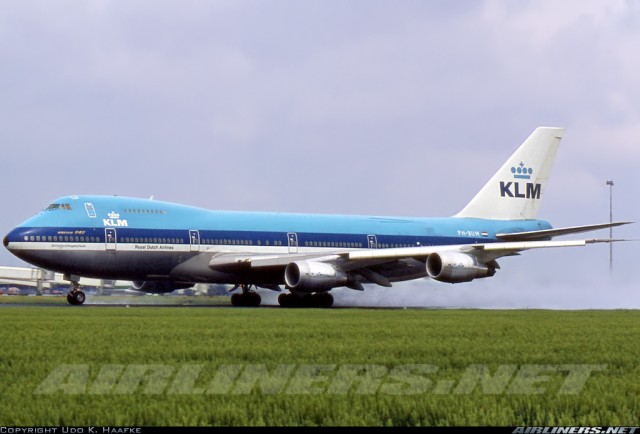
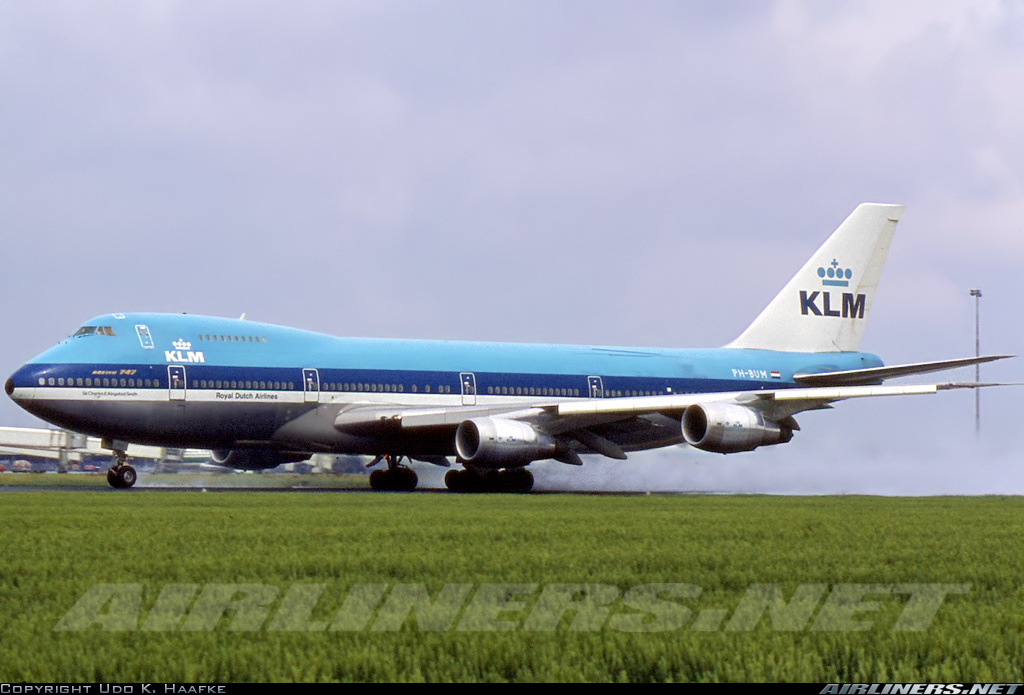
KLM Boeing 747-200 (PH-BUM) tkaen in May 1980 before the SUD upgrade. Photo by Udo Haafke.
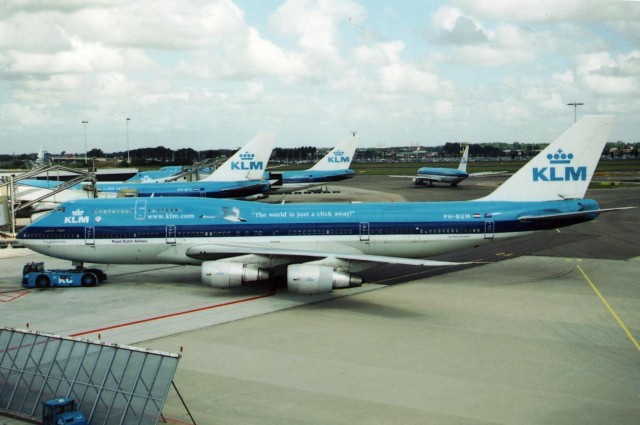
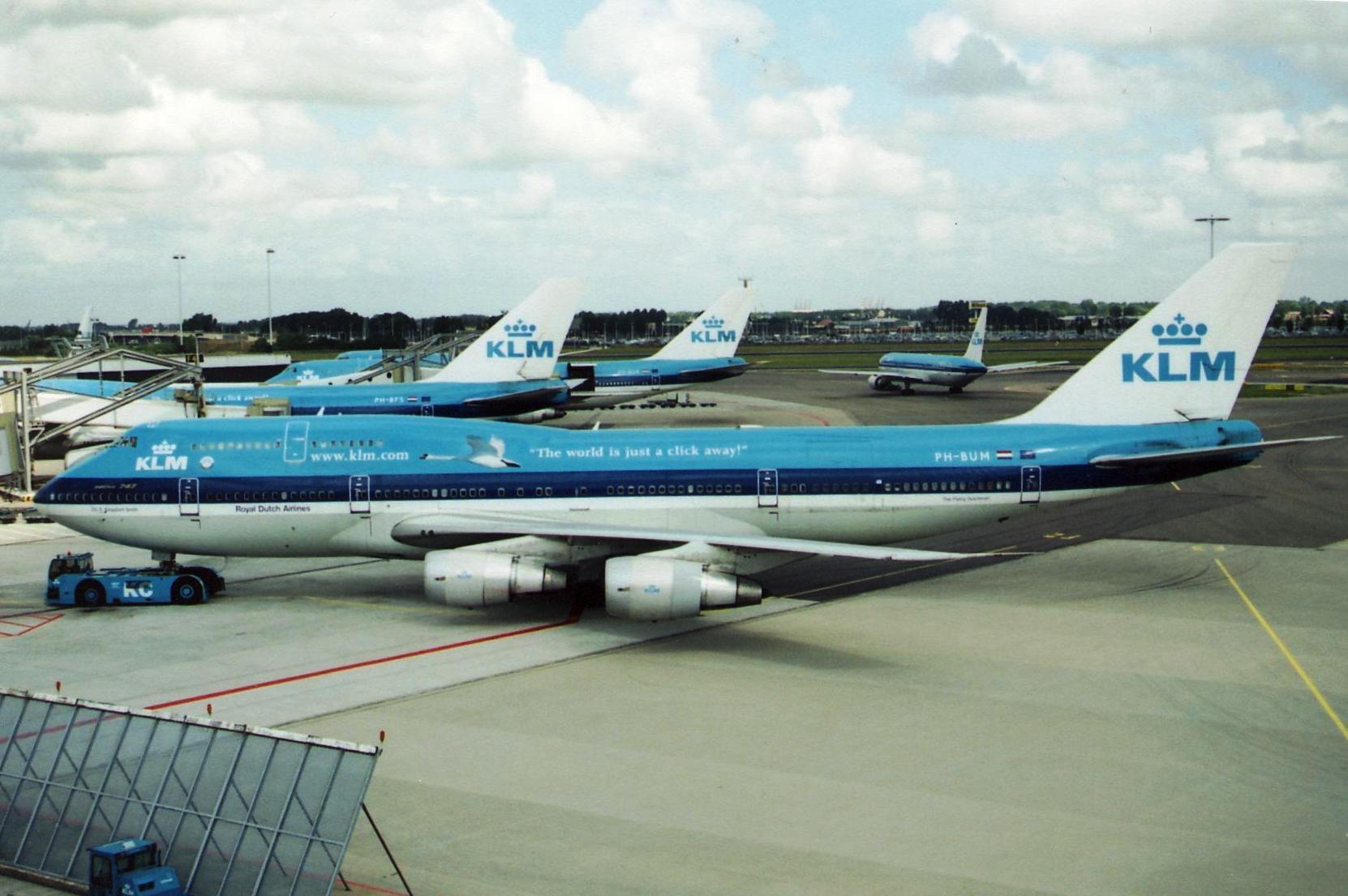
The same KLM Boeing 747-200 (PH-BUM) now with a Stretched Upper Deck. It looks like a Boeing 747-300, but really is still a -200. Taken in August 2003. Photo by Savvas Garozis.
Images by Udo K Haafke and Savvas Garozis
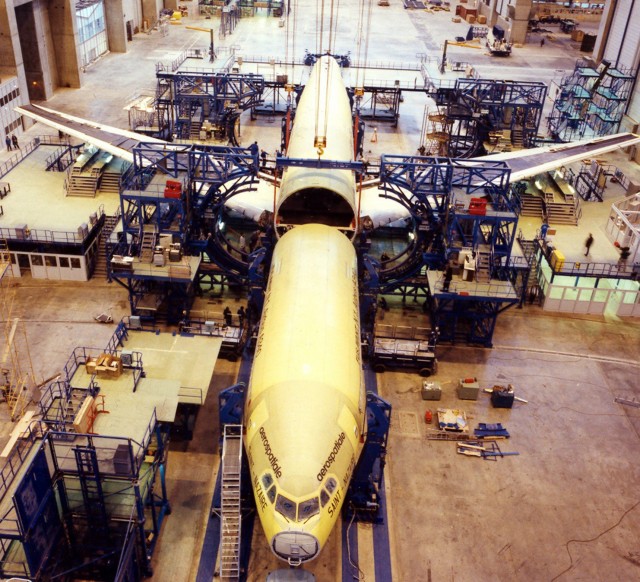
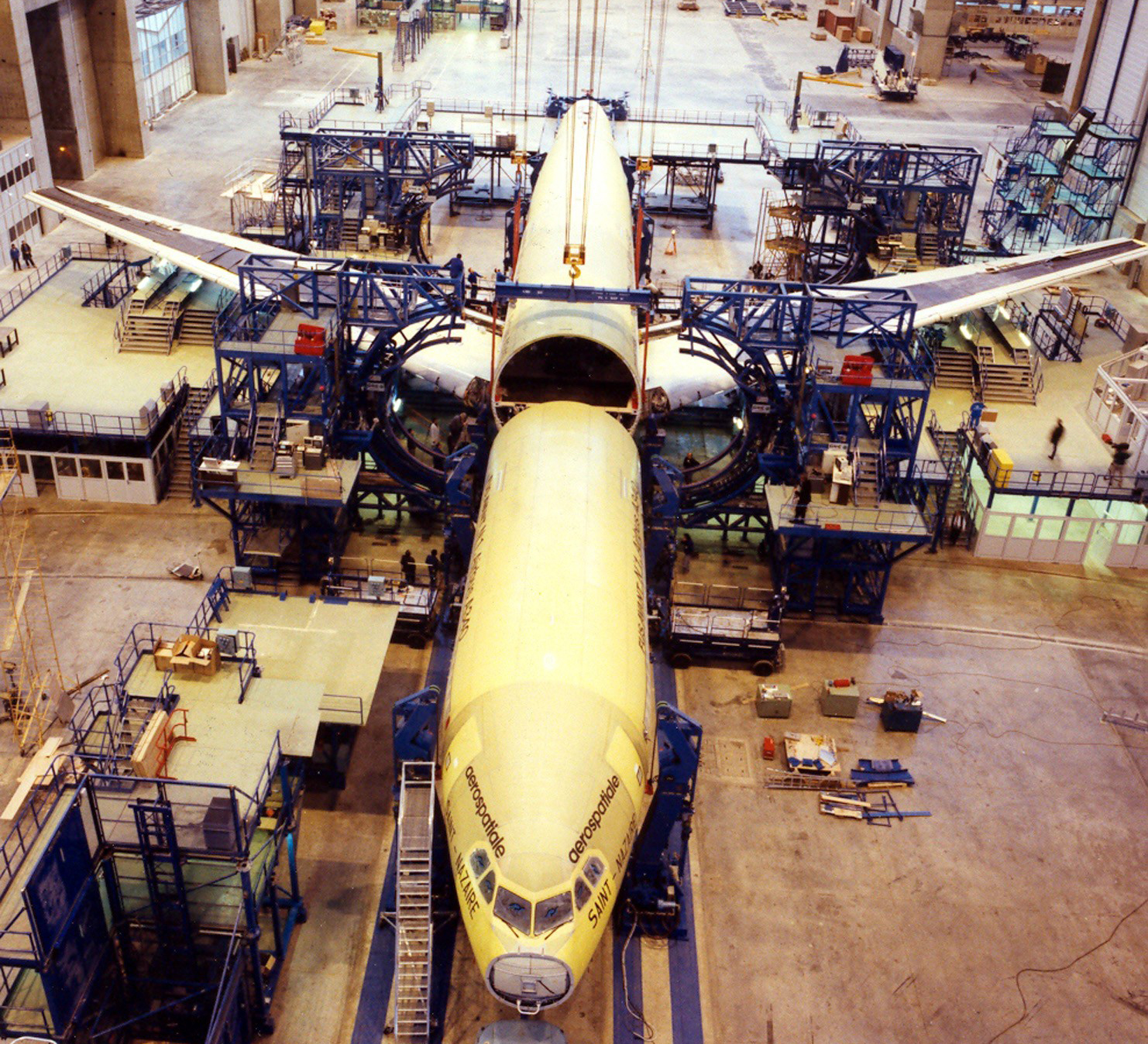
The very first Airbus A340 takes shape inside their factory. Photo from Airbus.
I have always loved the look of the Airbus A340. In the early days of jet airlines, seeing a single-deck plane with four engines on the wing was common. By the time the A340 first flew on October 25, 1991, there weren’t too many Boeing 707s or Douglas DC-8s flying around. Even for the amateur aviation enthusiast, it has always been quite easy to spot an A340.
The engines might provide an easy tell on what kind of aircraft it was, but they also drained a lot of fuel. Airlines started to opt for two engine Airbus A330s and Boeing 777s instead of the A340. Due to a lack of demand, Airbus officially announced the end to the aircraft due to a, “changing market dynamic,” (aka no orders) on November 10, 2011.
Although Airbus is no longer making the A340, there are still four that are left to be delivered. Two are set to go to VIP customers and two were ordered by Kingfisher Airlines. It is not certain when the final four will be delivered, but I am going to bet that Kingfisher might never take delivery of their two A340s due to their current financial difficulties.
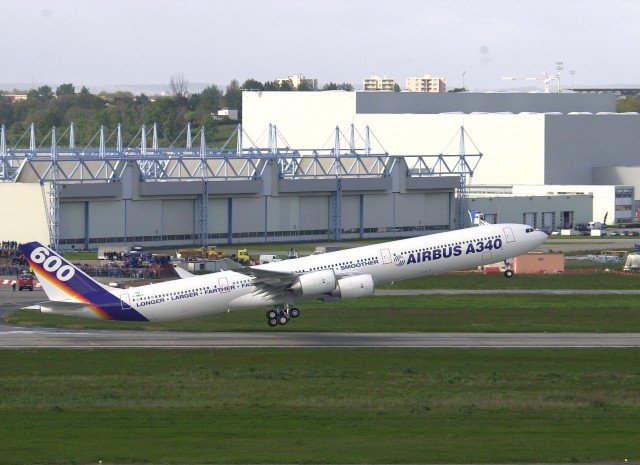
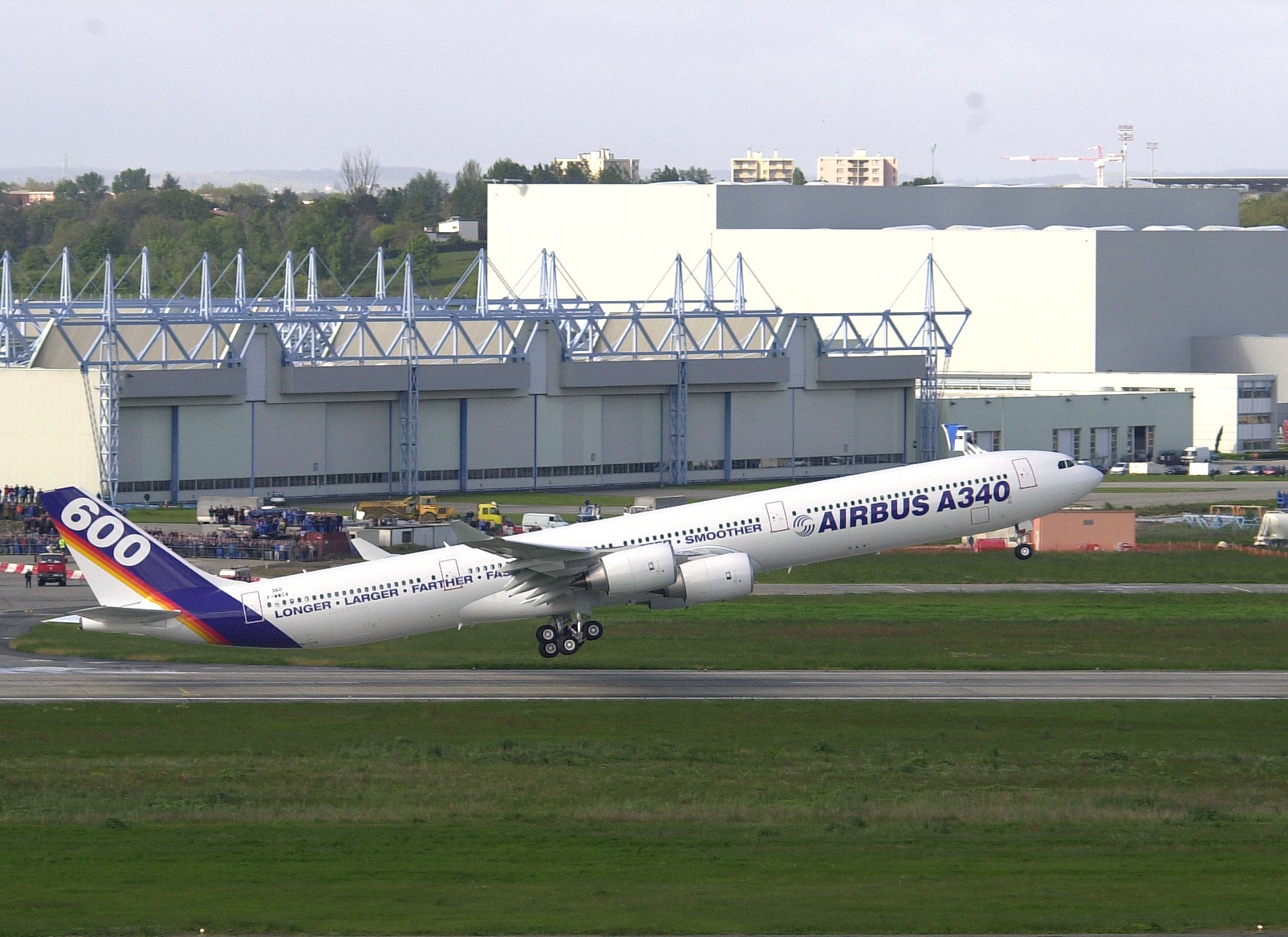
The first Airbus A340-600 takes off in Airbus livery. Photo from Airbus.
Well, times have changed with ETOPS certification and today, two engine aircraft can fly much farther away from land than they used to. When the A340 was first produced, many passengers (and probably even airlines) were weary of flying over water with two engines and the Boeing 777 wasn’t even in production.
As Boeing Randy Tinseth points out in his blog, Airbus used creative advertising to possibly play off the fears of passengers who might not want to fly over the open seas using a two-engined aircraft. Obviously any fear that people might have had was put to rest with the success of many airliners who have successfully flown over open waters with only two engines.
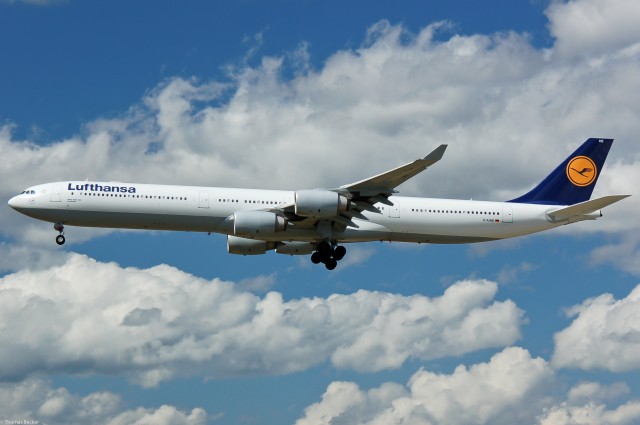
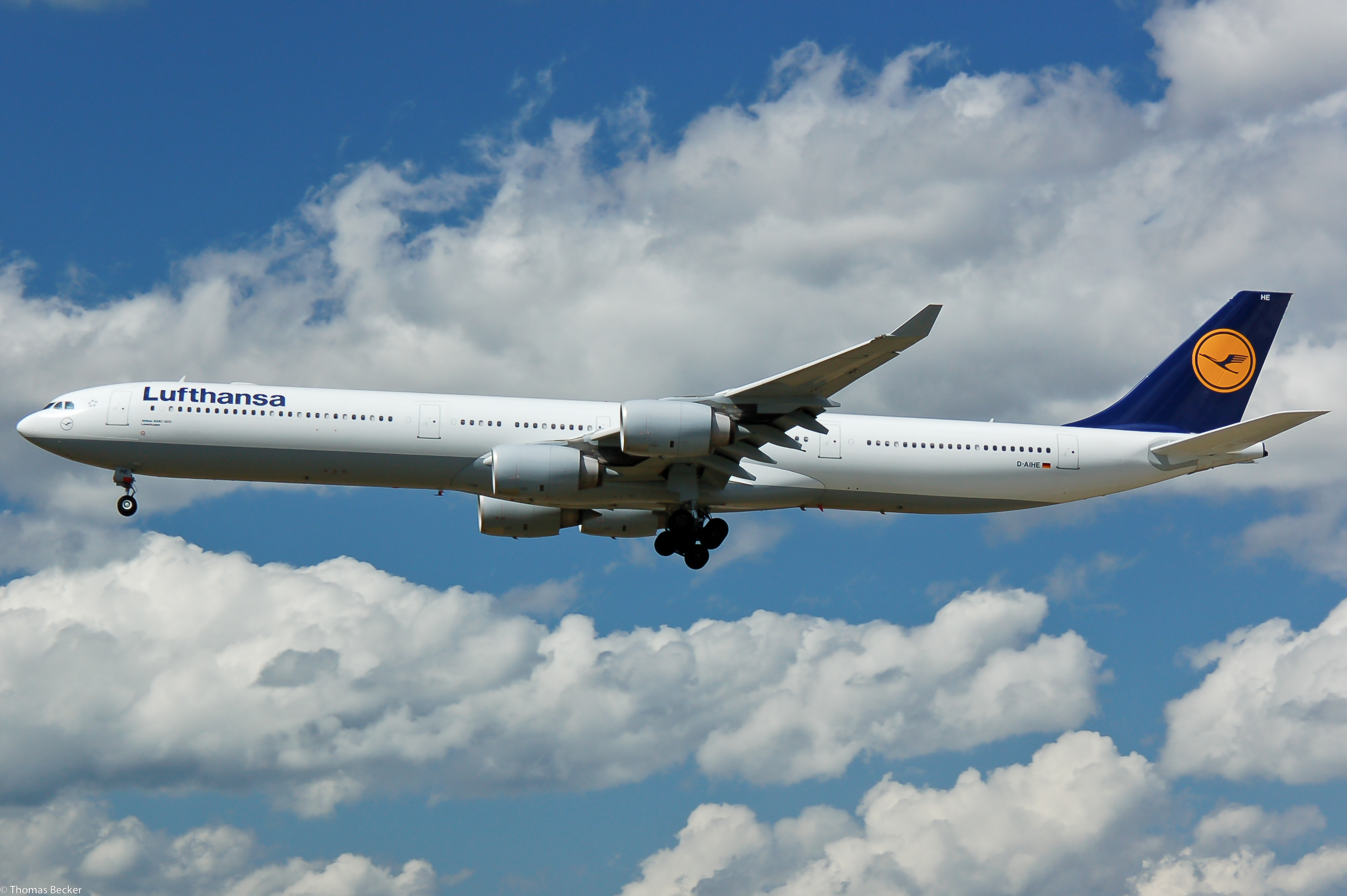
Lufthansa Airbus A340-642 D-AIHE Leverkusen. Photo by Thomas Becker.
There were a total of 379 of the A340 ordered and 365 are still in service today. Lufthansa Airlines is the largest operator of the A340 with 51 currently in service.
“Technological achievements during the last years today allow to operate aircraft of the size of the A340-300 efficiently with two engines, what hasn’t been the case earlier,” Nico Buchholz, Head of Lufthansa Group Fleet Management explained to AirlineReporter.com. “Still, on some routes the A340-300 is still superior to it’s twin-engine competitors, with regards to payload and flight performance. In light of the huge accomplishments made, however, aircraft of this segment now and in the future are clearly twin-engines, as demonstrated impressively by B777, A330, B787 and A350 aircraft.”
Currently, Lufthansa is not planning to replace any of their A340 fleet anytime soon. “We keep on applying modifications to make them more fuel-efficient, reduce noise or make cockpit modifications,” Buchholz explained. “That being said, our fleet is economically and technically up to date and we have no huge pressure to make a buying decision here. We will decide at an appropriate time.”
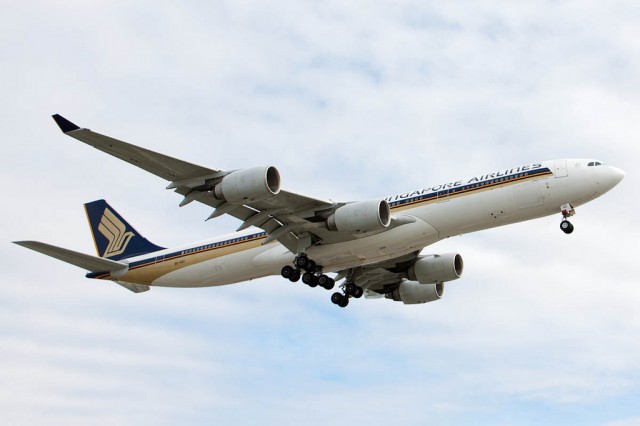
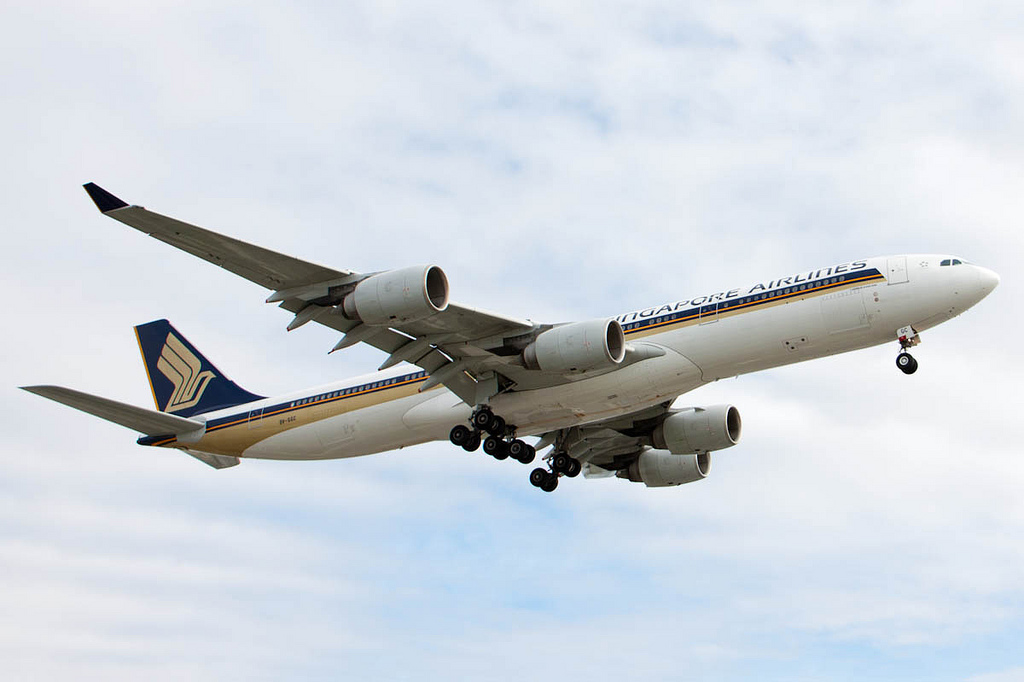
Singapore Airlines Airbus A340-500 landing at LAX. Photo by Bob Connolley
Singapore Airlines only operates five of the A340 aircraft, but they are unique in using them to fly the world’s two longest flights: Los Angeles (LAX) and Newark (EWR) to Singapore (SIN). Flight SQ21, from EWR to SIN, is the longest scheduled airline flight in the world, which is 9,535 miles and takes almost 19 hours. Flight SQ 37, from LAX to SIN, is the world’s second longest flight at 8,770 miles and takes about 18 hours. Both of these flights exclusively use the Airbus A340-500 aircraft. “What the aircraft does is create a non-stop link between the US and Singapore for growth,” James Boyd, Singapore Airline’s Vice President of Communications for the Americas explained to AirlineReporter.com.
At the time that Singapore Airlines started the flights, the A340-500 was the only aircraft capable of operating routes that long. Even today, there are only two aircraft that are able to handle the route: the A340-500 and Boeing 777-200LR.
Even though Singapore Airlines also operates the 777, Boyd explained that they are not planning on replacing their A340-500s anytime soon. Recently the airline invested quite a bit of money updating all five cabins on their A340s to all Business Class, providing the same product that is found on their Airbus A380.
Singapore Airlines is unique due to operating aircraft that many see as directly competing against each other: the Boeing 777 and Airbus A340/A330, the Boeing 747 and Airbus A380, and they have the Boeing 787 and Airbus A350 on order. Why? Because many of their routes are market and destination specific and each route is specifically matched up to the aircraft it uses and for them, that means a diverse fleet. Singapore’s two routes that use the A340-500s are very profitable and it wouldn’t make any sense to change out aircraft.
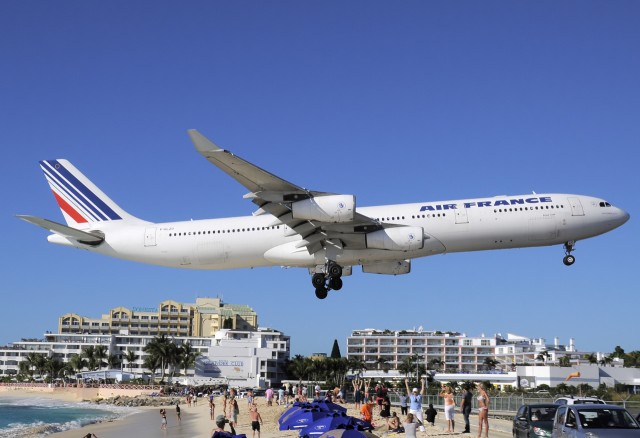
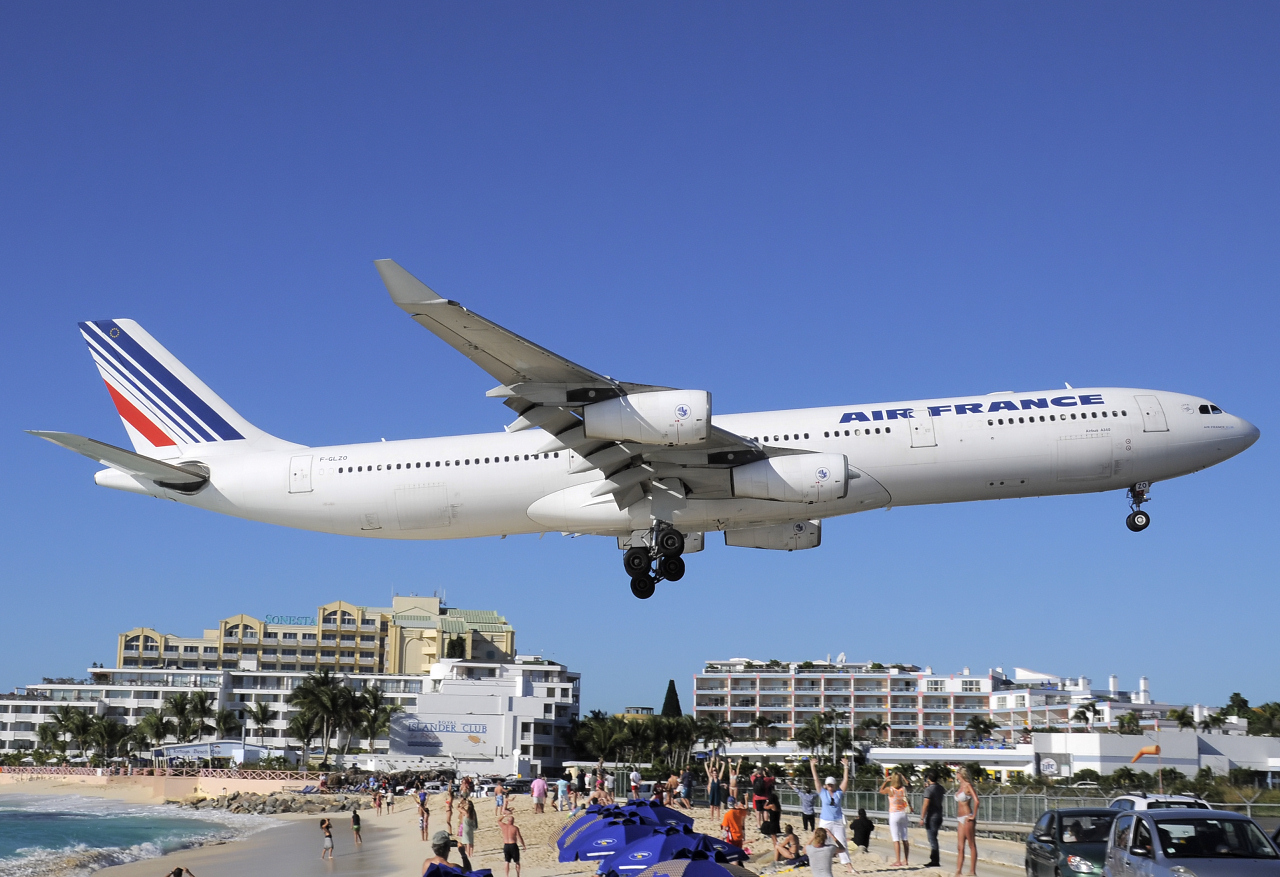
Air France Airbus A340-300 landing at the iconic Saint Maarten. Photo by Jordi Grife..
The end of the Airbus A340 leaves only two quad jets that remain in commercial airliner production: The Boeing 747-8 Intercontinental and the Airbus A380. As engines become more efficient, will there be more quad jets into the future? Probably not, but for those of us that get a kick out of seeing jets with more than two engines, at least we will see the A340 still flying for quite some time to come.
Images:
Lufthansa A340 – Thomas Becker
Singapore A340 – Bob Connolly
Air France A340 – Jordi Grife
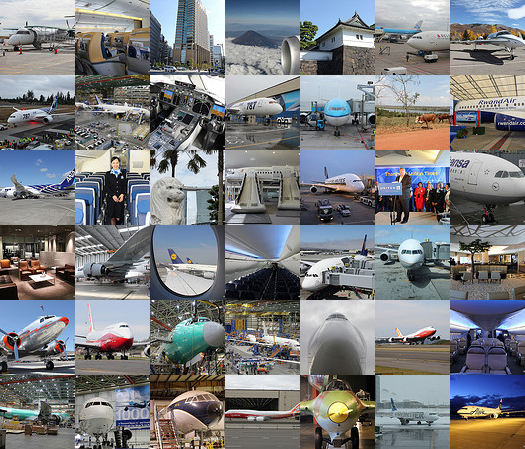
Thumbnail from each of my Flickr photo sets in 2011. Lots of good stuff. SUPER DOOPER bonus if you can tell me what each of these thumbnails represent -- without going to my Flickr page.
First of all, a Happy New Year to everyone. 2011 was another great year for the blog. Without your readership, airlines wouldn’t be willing to let me go on these adventures and share them with you, so I am highly appreciative for all your support.
In 2011, I was able to rack up over 81,000 miles flying for the blog (compared to 50,000 in 2010). Out of all the stories, photos and experiences which were the most popular to me and you? Well, this year it wasn’t so easy. All these “Tops” come directly from the blog at AirlineReporter.com and do not take into account of the readership on the Seattle PI or Reuters (even though are very important as well — but I just don’t have good data from those). Here are Top 5’s in different categories:
Top 5 Viewed Blogs
Rarely does time spent on a story relate directly to the amount of traffic seen. Many times, having access to a few sweet photos or a video and taking three minutes to post it will inevitably see more traffic than a story I work on for weeks. Traffic is traffic of course and it is always interesting seeing the most popular stories. These are the top viewed stories for 2011:
* Airbus A380 wing hits building at Paris Airshow
* Interior photos of ANA’s first Boeing 787 Dreamliner
* JAL livery revealed on 787 Dreamliner
* Photo of Boeing 747-8 Intercontinental outside, unpainted
* Taking a look at Delta’s Economy Comfort vs United’s Economy Plus
Top 5 Experiences
Lots of miles and many great experiences this last year, but these are my five favorite (in no particular order):
* Flying on the Boeing 787 Dreamliner for the first time
* Hitching a ride on a Beechcraft Starship
* Experiencing Singapore Airline’s A380 Business Class
* Delivering a RwandAir Boeing 737
* Watching the Boeing 747-8 Intercontinental take her first flight
Top 5 Cities Reading the Blog
This is the first year that Seattle (where I am based) moves down to number two in readership behind New York. Also, all five are US cities, where last year London made the list. Here are the cities that read my blog the most in 2011 (in order of most to least):
* New York
* Seattle
* Los Angeles
* Chicago
* San Francisco
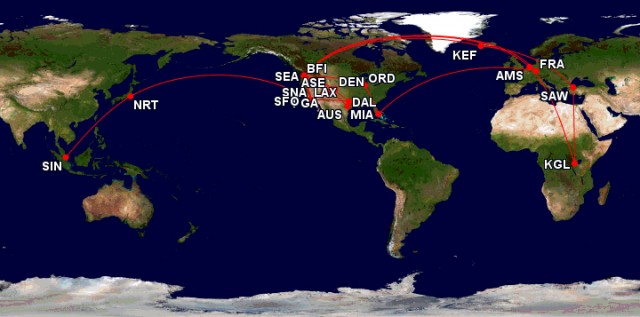
I feel lucky that I was able to fly over 81,000 miles for the blog in 2011. Hoping to break the 100k mark for 2012.
Top 5 Photos On The Blog
I am not a professional photographer, nor do I want to be one. I have enjoyed learning a lot about photography in 2011, but being around people who are truly amazing photographers, I won’t ever get to that level — but I am okay with that (less stressful for sure). Sometimes I like what I take, sometimes I do not. These are the Top 5 photos I enjoyed that were taken for the blog. Not saying they will win any awards, but here they are:
* Singapore Airlines Airbus A380 at Narita
* Boeing 747-8I at Boeing Field (taken by Nick Smith for AirlineReporter.com)
* Singapore skyline at night
* Rear view of the Beechcraft Starship. The plane has so many amazing angles, but I really enjoyed this one.
* Inside the Boeing 787 Dreamliner with tinted windows
Top 5 Most Commented Blogs
This year has seen many more comments on my stories and I LOVE IT. Not surprisingly there tend to be more comments on some of my more controversal topics. Here are the top commented stories (in order from most to least) of 2011:
* Received My First Body Scan and I Am Okay With It
* Airline Livery Opinion of the Week: American Airlines Livery Stinks
* PHOTOS: Airbus A380 Wing Hits Building at Paris Air Show
* CONTEST: How Many Boeing 737s Are Still Flying?
* Was United Airline’s Computer Outage That Big of a Deal? I Say Nay.
Previous New Years Posts:
Top 5 of 2010
My 6 favorite blogs of 2009
So what did your airline-related 2011 look like? Fly anywhere cool? Take some good photos? Where are you hoping to go in 2012?
Over the past week I have been receiving many different press releases from Boeing – most of which I wanted to share, but haven’t had the time to give them the attention that they deserve. To make sure that they all get a little attention, I decided to do this round up to touch base on what’s going on with Boeing. There are a few more story lines that I hope to go into a bit more detail over the next few days, but for now…
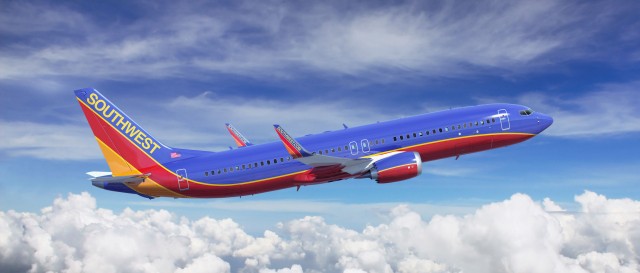
HI RES (click for bigger): Southwest Airlines Boeing 737 MAX 8. Photo by Boeing.
SOUTHWEST AIRLINES BECOMES LAUNCH CUSTOMER FOR THE 737 MAX
On December 13th, Boeing announced that Southwest airlines placed an order for 150 of the 737 MAX and would become the launch customer the new version of the 737.
“Southwest is a special Boeing customer and has been a true partner in the evolution of the 737,” said Boeing Commercial Airplanes President and CEO Jim Albaugh. “Throughout our 40-year relationship, our two companies have collaborated to launch the 737-300, 737-500 and the Next-Generation 737-700 ’“ affirming the 737 as the world’s preferred single-aisle airplane. As launch customer for the 737 MAX, Southwest, Boeing and the 737 continue that legacy.”
The firm order is Boeing’s largest in both dollar value and the number of aircraft ordered.
“Today’s environment demands that we become more fuel efficient and environmentally friendly, and as the launch Customer of the Boeing 737 MAX, we have accomplished both,” said Gary Kelly, Southwest Airlines Chairman, President, and CEO. “We are teaming up with our friends from Boeing to lead the industry in a way that makes both our shareholders and our Customers proud to associate with Southwest Airlines. Today’s announcement will allow us to maintain our position as a low-cost provider in the years ahead.”
VIDEO: Southwest Airlines Boeing 737 Max. Computer generated by Boeing. Thanks to Robert for pointing this out.
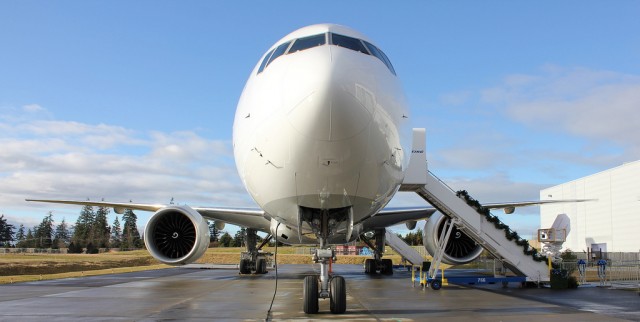
Air New Zealand's first Boeing 777-300ER at Paine Field. Photo by AirlineReporter.com.
BOEING 777 NOW HAS 330-MINUTE ETOPS
On December 12th, Boeing announced that its 777 received approval from the Federal Aviation Administration (FAA) to fly up to 330-minutes away from an alternative airport.
“Boeing twin-engine jets have flown more than 7 million ETOPS flights since 1985, and more than 120 Boeing operators fly more than 50,000 ETOPS flights each month,” said Larry Loftis, vice president and general manager 777 program. “This is the logical continuation of the Boeing philosophy of point-to-point service. Passengers want to minimize their overall travel time. This is one more step in that direction.”
To date, the 777 has flown more than 2 million ETOPS flights since June 1995 and 93% of 777s are flown on ETOPS routes.
“What this means is that the airplane is able to fly a straighter route between the city pairs and that’s good for the environment,” said Capt. David Morgan, chief pilot for Air New Zealand. “Less fuel is burned and less carbon dioxide is emitted into the atmosphere. It’s also good for customers because flights are potentially shorter and passengers could arrive sooner at their destinations.”
CHECKING IN WITH THE DREAMLINER WORLD TOUR
Boeing’s third Dreamliner, ZA003, is taking a six month journey around the world. Its first stop was in Beijing, China with different stops with-in China from December 4th to 11th.
“This great day demonstrates our partnership with China in pursuing aviation excellence,” said Marc Allen, Boeing China president. “Chengfei, Hafei and Shenfei — as exclusive and single-source Boeing suppliers — have made a great contribution to the success of the 787 program, producing the rudder, wing-to-body fairing, and vertical fin leading edge. We want to thank them for their role in making today possible.”
On the 11th, ZA003 flew over to Africa and became the first time a 787 has landed in that continent. From the 11th to the 14th, the 787 hung out in Nairobi and allowed Ethiopian Airline employees the chance to see the new aircraft they should be taking delivery of soon. ZA003 will remain in Africa until the 16th of December before flying to the Middle East with a stop in Doha to visit Qatar Airways.
At this point, Boeing has not announced future destinations, but I would imagine that ZA003 will continue to head west.
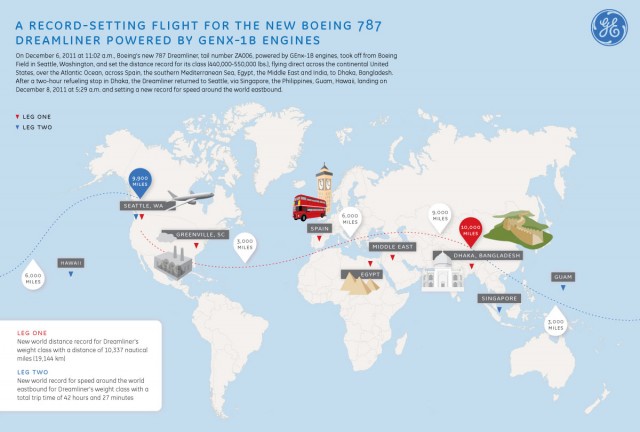
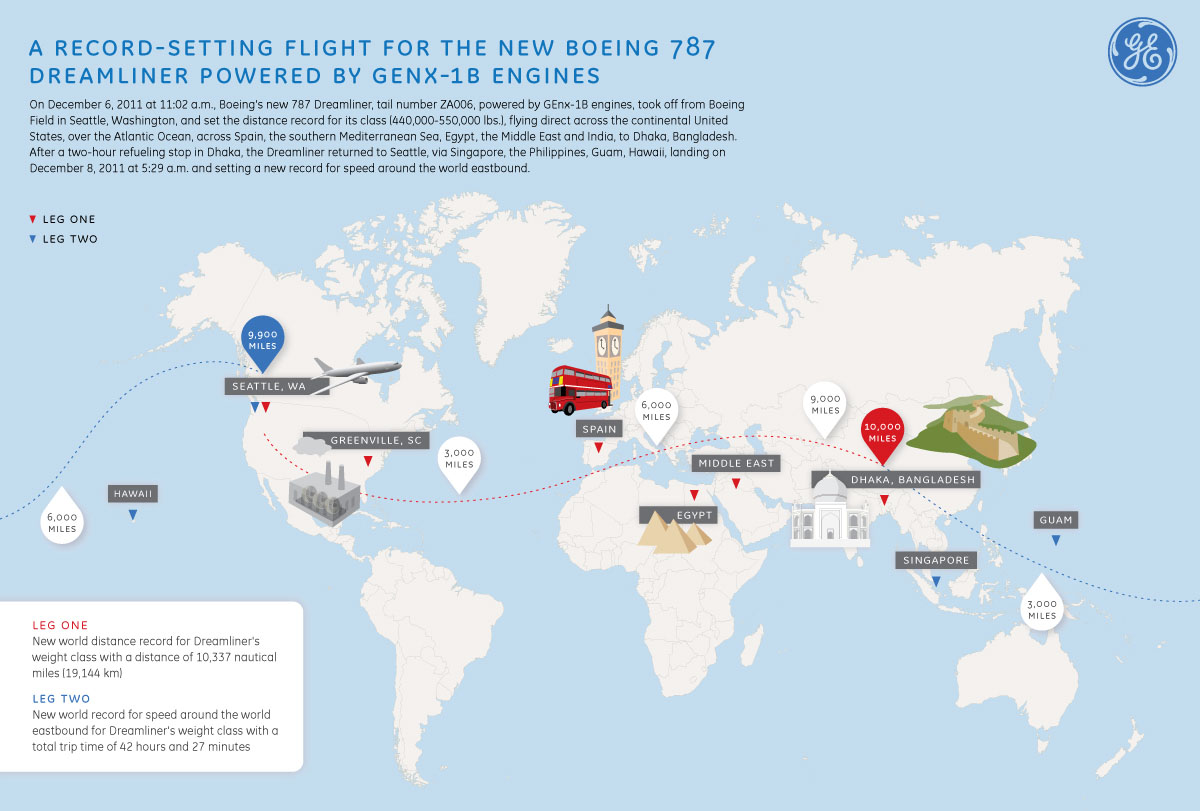
Graphic showing the record breaking Boeing 787 Dreamliner flight. Image is from GE. Click for larger.
THE 787 DREAMLINER BREAKS WORLD RECORDS
While ZA003 is traveling the world, ZA006 went and set some new world records. The 787 Dreamliner recently established two new records for speed and distance for the aircraft’s weight class.
From Boeing’s press release, “The sixth 787, ZA006, powered by General Electric GEnx engines, departed from Boeing Field in Seattle at 11:02 a.m. on Dec. 6 and set the distance record for its class (440,000-550,000 lbs.) with a 10,710 nmi (19,835 km) flight to Dhaka, Bangladesh, with credit for 10,337 nmi (19,144 km). This record had previously been held by the Airbus A330 based on a 9,127 nmi (16,903 km) flight in 2002.”
“Following an approximately two-hour stop for refueling in Dhaka, the airplane returned to Seattle on a 9,734 nmi (18,027 km) flight. The airplane landed at 5:29 a.m. on Dec. 8, setting a new record for speed around the world (eastbound) with a total trip time of 42 hours and 27 minutes. There was no previous around-the-world speed record for this weight class.”
Go Dreamliner go!
OTHER BOEING HEADLINES RECENTLY:
* FedEx announced order for additional 767 and 777 Freighters
* Boeing 747-8 Intercontinental Receives FAA Certification
* Ethihad Airways Orders 10 787-9 Dreamliners
* Boeing to Build New Everett Delivery Center at Paine Field
 Things got a little busy in 2011 and we did not have an official Aviation Geek Fest of 2011, but that is not going to stop us from having one soon. It has been decided that the next Aviation Geek Fest will be on Sunday February 19, 2012. Currently I am working with the Future of Flight and Boeing to do some cool things this year.
Nothing is locked down yet, so I can’t share, but you are not going to want to miss out on this one.
What is Aviation Geek Fest you ask? It is an opportunity for those who love aviation and airlines to come together in Seattle and celebrate and experience some pretty cool aviation related things. Check out Aviation Geek Fest from 2009 and 2010.
We aren’t even sure of the time, if it will cost money, how many people we can have come (it has been about 50 in the past) or any other details you will want to know. I can say that we like to make it better each year and that is the goal this year.
For now, mark you calendars and stay tuned.