Advertisement

Buy Wholesale products for your airline business on DHgate.com

Syndications


Advertisement

Helicopter training school in Gloucestershire. Take helicopter lessons to earn your PPL-H licence. Train for a career running a helicopter charter company.

How is the Boeing 737NG Different From the Classic? Guest Blog Part 1

A QANTAS 737-800 awaits take-off clearance as Virgin 737NG lands. Photo by Owen Zupp.

A QANTAS 737-800 awaits take-off clearance as Virgin 737NG lands. Photo by Owen Zupp.

Owen Zupp is a published author, journalist and experienced commercial pilot. With over 16,000 hours of varied flight experience he has flown many creatures, great and small, from outback Australia to all points across the globe. He holds a Masters Degree in Aviation Management and in 2007 his first book, Down to Earth, was published, tracing the combat experiences of a WWII RAF pilot from Dunkirk to D-Day and beyond. He also writes a blog on aviation on his website. This is a two-part story, written by Zupp, talking about his experience flying the Boeing 737 classic versus the 737 NextGeneration. Here is his story in his own words…

Introduction:

Somewhere across the globe a Boeing 737 takes off or lands every 5 seconds and over 1200 of their compatriots are aloft at any given time. With the 7000th aircraft rolled out in December 2011, the 737 has truly brought the term ‘prolific’ to airliner production and considering the maiden flight of the 737-100 took place in 1967, it is quite appropriate that the latest metamorphism be dubbed the “Next Generation”.

With its title clipped to the more easily handled, “NG”, the ‘next generation’ covers the -600 through to the -900 series of the 737. Of Boeing’s latest offering the 700 and larger 800s have gone on to dominate the skies, while the ‘Max’ is still yet to come. The NGs predecessors, the -200, -300 and -400 had provided the backbone of short haul travel in a very similar way. Whilst the number of earlier models is ever dwindling, they have gone on to be referred to as ‘The Classics’ as they reflect a last bridge between the analogue and digital flight deck. Whilst a highly visible transition, the clocks and dials are but one area of many in which the Classic has been superseded.

The flight deck of a Boeing 737-800. Photo by Owen Zupp.

The flight deck of a Boeing 737-800. Photo by Owen Zupp.

737 Next Generation Development:

The 737NG program was launched in 1993 under the title of 737-X. Boeing recognized the time-tested qualities of the type, but needed to bring the efficiency of new technology and systems to its most enduring machine. Fundamentally, the 737-X was to fly higher, farther, faster and more fuel efficiently than its predecessor without evolving into a new machine requiring a new designator and certification. A challenging task to say the least.

Much of the efficiency revolved around the redesigned wing. With 25% more total surface area and potentially 30% more fuel capacity, the new wing has much to offer. Boasting a higher span than the Classic, the new wing is a more swept with a constant angle of sweep and double-slotted continuous span flaps. Gone is the double swept leading edge and characteristic ‘kink’ of the earlier wing. Similarly, there have been changes to the leading and trailing edge flaps that have resulted in weight saving as well as aerodynamic efficiency. For all of the improvements to the aerofoil and lift augmentation devices, the most visible change to the wing and the aircraft generally, is the emergence of blended winglets on the 737.

The smooth, upward sweeping fairings at the tips stand a prodigious 2.4 metres and increase the span by a metre and a half. Simply put, the winglets benefit the aircraft through the reduction of induced drag and consequently improved operational and economic performance. Whilst yielding an impressive 4% saving in mission block fuel, the winglets also increase the 800s range by over 100nm. (Source: Boeing) Improved performance out of ‘hot, high and humid’ airfields is another advantage of the blended winglet. In fact, this aerodynamic device has proved so successful that it is now being retrofitted to 757s as well as 737s.

The NG also sees the introduction of GPS to the 737 navigation system. Previously only equipped with dual Inertial Reference Systems (IRSs), the system relied upon ‘updates’ from ground based VORs and DMEs to continually refine the aircraft’s present position. Without such updates, the pictorial presentation on the map display could be inaccurate requiring the crew to heavily rely on ‘raw data’ from conventional radio navigation aids. GPS provides a far more consistently accurate map display for the crew and allows for more integration of the aircraft’s Lateral Navigation (LNAV) and Vertical Navigation (VNAV) systems. Additionally, the NG is equipped with a Predictive Windshear Warning and Enhanced Ground Proximity Warning System (EGPWS). This ‘forward-looking’ form of the original GPWS provides improved terrain clearance by such mechanisms as Terrain Clearance Floor, Look Ahead and Runway Clearance Floor algorythms.

Efficiency and costs savings can also be achieved on the ground. Production line improvements saw the final assembly of a 737NG in a record-breaking 11 days in 2005. On the maintenance side, the NG was developed with an eye to reducing airframe maintenance costs by 15%. Comprised of significantly less parts than the Classic, the NG was also designed with far more ‘ease of access’ for maintenance crews. Redesigned leading edges, landing gear, electronics, APU and the 15% more efficient CFM56-7 engines all contributed to the bottom line. In conjunction with improved maintenance documents, corrosion prevention and extended scheduled maintenance intervals, the 737NG has won the battle of the dollar over its forerunner.

Looking back at the blended winglet of the 737NG. Photo by Owen Zupp.

Looking back at the blended winglet of the 737NG. Photo by Owen Zupp.

On the flight deck, the 737NG strongly resembles its twin-engined big brother, the Boeing 777. The panel is dominated by the presence of 6 LCD panels arranged side by side, replacing the combination of EFIS and analogue that was found on the Classic. For the pilots, this means a degree of modification of their instrument scan from the vertical to the horizontal. The flight deck was designed in response to the demand by operators that a new type endorsement not be needed. As a consequence, the overhead panel closely resembles the Classic with its array of toggle switches and dials, though the operation of the system behind the switch may well be different.

As for achieving higher, faster, farther and more fuel efficient performance; Boeing delivered. The NG possesses greater range by more than 400nm over the earlier model, whilst topping out at FL410 (41,000 feet) as opposed to the Classic ceiling of FL370 (37,000 feet). With a typical cruise speed of 0.78M and a sprint capability to 0.82M, the NG draws away from the Classic’s average cruise of 0.745M, whilst all the while burning less fuel. Furthermore, depending on the cabin configuration, the -800 can achieve all of this while carrying around 40 more passengers than its predecessor. From humble beginnings as the 737-100 nearly 40 years ago, the 737 has kept pace with the times through ongoing development and improvement. The 737NG is no exception.

Technologically, some 737 NGs can be equipped with a ‘Head-Up Guidance System’ or ‘HGS’. The HGS 4000 system features a transparent drop-down screen in front of the Captain on which is projected an array of flight information, allowing the pilot to operate in lower visibility situations than would otherwise be possible. Head-Up Display (HUD) technology has been available for years on military aircraft and Alaska Airlines started flying HUD on their 727s back in the mid-80s and all of their 737-400s are equipped with the technology.

Some airlines have opted for the Vertical Situation Display (VSD) on their aircraft. The VSD displays the current and predicted flight path of the aircraft and indicates potential conflicts with terrain. The VSD is designed to enhance situational awareness on the flight deck and is yet another way in which the Next Generation is offering advances over its predecessor.

BOEING 737 CLASSIC vs NEXT GENERATION
Part 1 |
 Part 2 | Owen’s Blog

Southwest Airlines Evolves Their Interior — More Seats, but for the Better

Yesterday, Southwest Airlines announced some pretty big changes for the inside of some of their Boeing 737 aircraft, which they are calling “Evolve: The New Southwest Interior.”

For the average customer, the differences probably won’t be so obvious — hence why Southwest is calling this an evolution rather than a revolution. The tones of brown and blue will be familiar, but with a closer eye, one can see the changes. From Southwest directly, here they are:

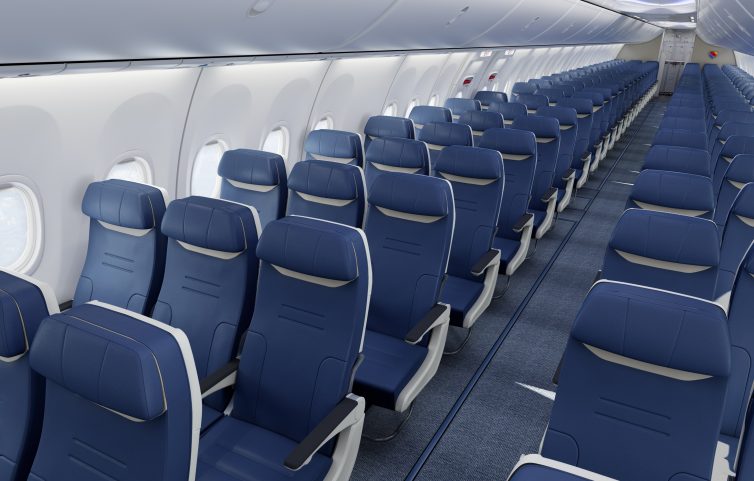
The new Southwest interior with new seats and carpeting. Photo by Southwest Airlines.

The new Southwest interior with new seats and carpeting. Photo by Southwest Airlines.

  • Modern Cabin Design: The new design incorporates natural, earthy tones combined with Southwest’s iconic Canyon blue and clean, aluminum accents for a more modern, fresh appeal.  The redesign is inspired by Southwest’s past with a nod to the future.
  • Lighter and More Comfortable Seat: The redesigned low-profile seat is more durable, made of eco-friendly products, is lighter, and more comfortable. 
  • Increased Under-Seat Space: The new design allows for more under-seat room for carryon luggage and approved pet carriers.
  • Customer Living Space: Reducing the recline from three inches to two inches preserves onboard personal living space while still allowing for ample seat adjustment for Customer comfort. 
  • Seatback pockets: The new netted seatback pockets are streamlined to provide more knee room. 
  • Headrest: The fixed-wing headrest provides better neck and head alignment with side-to-side support for sleeping.
  • Improved Ergonomics: The combination of the low-profile cushion and fixed wing headrestimproves ergonomics by positioning Customers “down and back” into the seat, allowing for better lumbar support, armrest alignment, and increased personal living space.
There might be less seat pitch, but there is more space.

There might be less seat pitch, but there is more space. Photo by Southwest Airlines.

The new interior means that there allows Southwest to put six additional seats on each aircraft. This is due to reducing the seat pitch from 32″ to 31″, using the skinnier seats and reducing the recline from 3″ to 2″. This will allow Southwest to increase their profit, without having to add fees.

The seats are made with eco-friendly materials and are designed to last longer, reducing replacement costs. Each seat weighs six pounds less than their predecessor, meaning real fuel savings for Southwest Airlines. The new carpet, which is made out of recycled materials, is put in by squares where a section can easily be replaced instead of taking out the whole carpet.

“We are preparing now for our next 40 years with a fleet modernization plan that includes the new interior, the Boeing 737-800 which is scheduled to come online beginning in March this year, and the 737 MAX, which is expected to join the Southwest fleet in 2017,” said Bob Jordan, Executive Vice President and Chief Commercial Officer. “The evolutionary changes we’re making with the new interior uphold our low-cost roots and historic focus on Customer Service. The cabin upgrade also allows us to create significant revenue opportunities without adding unwanted fees.”

Southwest plans to update all their newer Boeing 737-700s and also AirTran’s 737s and 717s. They have not stated if they will update their older classic 737s, but my guess is that they will not.  It would be unlikely, since they recently announced an order 150 new Boeing 737MAX aircraft.

Learn more about Southwest’s new interior:
* Great 360 view of the interior
* Story from Mary Kirby with APEX, who was there at the reveal
* See more photos and learn more on the Nuts about Southwest Blog
* In October 2009, Southwest shows off their Green Plane 

How Many Boeing 737s Are Still Flying Contest Answer + Interesting 737 Facts

HI-RES PHOTO (click for larger). On December 16th, Boeing delivered their 7000th 737 to flydubai. The airplane is flydubai’s 14th Next-Generation 737-800 with the new Boeing Sky Interior. Photo by Boeing.

HI-RES PHOTO (click for larger). On December 16th, Boeing delivered their 7000th 737 to flydubai. The airplane is flydubai’s 14th Next-Generation 737-800 with the new Boeing Sky Interior. Photo by Boeing.

On Friday I posed the question, “How many Boeing 737s are still flying today,” and I received a lot of responses. So what is the answer? (insert drum roll here)…

… did you click that drum roll link? It really adds to the suspense. If you did not do it before, it is not too late

According to Boeing, there are 5,424 737s still flying today with 358 airlines in 114 countries. Knowing that the first 737 flew on April 9, 1967, that is AMAZING! So, who were the three that got the closest and are winning a free internet session with GoGo In-Flight Internet?

* Thibaut: 5418
* Allen Cheng: 5419
* Will Pestle 5423 (only one away)

Some of you just guessed random numbers (which works out okay) and others went through some pretty impressive formulas. I was amazing how many people were pretty close to the final answers. A big thanks go GoGo for providing three prizes for this contest!

As promised, here are some other great facts about the 737 that come directly from Boeing:

* Today’s 737s are 5 percent more fuel efficient than the first models delivered. By late-2012, the airplanes will be a full 7 percent more efficient, with full incorporation of the latest performance improvement package. The additional 2 percent equates to $120,000 savings per airplane per year, and tons fewer carbon emissions.

* It was just shy of 15 years between the first Next-Generation 737 order and the 5,000th order. The Next-Generation 737 reached this order milestone more quickly than any other commercial jet in history.

* Airlines ordered 724 of the Next-Generation 737 models between the Next-Generation program launch Nov. 17, 1993, and the day the first airplane was delivered on Dec. 12, 1997.

* The Next-Generation 737 is as long as it is wide, earning it the nickname of the first “square” airplane.

* The Next-Generation 737 uses an advanced system called Head-up Display or HUD, which comprises a transparent glass display positioned between the pilot’s eye and flight deck window to show critical information such as airspeed, altitude and attitude, and flight path. The Next-Generation 737 is the leader of large commercial jetliners produced today with this capability. Boeing is proud to introduce HUD as part of its basic systems equipment for both pilots on our 787.

* The Next-Generation 737 airplane wing thermal anti-ice system has the capability of outputting hot air on the wing leading edge equivalent to about six full-sized (100,000 BTU) household furnaces.

* Within five years of entering service, the worldwide fleet of Next-Generation 737s surpassed 10 million flight hours, a feat equal to one airplane flying more than 1,141 years nonstop. The Next-Generation 737 is the first and only commercial jetliner to reach this milestone so quickly.

* On July 27, 2006, Boeing delivered the 2,000th Next-Generation 737 six years sooner than any other commercial jet airplane. The milestone delivery – a 737-700 to Southwest Airlines – occurred nine years after Southwest received the first Next-Generation 737.

* There are approximately 36.6 miles (59 kilometers) of wire on the Next-Generation 737-600/-700/-800/-900ER (extended range) models, four miles (6.4 kilometers) less than the 737-300/-400/-500 models.

* On average, there are approximately 367,000 parts on a Next-Generation 737 airplane.

* Overall, the entire 737 family is the best-selling commercial jet in history, with orders for more than 9,100 airplanes through the end of November 2011. More than 6,900 have been delivered.

* On Feb. 13, 2006, Boeing delivered the 5,000th 737 to Southwest Airlines. Guinness World Records acknowledged the 737 as the most-produced large commercial jet airplane in aviation history.

* Typically, about 50 gallons (189 liters) of paint are used to paint an average 737. Once the paint is dry, it will weigh approximately 250 pounds (113 kilograms) per airplane, depending on the paint scheme.

CONTEST: How Many Boeing 737s Are Still Flying?

The first Boeing 737. Photo found via Gordon Werner / Flickr

The first Boeing 737, which does not have GoGo Internet. Photo found via Gordon Werner / Flickr.

NOTE: The contest is now over. You can view the answer here.

Today, Boeing delivered their 7,000th 737 to FlyDubai – those are a lot of airplanes.

To celebrate this monumental achievement I feel like holding a contest. I was asked by a reader (thanks Robert G), “How many 737s out of the 7000 are still flying,” and that is a great question. I turned that question over to Boeing and have received an official answer that I am using for the contest. I also sent out a few “crack-team information finders” (thanks Dan and Ben) to see if there would be some website that would easily give the answer away (that happened during my last contest) and I feel confident this one is not easy.

Now, I am turning that question over to you: How many Boeing 737s are still flying today? (according to the official answer that Boeing gave to me on 12/15/11 – Note that although Boeing gave me the answer for the contest, they are no way involved with the contest)

Oh and there are some real prizes to go along with this one. GoGo Inflight Internet has agreed to give the three closest guesses a free internet session for their next flight (which makes a great stocking stuffer — for yourself).

So send me an email (david@airlinereporter.com) or leave a comment with your best guess (you only get one). You have until the end of the day Monday the 19th to guess and then I will reveal the answer with all sorts of other great facts about the legendary Boeing 737.

Game on.

RwandAir 737 Delivery Part 3: Landing in Kigali, Rwanda

We had taken off from Seattle a day before and had mini-adventures while in Iceland and Turkey. Now RwandAir’s first Boeing 737-800 was on her final leg to Kigali, Rwanda with only about 5.5 hours to go. In Part 1 I talked about pre-departure, then covered what it was like flying from Seattle to Iceland to Turkey in Part 2. In Part 3 I talk about what it was like finally arriving in Kigali to an amazing welcome.

Heading into African airspace on our way to Kigali, Rwanda.

Heading into African airspace on our way to Kigali, Rwanda.

Before the 20hr flight I was concerned about the comfort level of a domestic Boeing 737. I was also afraid of having too much free time on my hands, so I brought a book, downloaded a lot of airline articles and even got some additional games for my iPhone. However, with sleep, socializing and watching 30 minutes of Big Mama 3 (I can’t believe I lasted that long), I did not get bored. It was comfortable having an entire row to myself, but I am sure my tone would have been different if I had shared my row with seat-mates. The back of the plane seemed the place to go if you were looking to get some sleep. Quite a few folks sitting up front made their way to their own rows in economy to stretch and rest.

9,200 miles of adventure. Our route to Kigali.

9,200 miles of adventure. Our route to Kigali.

I had used my electronics quite a bit from Seattle to Iceland to Istanbul. By the time we were on our final leg, they were badly in need of some power. I had forgotten my international power adapter and did not get to charge while in Turkey (luckily someone let me borrow theirs while in Rwanda — thanks Adam). Unfortunately the seats in the back of the plane did not have power outlets, but those in Business class did. I had three different devices plugged into three different seats up front. It was important I was all ready to go when touching down in Rwanda.

While my electronic distractions were charging,I had no problem gazing out the window.  The sky was clear, so it was easy to witness  crossing over to African airspace. It was interesting seeing desert forever, then civilization and green around water. We followed the Nile for a while and it really became clear how a river or water source really creates growth.

Hanging out in the cockpit of RwandAir's Boeing 737-800 while over Africa.

Hanging out in the cockpit of RwandAir's Boeing 737-800 while over Africa.

Although socializing and watching movies can be entertaining, the best form of entertainment is being in the cockpit. Even though my devices weren’t fully charged, I didn’t want to turn down an opportunity to visit the front of the plane while cruising at 39,000 feet to take photos, video and talk to the pilots.

Both pilots at the time had come from the now defunct Olympic Airlines and were very excited about flying the 737-800 — almost to the point of being giddy. They said it was an obvious improvement in performance, ease of use and efficiency. It sounded like there would be a formidable (and friendly) competition to see which pilots would get to fly the new 737-800 vs the older 737-500s in the fleet.

Every time I got up into the cockpit during flight, the calm always surprised me. I don’t know what I really expeced. Maybe the pilots constantly at the controls, talking on the radio, messing with knobs. But during cruise with a modern airliner, they are able to easily take time to enjoy flight. Looking straight out the front windscreen into the limitless blue makes the aircraft feel like it is not even moving. It is a cool experience and it is unfortunate that it is rare for even media to get into the cockpit during flight (and this is only the second airline to allow me to share photos).

RwandAir's Boeing 737-500 looks on.

RwandAir's Boeing 737-500 looks on.

Before we knew it, the plane was starting its descent and we were almost done with our flying adventure. From the hotel to boarding the plane, most of us dressed up. But once on board, we changed into something more comfortable. Now realizing we were getting close to Kigali,  it was time to get back into professional wardrobe. You would have thought with only 30 people on board, there wouldn’t be any lavatory issues, but when so many are trying to change and brush teeth at the same time, it really caused some issues. Ichanged my shirt in the aisle and brushed my teeth in a lavatory being used to store drinks. A guy has gotta do what a guy’s gotta do. Luckily everyone was ready to go and seated by the time we were flying low over Kigali.

We were told we would do a low fly over the airport before circling around to land. As we kept getting lower and lower, some of us became certain that the fly-by was cancelled and we were going to land. Kudos to the pilot since we buzzed the tarmac just a few feet off the ground before pulling up, circling around and landing.

Our flight buzzed the airport before coming in for a landing. That is one nice fly-by. Photo from RwandAir.

Our flight buzzed the airport before coming in for a landing. That is one nice fly-by. Photo from RwandAir.

People on board the airplane cheered as we landed and taxied to the tarmac. Two fire trucks gave us an official water salute as we pulled into the airport and before getting off the plane we could see a group of dancers starting to make their way out towards the plane.

It is hard to describe what it is like to be jet-lagged and stepping off a plane that just flew from Seattle to Rwanda with people dancing, music playing and people wanting to shake your hand. This was an amazing moment for almost everyone there and the most impressive welcome I have ever experienced.

Upon landing we were greeted by dancers, local media and VIP guests.

Upon landing we were greeted by dancers, local media and VIP guests.

After things calmed down, we headed through customs and over to a special tent where additional guests were seating. All the important dignitaries and the airline CEO spoke and talked about the importance of this proud achievement.

The plane was not just carrying people over to Africa. Boeing has a program called Humanitarian Delivery Flights that, “humanitarian items; such as, medical supplies, clothing, and educational materials, are loaded into the empty cargo space of new airplanes being delivered and transported to a customer’s home destination.” On this flight, there were 1500 educational books that were being delivered to the Rotary Club of Kigali to be distributed to high schools, universities and libraries around the country. Boeing partnered with RwandAir and Operation USA to help deliver the books and there were a group of children at the celebration to accept them.

Some RwandAir pilots and me hanging during the post delivery reception.

Some RwandAir pilots and me hanging during the post delivery reception.

We all had some food, drinks and great conversations, but after our long journey, it was time to head to the Kigali Serena Hotel. I was not quite sure what to expect of my accommodations when staying in Rwanda. For some reason I kept picturing a bed with a bug net and a generator providing electricity. It is my own fault for not being informed, but it was a nice surprise to find that the hotel was way beyond my expectations. They even offered free Wi-Fi internet which can be hard to find in many American hotels.

The hotel was one of many interesting experiences during my four day stay in Kigali. Stay tuned for my Destination Rwanda story coming soon, followed by a video documenting the delivery flight. Until then…

VIEW ALL 90 PHOTOS FROM THE TRIP TO KIGALI

RWANDAIR BOEING 737-800 DELIVERY FLIGHT
Part 1Part 2Part 3 | Video | Photos | Destination Story | All