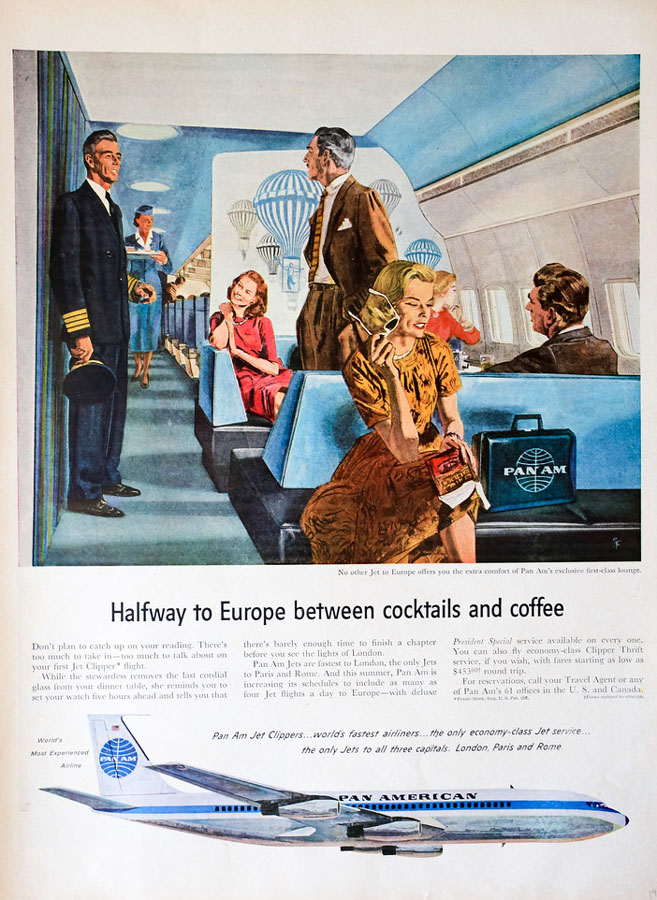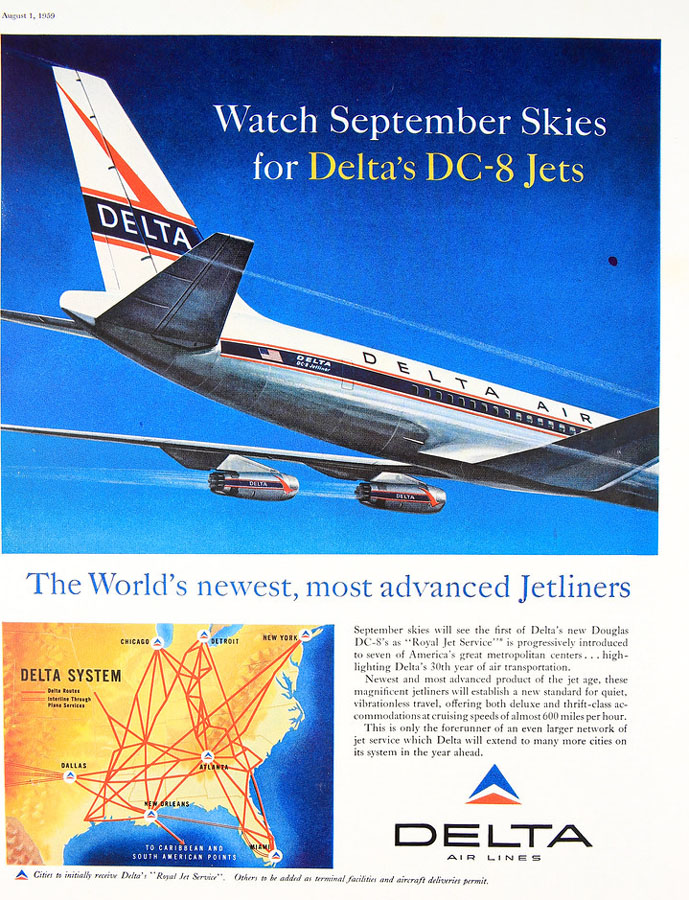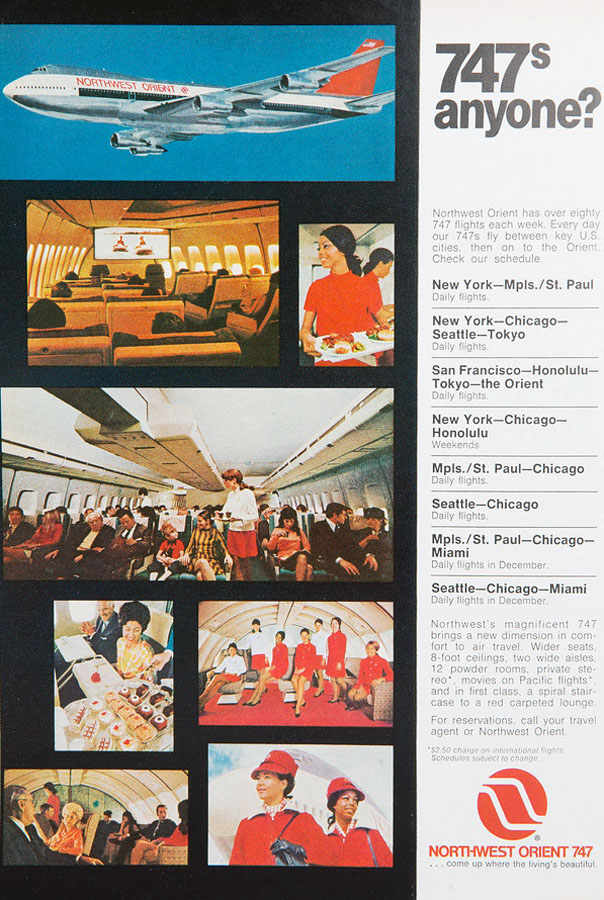
A TWA, featuring the Boeing 707, ad seen in The Saturday Event Post in 1959 – Image: Jeremy’s Collection
I love looking back at old airline advertisements that promote a new type of aircraft that will soon become the flagship of the fleet. We are talking about the iconic birds of yesteryear; like the Lockheed Constellation, Boeing 707, Douglas DC-8, McDonnell Douglas DC-10, and Lockheed L1011. However, there was one aircraft that let the world know that your airline has arrived (literally and figuratively): the 747 Jumbo Jet.
Before I continue, let’s make sure we are on the same page about the definition of ’œflagship.’ I really hate it when people just say ’œwell, Merriam-Webber defines <insert word here> as’¦’ because it is just a super lazy way to get your point across. Whatever, it is really easy to do it that way…
flagship
noun
flag·’‹ship | \ ˈflag-ËŒship \
1: the ship that carries the commander of a fleet or subdivision of a fleet and flies the commander’s flag
2: the finest, largest, or most important one of a group of things (such as products, stores, etc.) often used before another noun
In AvGeek terms, the flagship is often the coolest airplane that they have that will make passengers think “golly gee, that is a swell plane and I want to fly on it, I am going to take that airline” (I actually tried to make that sound sarcastic, but that is how I legit feel when I am looking for flights).
With so many airlines moving to smaller aircraft (B737, A320, E-Jet, and A220) and operating aging fleets (B767,B 757, A330ceo, etc), what aircraft do they see as their flagship today? I found some that were pretty obvious, and others that had me scratching my head. I am making my best guesses based on the information that airlines put out there to the public, so I might be wrong. With one or two, I am pretty sure that I am wrong. Let me break it down by airline, let you know what I found, and you tell me if you disagree.
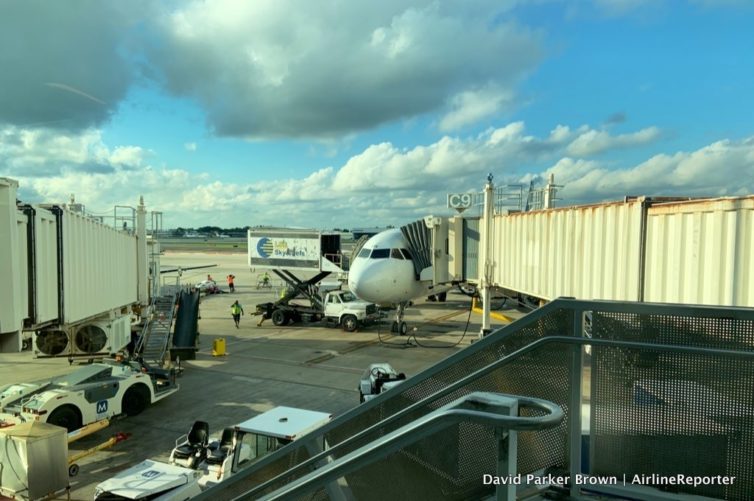
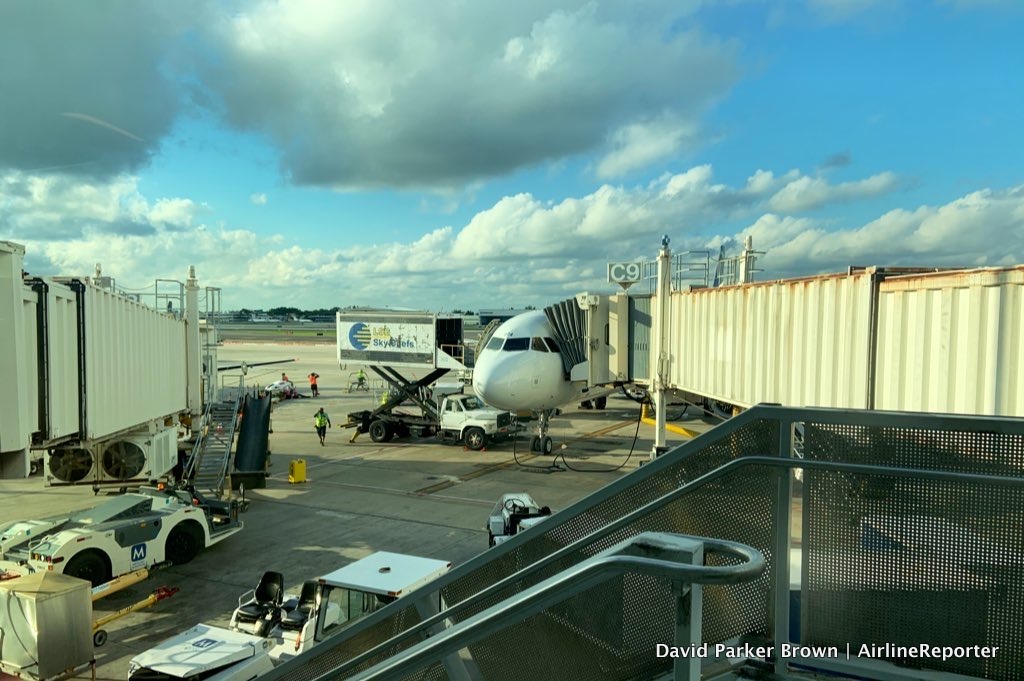
My gate at FLL gave amazing views of my Alaska Airbus A321…. not!
“What the heck is a diagcon look of an Alaska Airlines A321 first class product?” Don’t worry, I will get to that.
I had no expectation that I was going to write this review. I recently flew down to Fort Lauderdale (FLL) to hang out with Embraer and they were nice enough to put me in first class. When I was preparing for my flight home (I flew on Delta to FLL), I saw it was on an Alaska Airlines Airbus A321. Sweet. I knew that I would either be flying on one of Virgin America’s old birds with their first class product, or Alaska’s new product win/win. I did my thing and looked up the registration number, found the delivery date of the aircraft, and determined that I was going to be trying out the new product. Heck yea.
The good news and bad news is I just had a really long day, got very little sleep previously, and had just flown across the country the day before. That is bad since I wasn’t really prepared to do this review, but good since what better time to test out a product when you aren’t feeling 100%?
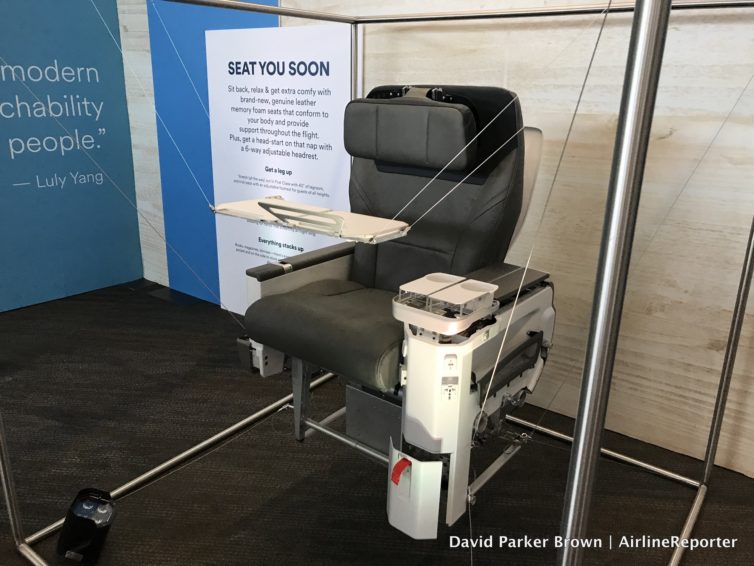
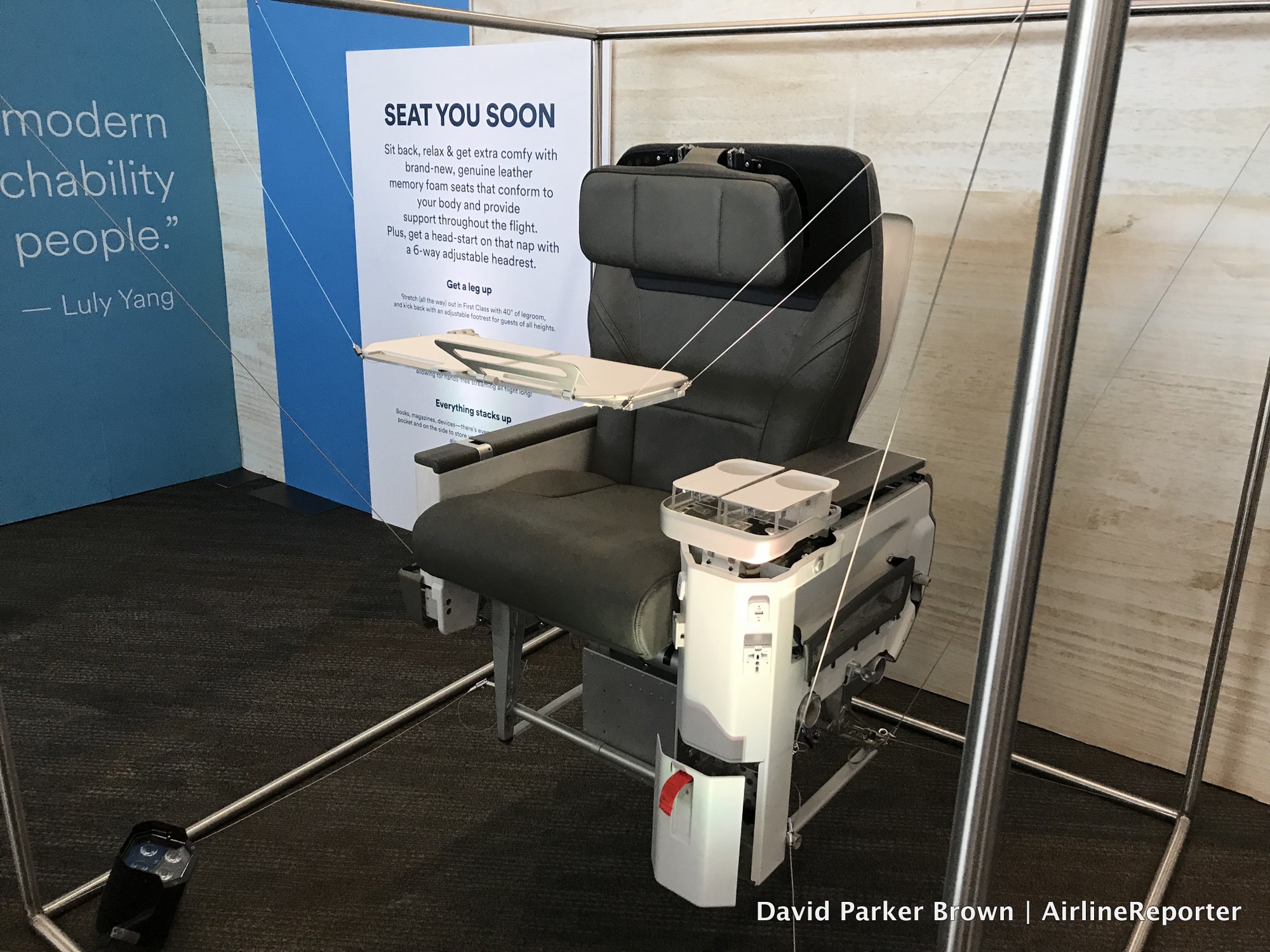
Pretty cool display of the new Alaska Airlines first class seat that I viewed during my previous media trip with them
Previously, I had the chance to fly down to SFO to preview Alaska Airlines’ new first class product on their Airbus A321s. I was only able to sit down in a first class seats for a short amount of time, and obviously media flights like that don’t give you a real experience of how the product compares. Know what does? A six-hour flight from Fort Lauderdale (FLL) to Seattle (SEA), that’s what! And looky there, I just recently did flew that diagcon flight.
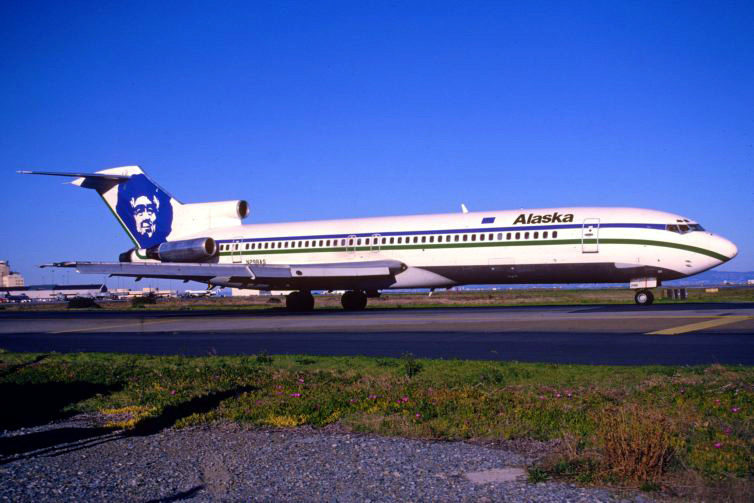
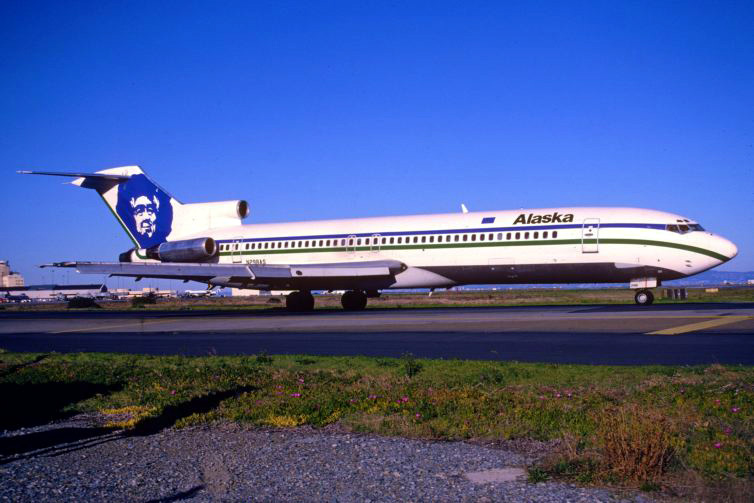
A classic Alaska Airlines Boeing 727-200 taken in 1989 – Photo: Aero Icarus | FlickrCC
The United States’ fifth-largest air carrier ’“ Alaska Airlines ’“ traces its roots deep into American history; in fact, the airline began in its namesake’s state nearly 27 years before Alaska achieved statehood. The formerly localized west coast regional air carrier boasts an impressive route structure, serving 116 destinations with over 1,200 daily departures. After the 2016 acquisition of San Francisco-based Virgin America, Alaska Airlines began a new phase of operations, utilizing its inheritance of 67 Airbus aircraft and dozens of new routes. When mainline service is combined with wholly-owned subsidiary Horizon Air and contracted carrier SkyWest Airlines, Alaska Airlines proudly boats the honor of operating the ’œMost West Coast’ flights each day.
However, Alaska Airlines and its affiliates have carefully expanded their daily operations far beyond the western United States, serving eastern seaboard destinations from Boston to Ft. Lauderdale. In 2014, 25% of all Alaska Airlines daily departures traveled across North America; after the Virgin America acquisition a mere four years later, that figure has nearly doubled. Simultaneously, growth to areas outside of the continental U.S. remains relatively stable and, in some cases, diminished. After connecting Bellingham, Washington to various Hawaiian destinations for nearly a decade, Alaska Airlines announced cessation of all Bellingham nonstop flights except service to Seattle-Tacoma. Growth within the airline’s namesake state of Alaska remains stagnant; service to Mexico faces a similar outcome.
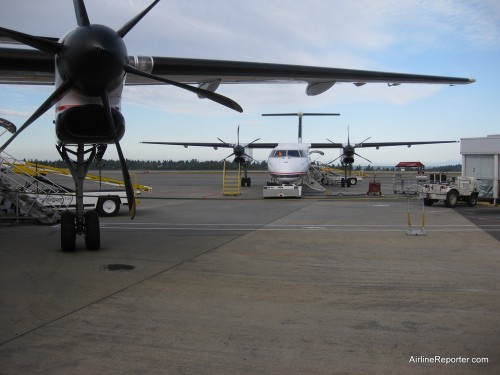
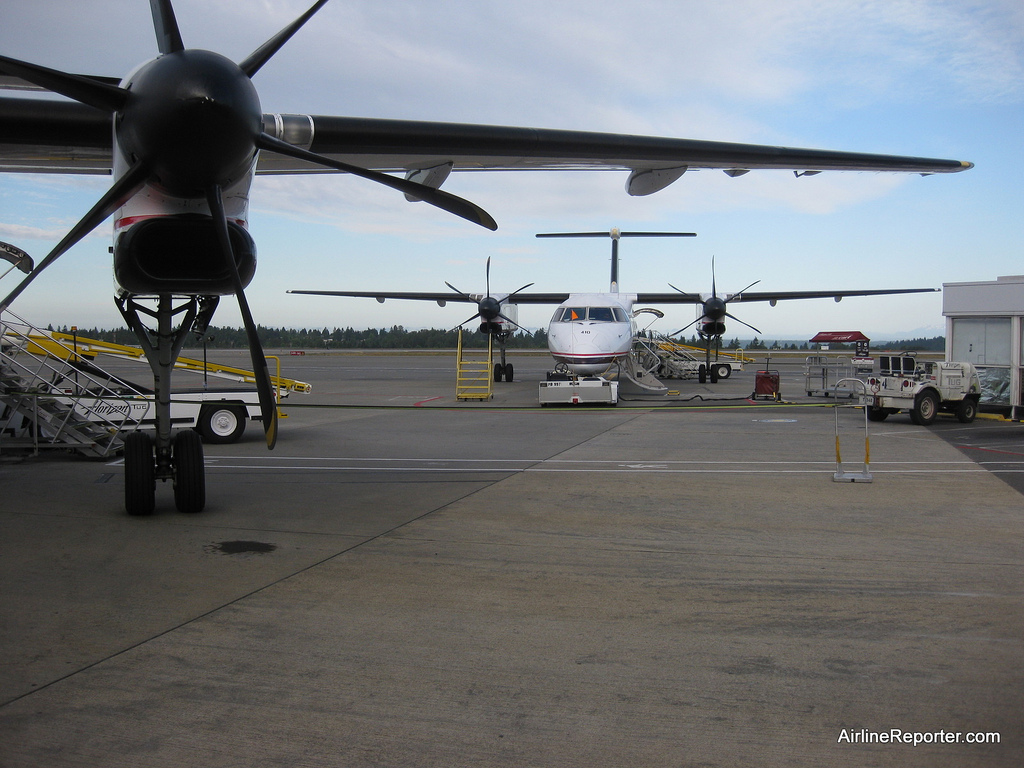
Horizon Q400s at Seattle
Alaska Airlines, alongside subsidiary Horizon Air and its partner SkyWest Airlines ’“ through a capacity purchase agreement ’“ has strategically eliminated under performing routes over the recent years. Instead, Alaska has elected to beef up its west coast hubs to maintain a stronghold among residents along the west coast. After the 2008 merger of Delta and Northwest, ferocious competition rose in former Alaska Airlines strongholds, specifically Seattle and Portland. Delta Air Lines maintains an expansive international network from Seattle, leading to recent growth and additions in domestic service and direct competition with Alaska Airlines. To combat, recent Alaska Airlines strategic decisions can be categorized into three distinct categories: Streamlined regional operations, acquisition of Virgin America, and an ever-expanding route network.
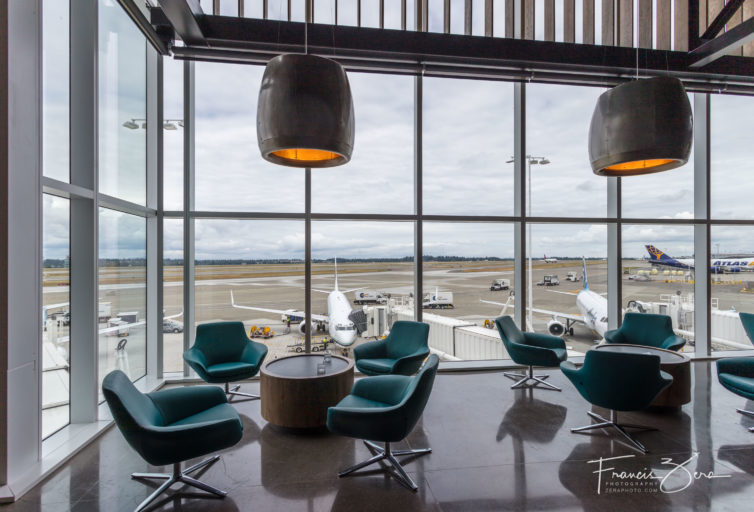
Alaska’s new flagship lounge is huge, comfortable, and offers great views of the runways at SEA
Alaska Airlines has upped their game by opening a huge new flagship lounge at Seattle-Tacoma International Airport on July 12. We got to tour the new lounge during a media preview the day before it officially opened.
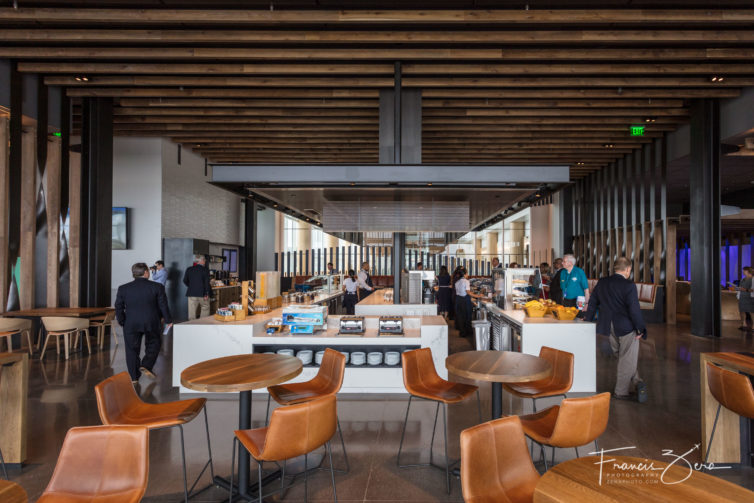
Plenty of room to sip that coffee
The new lounge is part of a $658.3 million update that the airport is currently building at the North Satellite facility; with the completion of this phase, the work is approximately 1/3 complete, according to Sea-Tac Airport Managing Director Lance Lyttle. Construction got underway back in February, 2017.
The project adds eight gates, 255,000 square feet of space, and several new restaurants and shops to the airport.
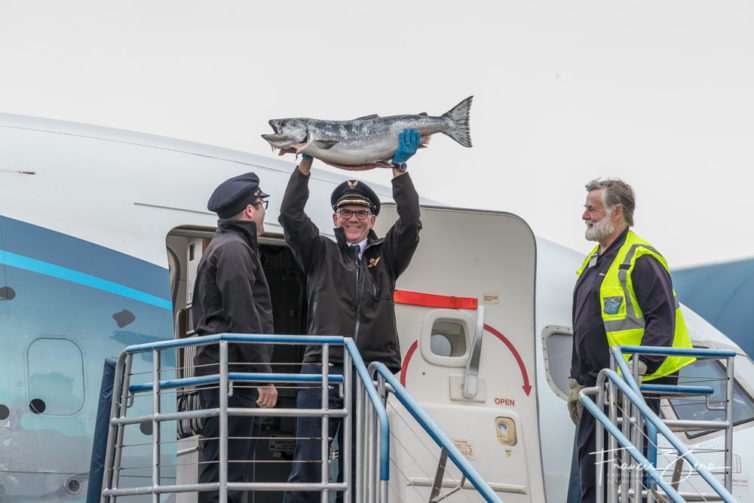
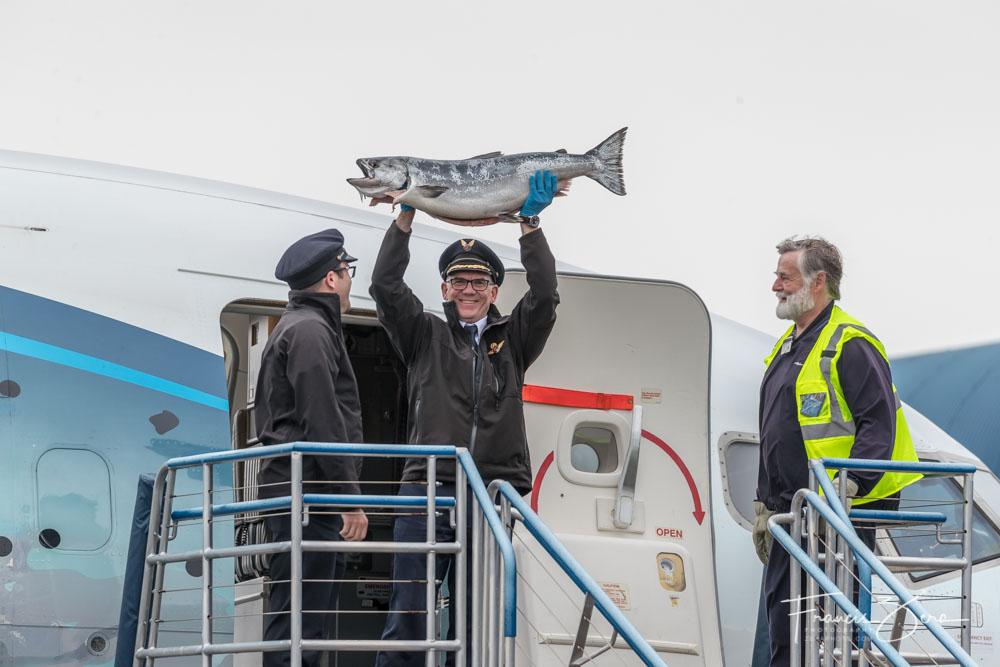
Alaska Air captain raises the lucky (or unlucky) Copper River Salmon
’œThis story again? It feels like Groundhog Day,’ Blaine Nickeson, AirlineReporter’s Associate Editor (and my good friend) said to me via email when I forwarded the fact that I was going to cover the arrival of the first Copper River Salmon for the eighth year in a row. He just doesn’t get it. Maybe you don’t either, but I am going to try to explain why I look forward to getting up at 3:30am to welcome some fish to Seattle.
Sure, sure, over the eight years the event has been pretty much the same (although this year was the most different). Historically, a bunch of folks show up at Alaska Cargo at Seattle-Tacoma International Airport, wait for the first Copper River salmon catch of the year to arrive from Alaska, and then have a cook off in the parking lot between three legit Seattle chefs. This year was different because there was no cook off. I will say that I did miss being able to try the salmon, but really the cook off part of the event was just filler and the real excitement was waiting for the plane to arrive.
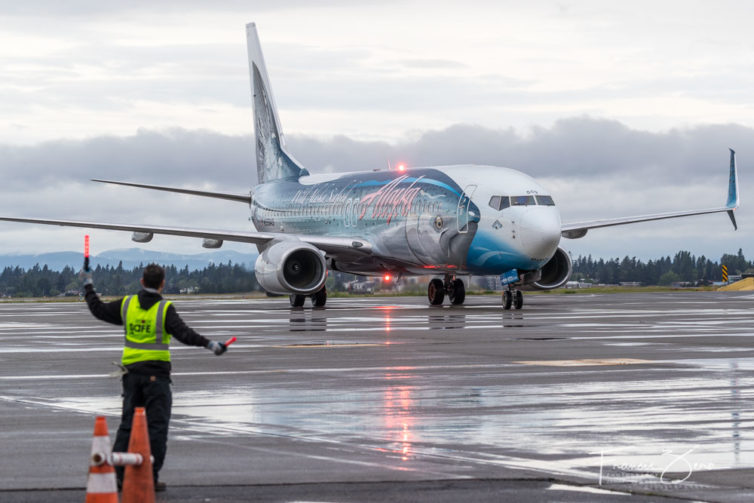
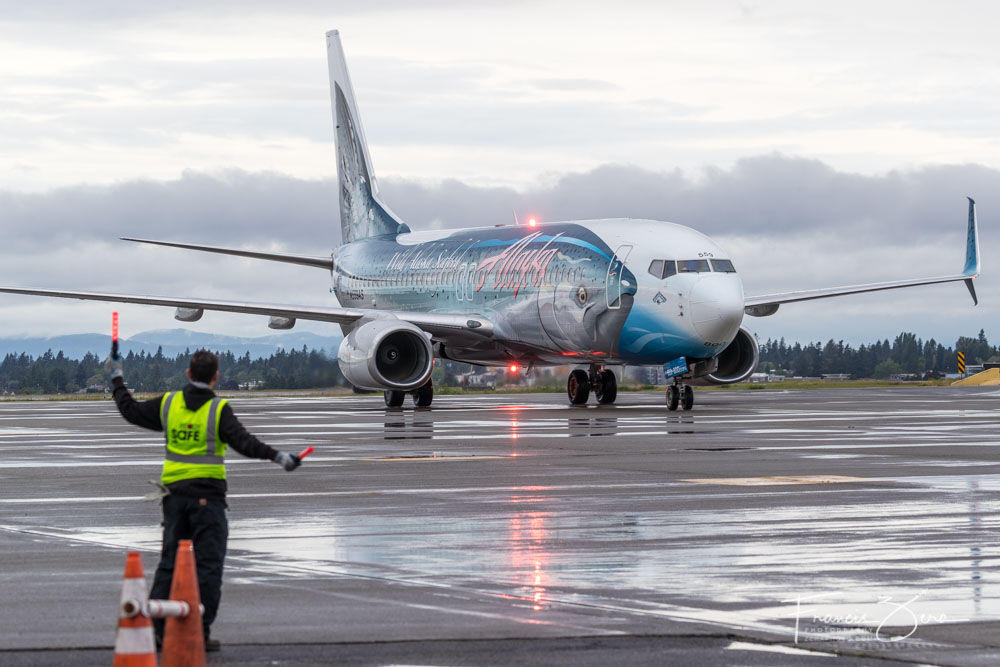
Beacon on! The Salmon-30-Salmon.
No question the best year was when I was able to fly up to Cordova, Alaska (on a milk run, in a 737 Combi), watch the fishing boats go out, see the ’œwinning’ fish be chosen, fly to Seattle with the said fish to the welcome crowd, and then eat the fish after it was cooked up by three fancy chefs. I think that experience really helps me better appreciate what it takes to get from ocean to tummy (like farm to table, but better).
Even with this year having no flight north and no fancy chefs, it was still awesome and I love going. When I reached out to Francis (who writes for us and is an amazing photographer) to see if he wanted to go with me, he was more than excited to come. Upon seeing Blaine’s anti-fish comments, Francis replied “for some reason I can’t stay away, either.” Blaine was hoping for a different angle for this year’s story… I think I found one my friend, but not sure how you are going to feel about it!