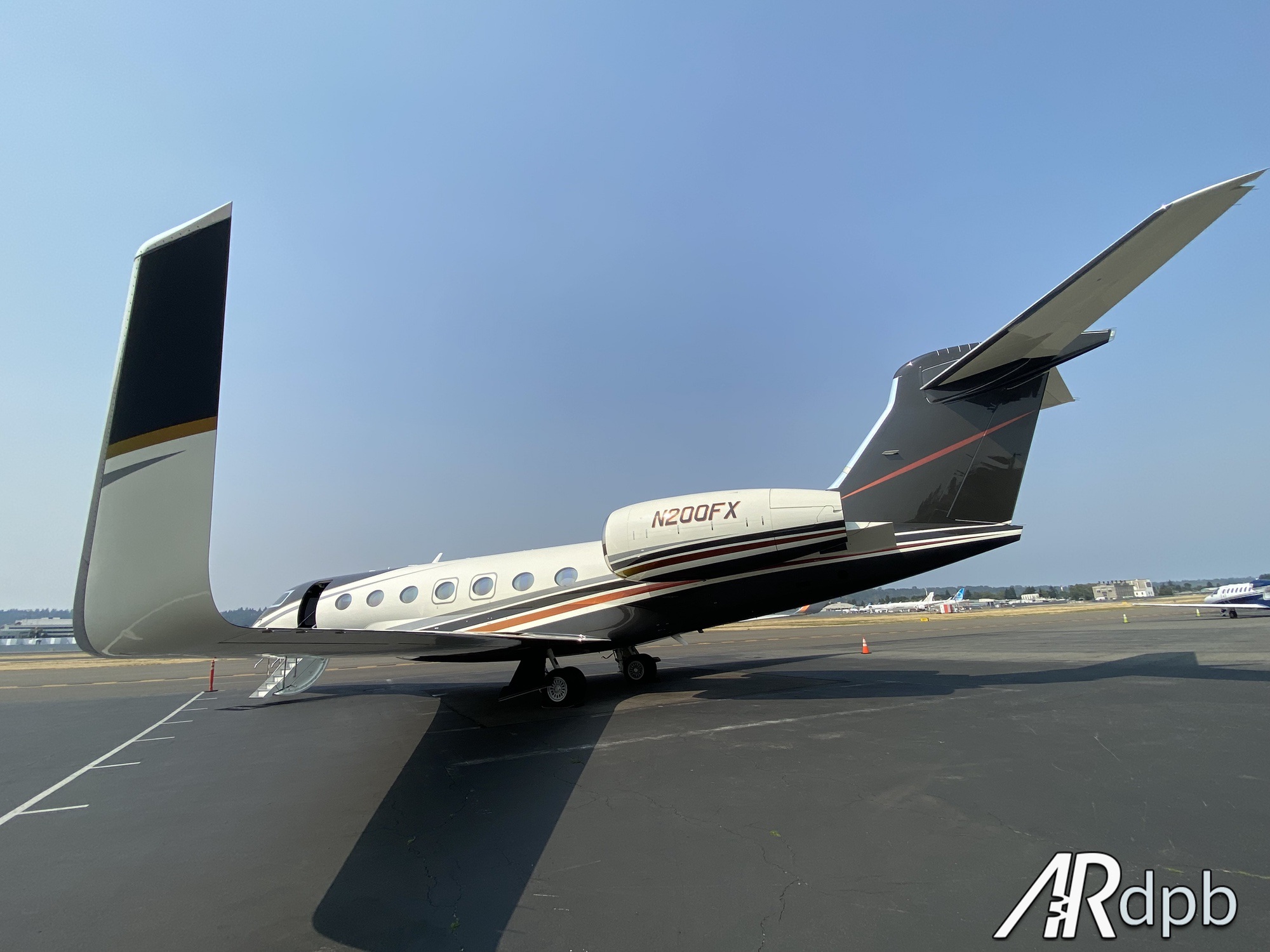
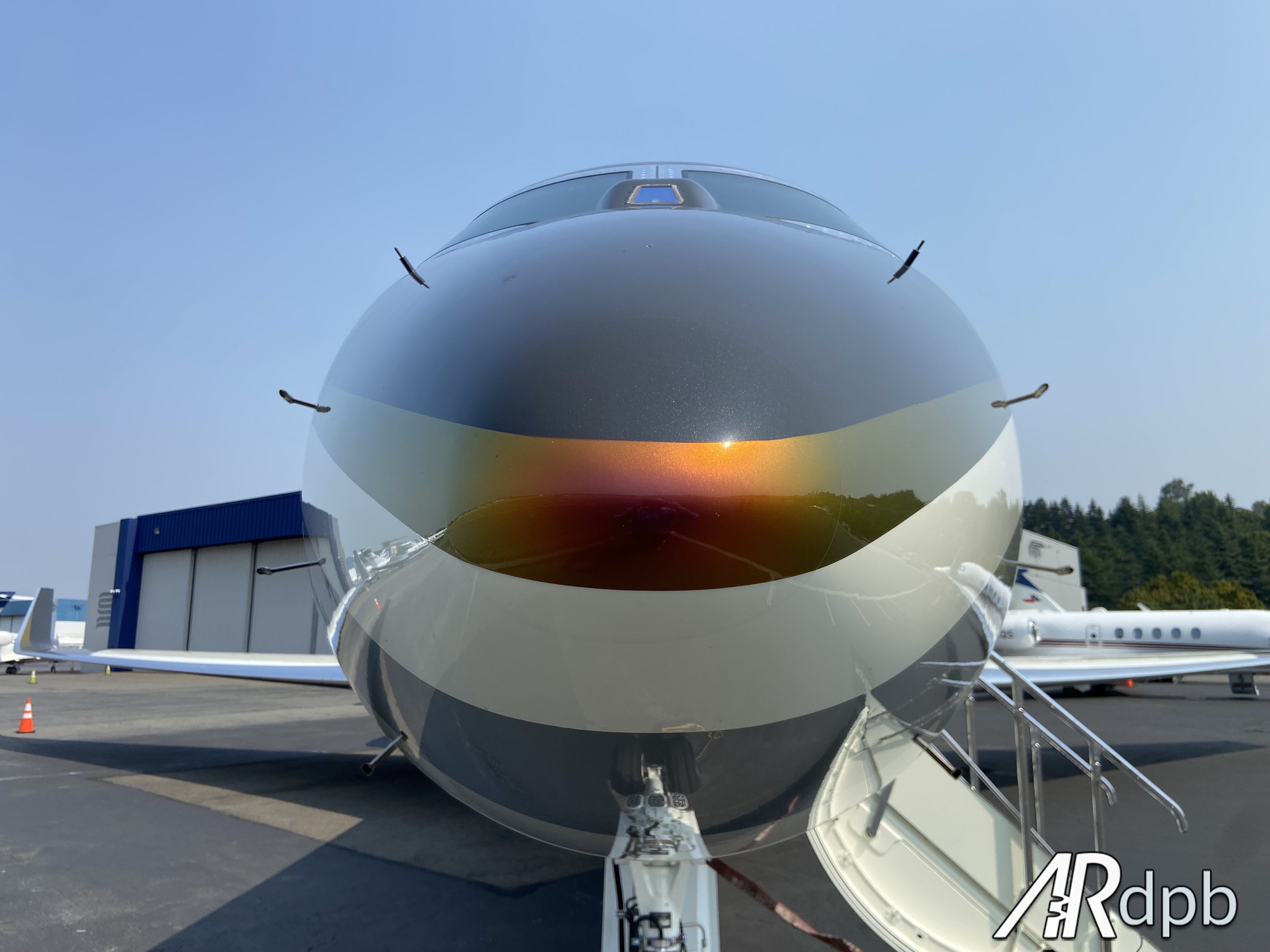
When Flexjet recently reached out asking if I would like to tour their first Gulfstream G500 (N200FX), how could I refuse? I tried to act cool, but of course I was giddy to have the opportunity to check out one of the most premium private jets on the market today (I guess the cool kids are calling them “PJs”).
N200FX sitting on the tarmac at King County International Airport (aka Boeing Field)
You can see the color change paint from orange to green
I met up with the Flexjet representatives at the FBO at King County International Airport (KBFI) and we walked out to the tarmac where N200FX awaited us. Of course there was no security, no lines, we just walked out to the plane when we were ready to go. I have to say that Flexjet has a beautiful livery and the fact that part of its paint design has “chameleon” paint that changes color depending on the sun’s angle, made it all that more special.
After spending some quality time with the outside of the G500, I was delighted to board and check out the interior firsthand!
I was fortunate enough to be able to attend this years EBACE and, for me, as with last year, it was an excellent show with many new concepts unveiled within the business aviation sector.
Honeywell has a large presence in Phoenix, specifically at Deer Valley Airport. At one point this was the legacy of Sperry Electronics, which got its start making gyroscopes for Curtiss biplanes. They even had a rudimentary autopilot demonstration in June, 1914.
So, what does this have to do with Honeywell? Well, prior to their purchase by Honeywell Aerospace, Sperry developed the first Flight Management Computers (FMC). The best way to describe an FMC is that it’s a layer above the autopilot and allows for a degree of pre-planning and programming for the aircraft’s mission. Flight Management Computers have evolved to a level most of the old Sperry guard could never have imagined, though the form factor has remained relatively the same.
Honeywell Aerospace is not known for sitting still. Much of their avionics technology hangs out on the bleeding edge. The thing is, airlines and their associated airframers tend to demand low cost AND reliability. Flight deck and avionics design usually evolves within corporate aviation. It is no wonder, then, that Honeywell and Gulfstream work so closely to develop an integrated flight deck and avionics suite. The internal name of the Honeywell avionics and flight management package is Primus Epic.
While it is also at home on a Falcon 7X, Dassault puts their own special finishing touches on it so that it better matches their ecosystem. We’re not talking about Dassault today- we’re discussing Gulfstream- so the Honeywell system is marketed as PlaneView.
How does one get a good understanding of the practical elements of PlaneView/Primus Epic you ask?
The best way. By seeing it in person by flying on a Gulfstream G650 and who am I to say no?