Around the World

Miles flown in 2013 for stories: 162,018

Advertisement

Buy Wholesale products for your airline business on DHgate.com

Syndication


Advertisement

Buy many rc helicopters on Tmart.com and Free Shipping

Advertisement

Helicopter training school including beginners helicopter lessons and helicopter charter company.

Behind the Scenes: How Singapore Airlines Prepares its Meal Service

Singapore Airlines goes item by item checking the food quality.

Singapore Airlines goes item by item checking the food quality at the Flying Food Group at SFO.

When it comes to airline food, most people have a pretty low expectation of what they will receive. That expectation has lowered even further over the past few years with the almost-complete elimination of free airline food served on domestic flights within the United States. To find a decent airline meal, one needs to take an international flight. Typically, the amount you pay for a ticket will correlate with the level of meal you will receive. How does a world class airline go about providing multiple meals for  up to 477 passengers on just one flight? I wasn’t sure, but when I was recently given the opportunity to check out how Singapore Airlines runs its food operation out of San Francisco (SFO), I could not refuse (note that my trip down and back were taken care of by Singapore Airlines and JetSuite).

Checking out Singapore Airlines makes sense. For them, food is not just something they give to passengers to make sure they don’t go hungry; they see it as part of the in-flight service. It is an experience both via taste/sight and a positive interaction with the flight crew. How does an airline prepare a meal for someone who has spent $5000.00 or even $20,000.00 on a ticket and are used to the best things in life? Well, it is not easy, nor cheap. Each year, Singapore Airlines spends about $500,000,000.00 just on their food service alone — that is quite the investment.

The room has food all around from first, business and economy levels of service.

The room has food all around from first, business and economy levels of service.

At each main Singapore Airlines hub in the US, it selects a caterer to produce the food. At SFO, it uses Flying Food Group, which also provides airline catering for a number of other airlines, even though all of Singapore’s recipes are unique.

Frequent fliers on Singapore do not want to see the same food week after week, so the airline needs to keep the selection new. Because of this, Singapore Airlines changes most of its entire menu each quarter. Hidden away in Singapore Airlines headquarters is a list of all the food that will be served in the coming quarters. The menu is not just a broad, “we will serve chicken and salad,” but a list that is extremely detailed, down to the exact last gram of everything, how many nuts will be on that salad and how much the entire meal will weigh.

The Singapore food tasters need to come in hungry, since they will be leaving full.

The Singapore food tasters need to come in hungry, since they will be leaving full.

There is no down time when it comes to the food. Just after the previous quarter’s food goes live, Singapore sends the next quarter’s menu to the Flying Food Group, so that they can start preparations for following quarter. Their chefs work on successfully creating the new menu and once they have all the food from each of the three classes completed, they invite Singapore Airlines in for a Menu Presentation to visually inspect each and every item and then taste test the food — this is where my visit comes in.

After landing at SFO, I was driven  to the Flying Food Group building, located just down the street from the airport. The building is not the most beautiful on the outside, but it is more about what is on the inside. After being checked in, I put on an official food tester garb and was taken to a back room, which had hundreds of different food options on display. Representatives from both the Flying Air Group and Singapore Airlines went item by item, going over every aspect of each main dish, side dish, sauces and the plate layout.

The chef shows off his creations.

The chef shows off his creations.

Once the food is agreed upon, photos are taken that will be placed on the aircraft, so that flight attendants will know what the final serving should look like. But before anything can be finalized, the food needs to be tasted. It is a rough life, but to be able to write the best story possible, I decided I should probably try some of the food.

We were escorted to another room, where samples of the food were being served. From the soups to salads, to main entrees, I have to say that they were good — really good. During the sampling it was determined that one of the soups was a bit too spicy and Singapore requested that it be toned down a bit and the caterer agreed.

Making quality food at a restaurant on the ground is difficult enough as it is. Creating a meal, that will not be eaten for another ten hours and it still needs to taste world class is a whole other level. One question is how much should the caterer cook the food vs how much does it get cooked on the plane? For example, chicken will be cooked about 60% on the ground and the rest in the air, where steak will only be cooked 30% before being loaded onto a plane.

Singapore Airlines Airbus A380 can hold 471 people. Times that by multiple meals and things can get challenging.

Singapore Airlines Airbus A380 can hold 471 people. Times that by multiple meals and things can get challenging. This A380 is seen waiting at Narita in Tokyo.

No matter what level the food is cooked, once it is ready, it is “blast chilled.” Now, do not call this “freezing” the food — I got the feeling that calling it that is borderline insulting. In the blast-chilled process, the food is taken to just above freezing very quickly, but doesn’t cause all the damage at the cellular level that freezing does. The food is then loaded onto carts, then to a truck, then off to the airport to be loaded onto the aircraft. It is an impressive ballet of trying to time things just right so the food does not go too long before being consumed.

Delays in the airline business are inevitable. While passengers begin to stress about arriving late, there are people who are thinking about the food. If a delay pops up early enough, the food’s preparation is held off until later. If the food is already made, it will be stored in a freezer at the caterer. The worse case scenario, if a flight is delayed after the food has already been loaded onto the aircraft, there are times, where the call is made to dump the current food and have the caterer bring over a fresh supply. It is a costly waste, but better than passengers getting sub-par food or worse, sick.

Lobster, quail eggs and caviar make for an impressive meal.

Lobster, quail eggs and caviar make for an impressive meal.

It is difficult, but having to destroy food is part of the airline catering business. At the end of each flight, there will always be left over food. Either from passengers who didn’t finish their entire meal or for whole carts of food that were never used. Due to international regulations, all food that returns to the US on an international flight needs to be destroyed. The carts are loaded back onto the caterer’s trucks, taken to the facility and placed into a huge oven before being disposed of. This is to assure that there are no food-borne bugs that could cause an international incident.

Serving the same quality of food in economy as you do in first class could also cause some sort of incident — folks who pay more, expect a higher level of food. First class meals are prepared using three different types of ovens: steam, convection and microwave. Each item is individually cooked before being served to the customer. Economy food is made to be more efficient and less time consuming. If you order scramble eggs as a First Class passenger, they will break open real eggs while in-flight and prepare them right there on the plane for you. However, if you are seated more towards the back, you are getting pre-prepared eggs from the ground.

And then, the meal ends up on the plane. This photo is from 2010 on Singapore Airlines A380 Business Class.

And then, the meal ends up on the plane. This photo is from 2010 on Singapore Airlines A380 Business Class.

What amazed me the most about this was how much process, time, energy and money is involved to get food to passengers. The crazy thing is this is only for  SFO flights, (there are only three: Seoul, Hong Kong and Singapore) and each of these steps are repeated around the world.

If you get bored of the Singapore menu before the quarter runs out, you also have the options Book the Cook program, which allows you to order a custom meal.

I have had the opportunity to fly on Singapore Airlines A380 previously, and I had no idea the work and preparation that went into my food. Airline food might never be the same for me. I am always going to think about how the meal was planned, cooked and the detailed process it experienced before reaching my palate.

View all 23 photos from the Singapore Menu Presentation

Behind the Scenes: Virgin America Starts Service to Palm Springs

Celebrate Good Times! Sir Richard Branson helps to cut to ribbon at San Fransisco on December 15th. Photo by Nick Smith, AirlineReporter.com Correspondant.

Celebrate Good Times! Sir Richard Branson and Palm Springs Mayor Steve Pougnethelps cut the ribbon at San Fransisco on December 15th. Photo by Nick Smith / AirlineReporter.com.

On December 15th, Virgin America celebrated their inaugural service to Palm Springs International Airport (PSP). The airline is offering daily non-stop flights from San Fransisco (SFO) and seasonal flights from John F Kennedy International Airport (JKF) with just one stop (in SFO), but no plane change required.

If you know Virgin America, they can’t just start a new route without some fun — this was no exception. AirlineReporter.com Correspondent Nick Smith was able to join in on the fun, starting in SFO, then taking the inaugural flight to PSP and a bit of fun while relaxing at the Riviera Palm Springs (note that the costs for the flight from Seattle to SFO to PSP and the hotel were taken care of by the airline and hotel).

“The Virgin terminal immediately turned into a party,” Nick explains.  ”Rat Pack impersonators set the tone of early fifties high class style that awaited down in Palm Springs.  Crowds gravitated as Dean, Sammy and Frank occasionally broke into into a solo while holding martinis (which Virgin made available to everyone waiting to board).”

SFO’s new Terminal 2 had a party atmosphere and after a few short talks and a ceremonial ribbon cutting, it was time to board the plane; one of Virgin America’s stylish Airbus A320s (N623VA).

Sir Richard Branson walks down the aisle.

Sir Richard Branson walks down the aisle. Photo by Nick Smith / AirlineReporter.com.

Although the flight was short from SFO to PSP, there was still great adventure to be had. Drinks were on hand and Nick was able to hob-knob with David Cush, President and CEO of Virgin America and Sir Richard Branson.

“Sir Branson began his day in Australia but didn’t show any signs of fatigue,” Nick explained. “He made plenty of time for everyone’s questions and brought everyone’s spirit higher than the aircraft could have by itself.  He clearly holds a lot of excitement for the new route and, like I, had never visited Palm Springs. ”

Special flights like these are always different. Most people are up and out of their seats and interacting with others. It is like a social shin-dig 30,000 feet up and this one was no different.

The Rat Pack on board the aircraft (at least people that look like them).

The Rat Pack on board the aircraft (at least people that look like them). Photo by Nick Smith / AirlineReporter.com.

“My favorite part of the flight was walking up and down the aisle talking to those who made this inaugural journey.  Not a single passenger didn’t carry a smile and everyone had a story.”

Once the plane landed, it was welcomed by a water cannon salute and local media. There were lots of poses on the red carpet before Branson was whisked off in a helicopter (he is one busy dude) and other invited guests headed to the Riviera for some great food and drinks.

The feeling of the hotel really mirrors the energy from the surrounding area. “I asked Geoff Young, General Manager, a little about the history and style of this place, which encapsulates the spirit that made Palm Springs so popular in the heyday of early 1960′s Hollywood vacationing style,” Nick reported back. “He, as well as each member of the staff, showed absolute professionalism and commitment to service.  It’s been a while since I actually felt special at a resort; this place did it.” This is about the time where I really start regretting sending Nick and wishing I was able to make the trip on my own — oh well.

What would Palm Springs be without Palm trees? Photo by Nick Smith / AirlineReporter.com.

What would Palm Springs be without Palm trees? Photo by Nick Smith / AirlineReporter.com.

Palm Springs is the 16th desitnation that Virgin America flies to and it most likely won’t be the last. They have over 50 planes on order and big plans to continue growing. Although they hit a snag withing having to cancel their flight to Toronto and that pesky issue with not always making profit, they are still an airline that many in the business have started to watch closely. Palm Springs seems like a good fit for the airline and the city is excited to have them.

“The Virgin brand is a perfect fit with our destination,” said Scott White, President and CEO of Palm Springs Desert Resorts CVA.  “From our stylish hotels and resorts to our international festivals and 360 days of sunshine, the Virgin America guest will be able to find and experience their personal oasis!  Virgin America’s new nonstop and through flights from SFO and JFK will also lower fares and improve service in our market, allowing more travelers to enjoy all that our unique region has to offer.”

Photo Blog: An Inside Look at Lufthansa’s Airbus A380

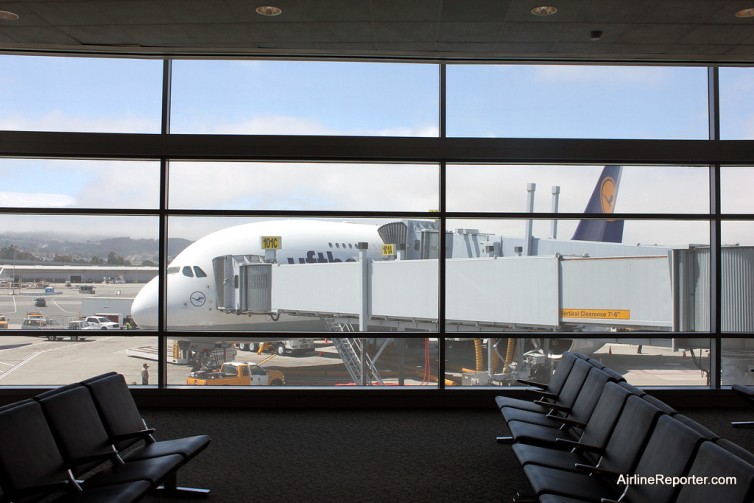
Lufthansa's Airbus A380 waits at SFO

Lufthansa's Airbus A380 waits at SFO

Yesterday, San Francisco International Airport saw their first passenger carrying Airbus A380 arrive, operated by Lufthansa. Once all the passengers were able to de-plane and the aircraft was cleaned up (this was the first time that the SFO based cleaning crew cleaned up an A380), media and guests were able to take an inside look at one of Lufthansa’s seven Airbus A380′s.

I was excited, since this was my first time actually inside an A380. I had only seen one previously from the tarmac and of course I have viewed lots of photos, but there is nothing like getting inside the world’s largest commercial airliner.

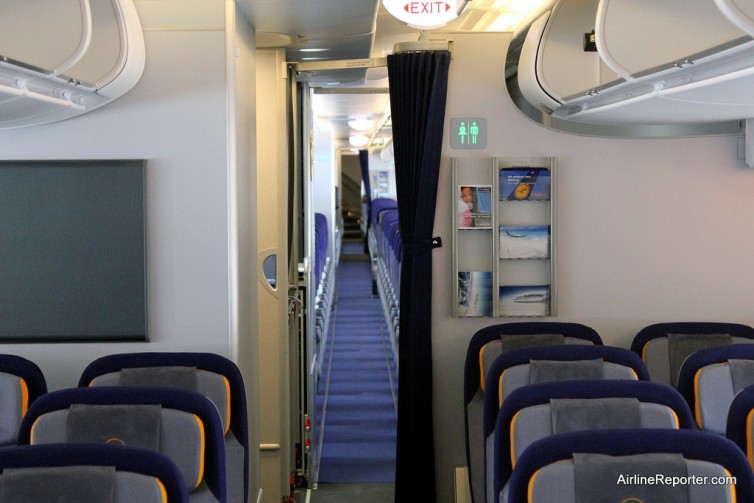
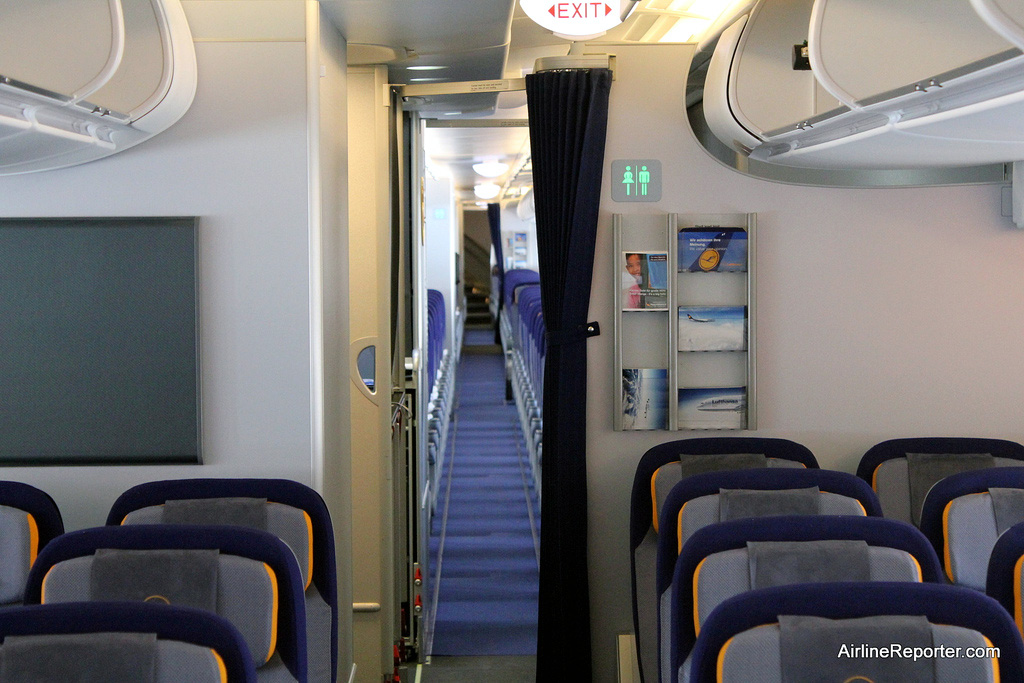
The economy class seats on Lufthansa's A380 look slick and are pretty comfy to boot.

The economy class seats on Lufthansa's A380 look slick and are pretty comfy to boot.

Due to the A380′s size, there are three jetways options that passengers can board. Two are located on the bottom deck and one goes to the top. The tour started on the bottom where all 420 economy seats are located. Even though the bottom deck is long, but it doesn’t feel it, since it is broken up into individual sections. Every seat has their own in-flight entertainment system, adjustable headrest and ample legroom. Sitting in the seat, I was plenty comfortable for the three minutes I was there. Not too sure how my 6’1″, 250lbs frame would handle 11 hours if I had someone sitting next to me.

All the Business Class seats can be found on the upper deck of the A380.

All the Business Class seats can be found on the upper deck of the A380.

On a longer flight, I would prefer to head up top where you can find 98 Business Class and eight First Class seats. One of the first things I noticed were all the seats on the aircraft were cloth. In most Business and First Class areas, one is more likely to find leather. This didn’t make the seats any less comfortable and most likely would reduce sliding when converted into a bed.

While on the upper deck, I took a look at the Airbus A380's massive wing.

While on the upper deck, I took a look at the Airbus A380's massive wing.

While up on the second deck, I had a chance to sit down and take a look out the window. The Airbus A380 has one frek’n big wing. These large wings have 54% more surface area over a Boeing 747-400 and you can tell.

The new Lufthansa First Class has ample room and a large screen. I could easily burn 11 hours happily in this section.

The new Lufthansa First Class has ample room and a large screen. I could easily burn 11 hours happily in this section.

The new Lufthansa First Class on the A380 was quite impressive. Each person has their own area, with large screen and fold down bed. The walls were covered in suede (or fake suede) and extra sound deadening is used to keep the sound to a minimum. The First Class cabin also has access to two very large lavatories. We are talking full sitting couch and vanity. If you ever wanted to join the mile-high club, this would be the place to do it — even all that extra sound deadening might help. From forks to roses, Lufthansa’s catering crew loads on 40,000 items for just the First Class passengers alone (yes, 40,000). That just goes to show the level of service that flying First Class provides.

This is one of the lavatories in the First Class section. Can anyone say Mile High Club?

This is one of the lavatories in the First Class section. Can anyone say Mile High Club?

One thing you will find missing in the first class section are overhead bins — they are missing. Instead each seat has a storage area where passengers can store their belongings. This really adds a sense of upward space and makes the First Class cabin that much more comfortable. Even though the Business and First Class areas are what you might expect, it just doesn’t feel as exclusive on the top deck of the A380 versus the smaller top deck of the Boeing 747-400.

This is the first time I have seen three jet ways be used to de-plane an aircraft.

This is the first time I have seen three jet ways be used to de-plane an aircraft.

Although the A380 looks impressive pulling up to the gate, it is missing some of the grace that the Boeing 747-8 Intercontinental has in my opinion. The Airbus A380′s job is not to win any beauty contests, but to provide airlines with an economical way to move a lot of people in style and it does just that. After my tour of an A380 I am super pumped to get a ride in one and hope to write up a trip report soon.

For those of you who have flown in an Airbus A380 what have been your impressions?

CHECK OUT THE REST OF MY PHOTOS ON FLICKR

San Francisco Welcomes First West Coast Lufthansa Airbus A380 Flight

Lufthansa's Airbus A380 (D-AIMD) gets a water salute when arriving to San Francisco on May 10th.

Lufthansa's Airbus A380 (D-AIMD) gets a water salute when arriving to San Francisco on May 10th.

Today was a beautiful day to fly down to San Francisco (SFO) to greet the Lufthansa’s first Airbus A380 passenger flight from Frankfurt, Germany to SFO.

The Airbus A380 is the largest passenger airliner made and it’s closest competitor will be the Boeing 747-8 Intercontinental, when it makes it to the market. I have been able to catch a glimpse of a Qantas Airbus A380 while in LAX, but this was my first time to get up close and personal. I do not think the A380 is as majestic as the Boeing 747, but she is very impressive for sure.

The event is a big deal for the airline and the city. San Francisco Mayor Edwin M. Lee has officially declared May 10, 2011, as  ”Lufthansa German Airlines Day.” Pretty cool when an airline gets an official city day. I am not sure it really means anything, but still neat.

The airport had to make very little updates to prepare for the A380, since the International Terminal was designed with the A380 in mind and it fit with no problems.

Lufthansa already has taken delivery of seven A380′s with an additional 15 on order.

As part of the event, we got a tour of the interior of the A380 and I will be posting that story tomorrow.


An Inside Look at American Airlines Admirals Club at San Francisco

The atmosphere inside the Admirals Club at SFO really feels like the city. I especially love the trees.

The atmosphere inside the Admirals Club at SFO really feels like the city. I especially love the trees.

American Airlines (AA) has many clubs around the world and it takes something special for one to stand out and the new Admirals Club at San Francisco International Airport’s (SFO) new Terminal 2 does just that.

When walking in, you can tell this club is different.  Straight in from the door is a sitting area with (fake) trees that feels like you are sitting at a cafe at some square in San Francisco. The colors, the furniture and even the fire place “captures the spirit and culture of the city,” Nancy Knipp, President of American’s Admirals Club explained to me while we sat under the trees. The club is designed to let passengers know that they are in San Francisco.

There is everything you would come to expect from a high-end lounge: luscious seating, free Wi-Fi, business center, bar, showers and free snacks. Having your flight delayed or being early is no big deal when you can hang out in this lounge.

The seating was very comfy and welcoming. No problem finding an outlet, they are everywhere.

The seating was very comfy and welcoming. No problem finding an outlet, they are everywhere.

The new club is a huge improvement from their old one at SFO – literally. The new club is about 95,000 sq feet and can now seat 165 people versus the 90 of the previous club.

If you do not have elite status with American Airlines, you can still get a day pass for the club for only $50. Not a bad deal if you have some time to burn in at the airport. The nice part of AA’s day pass is you have access to all their Admirals Clubs for the day, no matter their location. This is very handy if you have a stop or two during your trip.

SEE ALL SEVEN PHOTOS OF THE AA ADMIRALS CLUB AT SFO