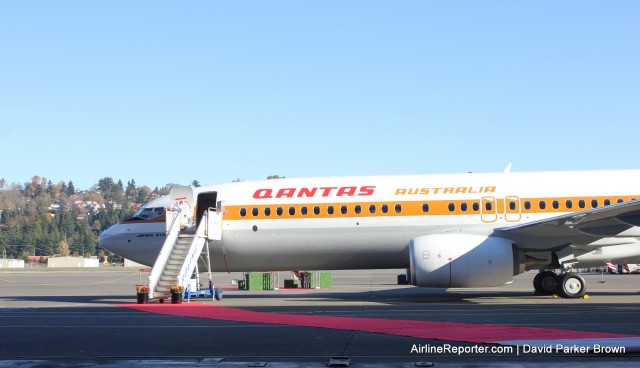
The Qantas’ retro livery on their new Boeing 737
I always love being invited to celebrate a new delivery for an airline, but I wasn’t sure how Qantas might make a 737 delivery special. There have been over 8,000 of the aircraft type delivered and Qantas is already operating 74 737s.
Of course, the big deal about this 737-800 (VH-XZP) is that it is in a retro livery. A livery that flew on the airline from 1974-1981. That is a good start.
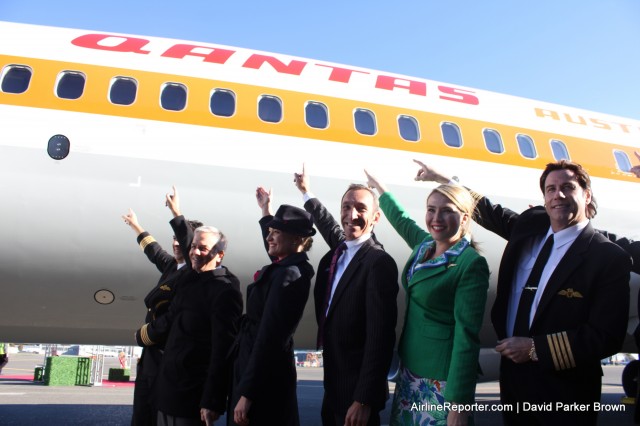
John Travolta showed up and celebrated with Qantas
However, because of all the mindful AvGeeks out there, photos of the new livery have been on the internet for a week. How was Qantas going to make this celebration really stand out?
They were able to use this opportunity to celebrate the 70th anniversary of the kangaroo being used as their logo and this month is also their 94th birthday. All great things, but I think overall there were two things that really made this event work: a shiny disco ball and John Travolta.
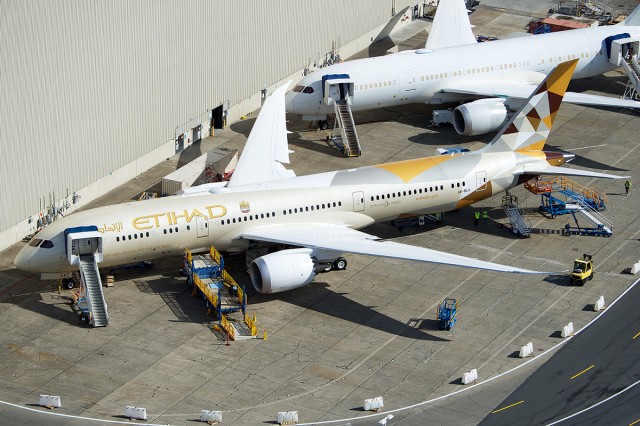
Aerial photo of Etihad Airways’ first 787-9 at Paine Field – Photo: Bernie Leighton
Here we have the fourth installment of showing off the beautiful Boeing 787 Dreamliner liveries that have been seen at Paine Field and around the world. There have now been 42 different liveries. Last update was from July 2013 and we have seen quite a few new ones since then.
Let me know in the comments: Which 787 livery is your favorite? Your least favorite?
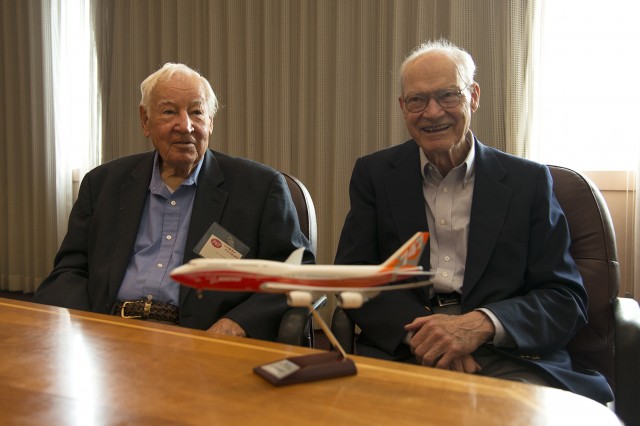
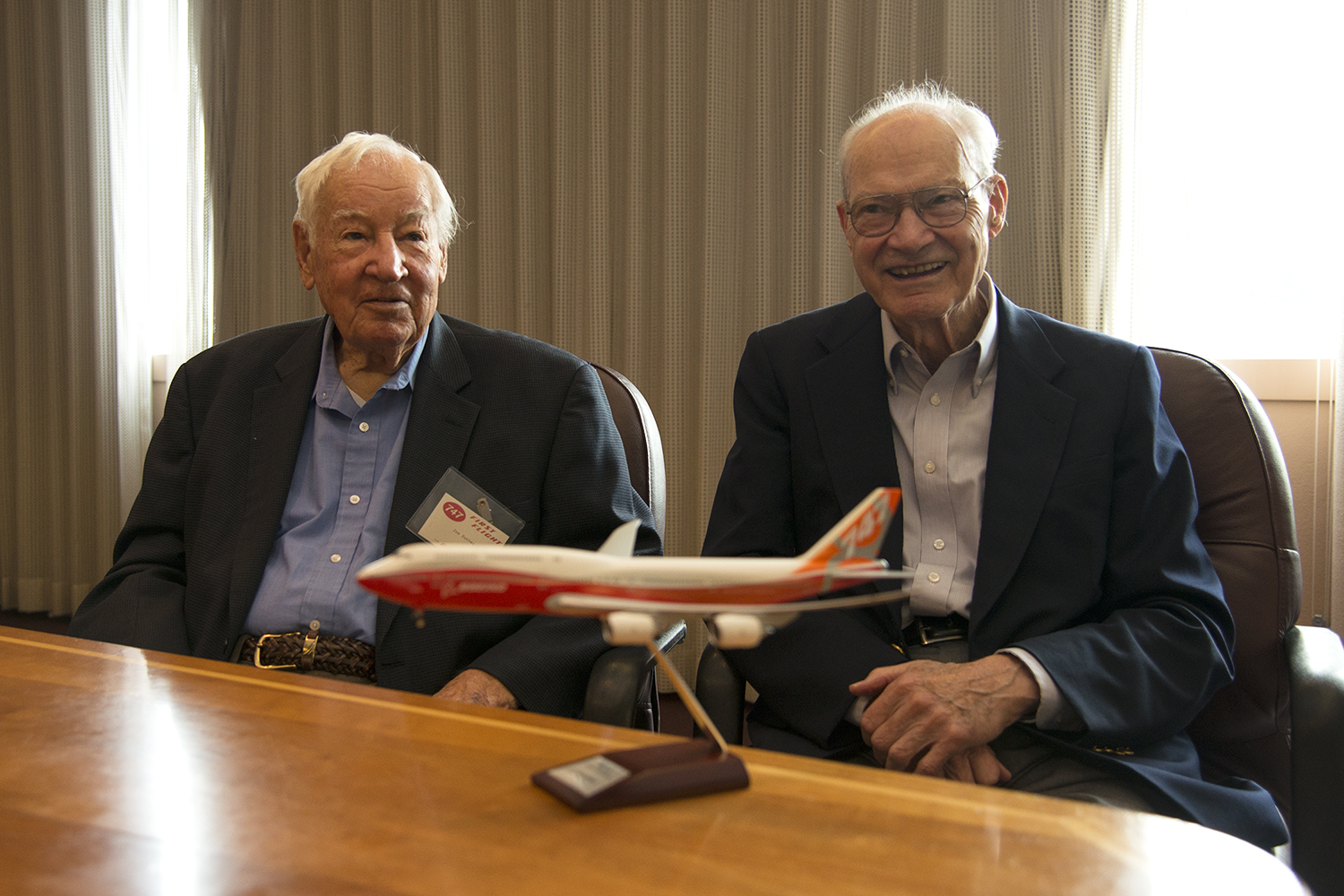
Joe Sutter and Brien Wylge – Photo: Kris Hull
Recently, the Museum of Flight in Seattle finished the first phase of restoring the historic first 747 to its original 1969 appearance. To celebrate this accomplishment, they hosted an afternoon seminar with Joe Sutter, who led the engineering team and is credited as the “Father of the 747”, Brien Wygle, the former Boeing Chief Pilot in 1969 who was in the right seat during the first flight, and noted author Clive Irving, who wrote one of the authoritative books on the 747. Before the main events on October 18th, we had the opportunity to sit down and talk with Sutter, Wygle, and Irving.
The 747 was an aircraft that was developed quickly by today’s standards, according to Sutter. “I was asked to investigate large aircraft designs in April 1965, Pan Am placed its first order in 1966, and we rolled out the first aircraft in 1968, with first flight in 1969, followed by entry into service in early 1970.” For an aircraft the size of the 747, three years from initial concept to rollout of the first model is still today unprecedented.
According to Irving, “It was a large program, and Joe was in the middle of the chain of command, and whenever there was a critical decision to be made, and no one else wanted to make it, Joe made it. He was the one in the end who signed off on everything, and took full responsibility.
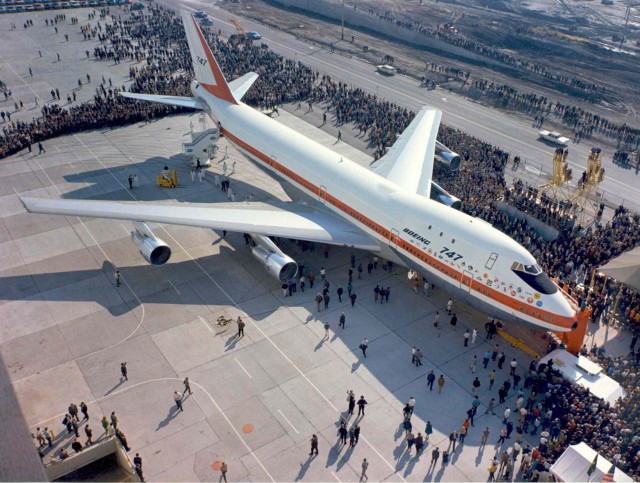
Roll out of RA001, the first 747 – Photo: Boeing
You will not find that speed in today’s environment.”It was a massive undertaking, and at one point, we were spending $5 million a day on the project. I was directed to cut 1,000 engineers by leadership, and I polled my crew and asked what they can do without; they said, ‘nothing, we need 800 additional engineers!'” said Sutter. “We were relegated to an old warehouse on the Duwamish River before the Everett factory was built, while the team heading up the government-sponsored SST program were housed in brand-new offices and buildings.”
When asked about how he felt being “relegated to a side project” compared to the high-profile SST program, Sutter replied, “We had a job to do, and we were going to build an airplane that did that job. We were going to get our job done, and we had the attitude that if we did a good job, the plane would have a great future.”
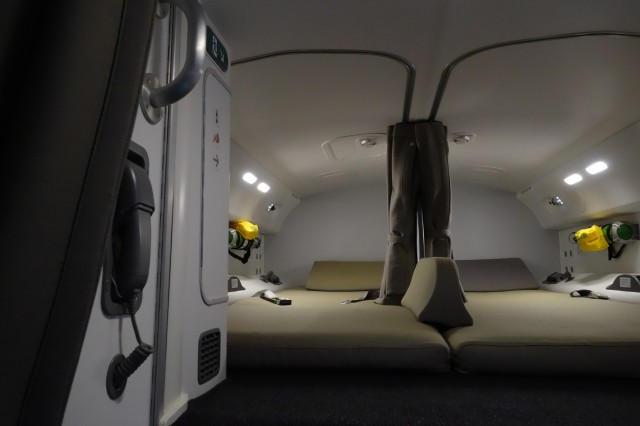
The pilot’s rest area inside an Air Canada Boeing 787 Dreamliner – Photo: Howard Slutsken | Airways News
Often passengers on long-haul flights do not stop and think about the need for the flight crew to rest. Pilots and flight attendants only have a certain number of hours that they can work, and then they need their time to rest.
Some airlines opt for crew rest areas either above or below the passenger cabin of the aircraft, while others will have crew just use your standard passenger seat.
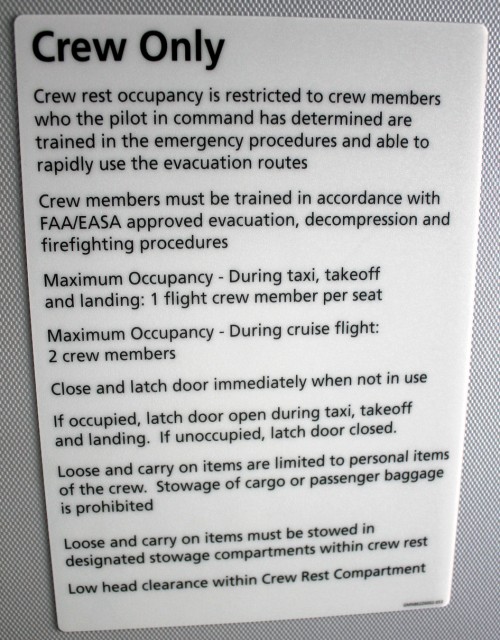
A crew rest sign means business – Photo: David Parker Brown | AirlineReporter
We have had a chance to visit quite a few different rest areas and I have to say that one thing that most of them have in common is they are small. They probably wouldn’t be a good fit for those who are claustrophobic.
It is not always easy to get to the rest areas (normally, steep stairs or a ladder), and once you are in, there isn’t always too much room to maneuver. However, what they do offer is a private space, away from passengers, to get some rest.
We wanted to share the number of different crew rest areas that we have visited. Enjoy the photo tour:
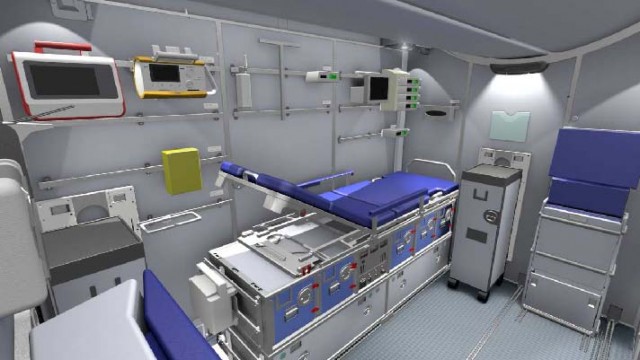
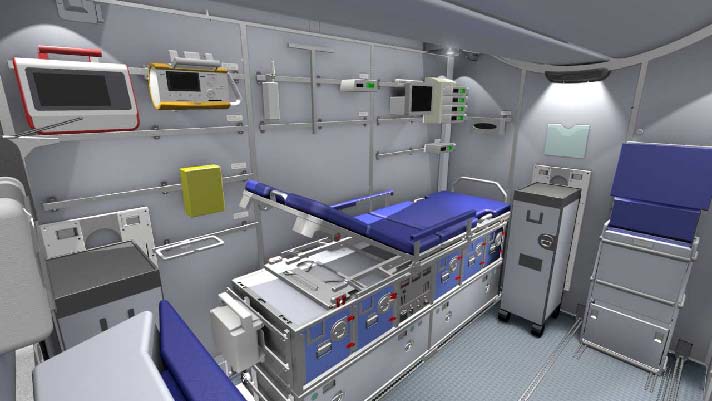
A rendering of the inside of Lufthansa’s Patient Transport Compartment, the “flying ICU” – Image: Lufthansa
Lets face it, nobody wants to need medical care while on board a plane. And yet, with a huge number of people traveling by air everyday, it’s inevitable that it will happen with some regularity. In fact if you travel by air regularly, you have probably heard the flight attendants ask over the PA if there is a “medical professional onboard.”
Any malady that can occur on the ground can happen in the air, and the altitude while on a commercial aircraft can even exacerbate certain medical conditions. That means that some people may be more likely to need medical assistance in the air than they do on the ground.
For German airline Lufthansa, there are about 3,000 passenger medical emergencies that occur on board each year. Of those, an average of 54 emergencies are serious enough that they require the flight to be diverted so that a patient can obtain urgent medical care. I recently had a chance to sit down with the airline and learn how they cope with these situations. Not only is the airline well prepared for any emergency that may arise in flight, they are also ready to treat those who need care before they board the aircraft.