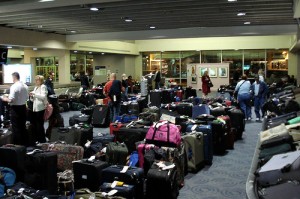
The European Union (EU) is pushing to create tougher regulation over airlines and airports that damage and lose luggage.
Recently, United Airlines felt the brunt of a passenger who had his guitar broken during a flight. He was unhappy with how the airline treated him and if you agree or disagree, his video went viral and got a positive reaction from United.
Of course this strategy cannot work for everyone. The EU Commission is proposing that each EU country create an agency to monitor incidents of lost and damaged bags. An EU Commission survey shows that between November 2008 and March 2009, airlines on average lost one bag for every 64 passengers. ’œIt’s a serious problem,’ European Transport Commissioner Antonio Tajani said, ’œWe have to act.’
With airlines charging more for checked bag fees, it is frustrating that so many bags in the EU would be lost and damaged. Even though having less baggage lost would of course be better, is it worth all the extra money it would cost to have the government watch over the industry?
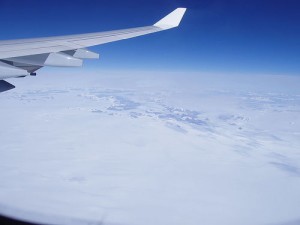
The Library of Congress shows that Matthew Henson was the first person to reach the North Pole on April 6, 1909. It took him eight attempts to finally make it to the North Pole. The journey was difficult and I bet he never imagined that a little over 100 years later an airline could have flown over the North Pole region 10,000 times. United Airlines flight 898 from Beijing to Washington, DC marks their 10,000th polar flight.
Today in the Sky points out that United Airlines has quite a few daily flights on four polar routes: Chicago-O’Hare Beijing; Chicago O’Hare-Shanghai; Chicago O’Hare-Hong Kong; and Washington Dulles-Beijing. The routes and flights didn’t come easy. In 1999 with the combination of better technology and better cooperation from Russia, UA were able to start the first of these first flight in Jan 1999 from Chicago to Hong Kong.
Polar flights are able to save time, fuel and money. Currently United Airlines only flies about 20% of the polar flights worldwide.
Have you ever flown in first class and felt bad about having to look at the people sitting in the back of the plane? Ever been in the back of the plane and hated seeing the treatment that the front of the plane received?
Worry no longer, the class divider (aka cabin curtains) is making a comeback.
After the September 11th attacks, the TSA mandated airlines lose their curtains, allowing easy plane visibility. Passengers (presumably from the front of the plane) have complained and want to have more privacy and airlines are responding.
American Airlines is in process of adding new curtains to recreate the class separation. United Airlines started earlier, installing mesh-type curtains over three years ago.
As time goes on, more and more airlines will most likely follow. Even being in the back of the plane, this can be a good thing, since I don’t enjoy seeing what I am missing.
Have you ever wanted to see what it takes to upgrade the cabin of a Boeing 747-400? Do you have 1 minute and 37 seconds of spare time? Well then, United Airlines has a video for you. United Airlines posted a video on YouTube showing a remodel of first and business class cabins on a Boeing 747-400.
United Airlines has been holding off for quite awhile from buying any new planes. They had talked about reducing their fleet, however, now they plan to order up to 150 aircraft by this fall.
As they have been waiting for a good time to buy, their fleet of almost 400 aircraft have aged. Now they are looking to replace their wide-bodied jets and Boeing 757’s with new aircraft. They are also hoping to get rid of their almost 30-strong fleet of Boeing 737’s.
It’s a large order, which gives them tremendous buying power. United Airlines states they are in talks with Boeing and Airbus and only want to purchase planes from one of the two manufacturers. This could be a huge payoff to the winning bidder and will probably create a lot of interesting deals for United to consider. With airlines cancelling orders for aircraft already being built, this could be a better than average boom for either Airbus or Boeing.