This was originally posted on Jan 31st and updated and re-posted on Feb 13th…
NOTE: When you print your tickets, it incorrectly states where to meet on Saturday. We are to meet at the Museum of Flight by Noon to take the 737 factory tour.
This is shaping up to be one EPIC event and I am so happy that so many of you will be able to join in. All 420 tickets sold out over the weekend and there were over 35 people on the wait list.
If you are still looking for a place to stay the Hilton Garden Inn at Paine Field is still offering a special #AGF13 discount.
Be Social Media Ready to share this adventure. Follow #AGF13 on Twitter and be sure to follow/mention/like the following companies/organizations who are making #AGF13 possible:
Here is the schedule (as of now):
SATURDAY FEBRUARY 16th: Renton and South Day
- 9:00am to 5:00pm: Open access to tour the Museum of Flight and the Space Shuttle trainer (minus the crew compartment). Also be sure to check out the 2013 Northwest Scale Modelers Show going on in the main gallery from 10:00am to 5:00pm. [Ticket Required: Boeing 737 Tour Ticket. Age Restriction: None. Cameras: Allowed]
- 9:00am to 3:00pm: #AGF13 HQ will be located in the Skyline Room at the Museum of Flight with coffee. [Ticket Required: Boeing 737 Tour Ticket. Age Restriction: None. Cameras: Allowed.]
- 12:00pm: Meet in the Museum of Flight’s lobby where we will board buses and given a Boeing 737 Factory balcony tour in Renton, WA. [Ticket Required: Boeing 737 Tour Ticket. Age Restriction: 12yrs and older. Clothing: no high heels, no open toes. Cameras: Not allowed.]
- 5:00pm to 6:30pm: Receive a VIP after hours tour of Personal Courage Wing at the Museum of Flight. [Ticket Required: Boeing 737 Tour Ticket. Age Restriction: None. Cameras: Allowed]
SATURDAY AGF13 TICKETS ALSO GET YOU ACCESS TO [A ticket or badge for AGF13 is required, cameras are allowed and no age restrictions for all]:
SUNDAY FEBRUARY 17th: Paine Field Day
- 10:00am, 11:30am and 1:00pm: There will be multiple tours leaving the Future of Fight (meet in the main lobby) to tour the Boeing Dreamliner Gallery. [Ticket Required: Dreamliner Gallery Group Ticket With Appropriate Time. Age Restriction: None. Cameras: Allowed]
- 3:00pm: VIP Boeing Factory Floor Tour. Meet at the Forward Cabin conference room (follow the signs) at the Future of Fight and we will be bussed to the factory. [Ticket Required: Boeing Factory Tour Ticket. Age Restriction: 12yrs and older. Cameras: not allowed. Clothing: no high heels, no open toes.]
- 5:00pm to Later: #AvGeek shin-dig at the Future of Fight with pizza, beer and airline/aviation related prizes and lots of nerdy aviation talk. [Ticket Required: Any AGF13 ticket. Age Restriction: None. Cameras: Allowed.]
SUNDAY AGF13 TICKETS ALSO GET YOU ACCESS TO [A ticket or badge for AGF13 is required, cameras are allowed and no age restrictions for all]:
OTHER THINGS TO CHECK OUT WHILE IN TOWN [not officially part of #AGF13]:
If you have questions, please leave them in the comments. Thanks! See you this weekend and prepare to HAVE FUN!
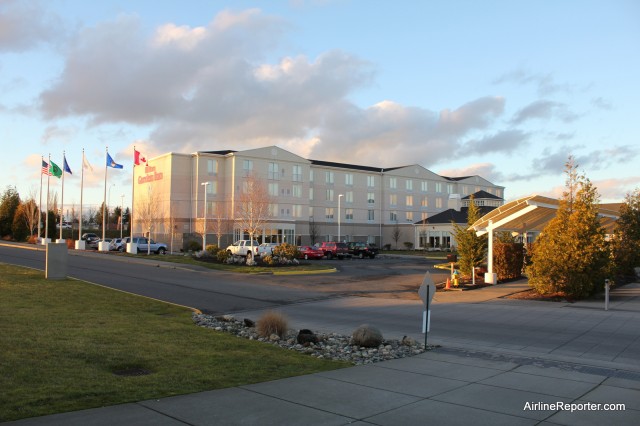
Yes, blue skies can exist in the Seattle area in January (this is Friday, most other photos are taken on Saturday with rain). This photos of the Hilton Garden Inn was taken from the entrance of the Future of Flight.
Not all hotels are created equally. Many compete with a long list of amenities to help entice travelers to stay in one of their rooms. Coffee makers, robes, Wi-Fi, breakfast are just some of the common weapons used to gain your business. But for AvGeeks there is something else that can trump all others: spotting airliners from your room.
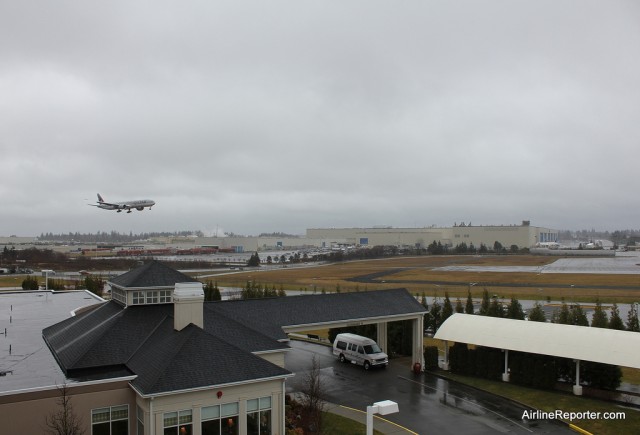
There are the rain and clouds I have grown to love. A Qatar Airways Boeing 777-300ER about to land at Paine Field – taken from my hotel room. When it is sunny, there are plenty of wonderful mountains in the background.
There are hotels around the world where you can watch airplanes come and go, but there is only one hotel that is located right at the edge of Paine Field, where Boeing builds their 767, 777, 747-8 and 787 aircraft and that is the Hilton Garden Inn Seattle North/Everett.
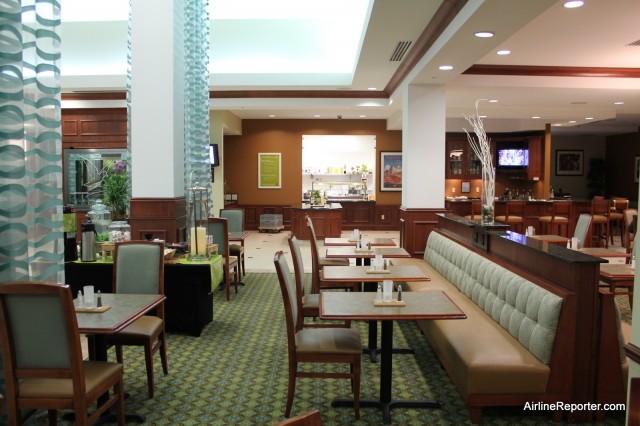
Just off the lobby is a bar (no draft, but they have bottled beer and hard alcohol) and restaurant.
Since I live about 15 minutes away from the Hilton Garden Inn, I have never needed to use it. However, talking to other AvGeeks who have stayed there, I heard positive things and wanted to see how good the aviation spotting would be from the hotel. When given the opportunity to stay at the hotel on a Friday night, I figured why not (they provided me the room for free for the review)?
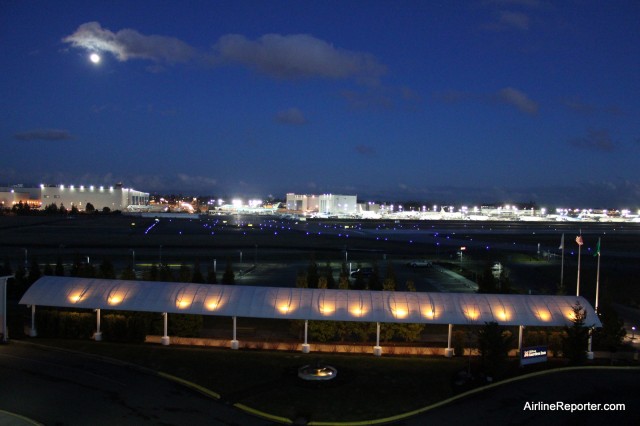
It was mighty cold outside, but warm inside my room when I took this photo of Paine Field.
The hotel is situated in the northwest corner of Paine Field, right next door to the Future of Flight. I visit Future of Flight quite often, so I was no stranger to the area. I was given the keys to the most premium room at the hotel: The Presidential Suite. Normally when a room has such an impressive name, I end up having pretty high expectations. And those expectations were more than met.
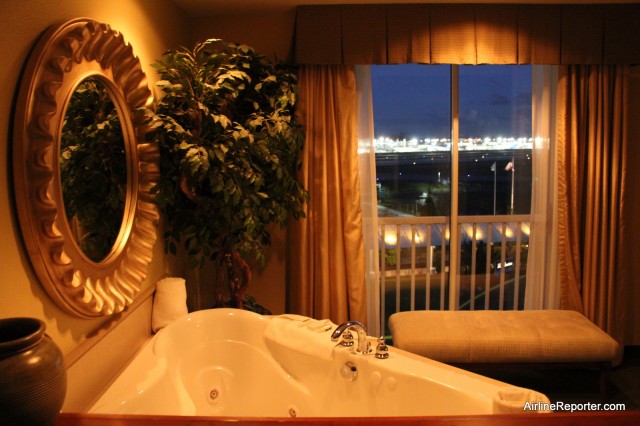
Yea. This is living. Nice big tub overlooking Paine Field.
I have been very fortunate to see some pretty impressive hotels around the world. Not to say that Everett/Mukilteo/North Seattle are bad places (I mean, that is the area that I call home), but I wasn’t expecting to find such a nice room. I think when I first walked in I said something like “Holy cow, I wasn’t expecting this.” Maybe I said something a bit more adult than “holy cow,” but you get the idea.
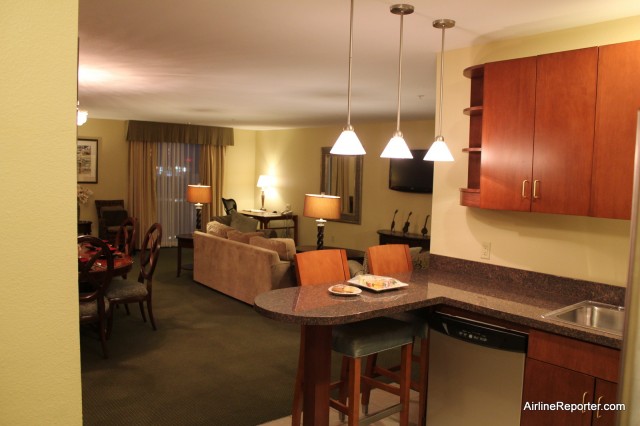
This is the view after walking into the Presidential Suite. Kitchen to the left, dining and living room straight ahead and bedroom to the left.
The Presidential Suite is the size of three standard rooms and has an almost full kitchen, a living room, full dining room, two fire places (not real fire, but whatever), and two bathrooms. I was hoping that there might be a jetted tub in the room and was excited when I found there were two: a smaller one in the bathroom off the bedroom and a quite large one overlooking Paine Field in the bedroom next to the king sized bed.
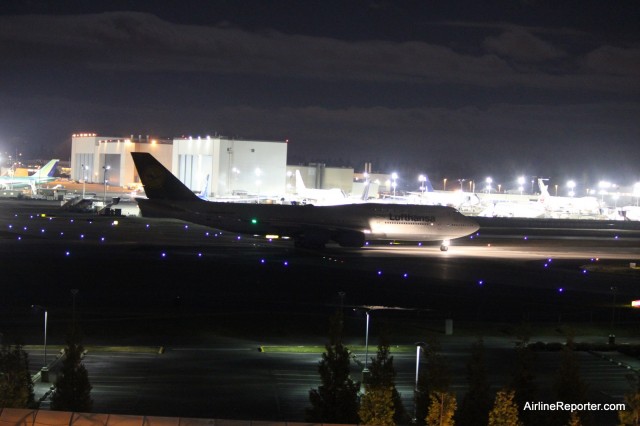
This Lufthansa Boeing 747-8I delivery flight was a few hours late, but still able to enjoy it taking off.
Sure, all these amenities are fabulous, but I wasn’t there for the trinkets, I was there to check out the view. Unlike other rooms that only have window views to Paine Field, this suite had three sliding glass doors that look out to PAE, making it perfect for spotting (which Malcolm Muir spotted me spotting from my room). Yea, I felt that this room was built for me and I was pretty certain I never wanted to leave.
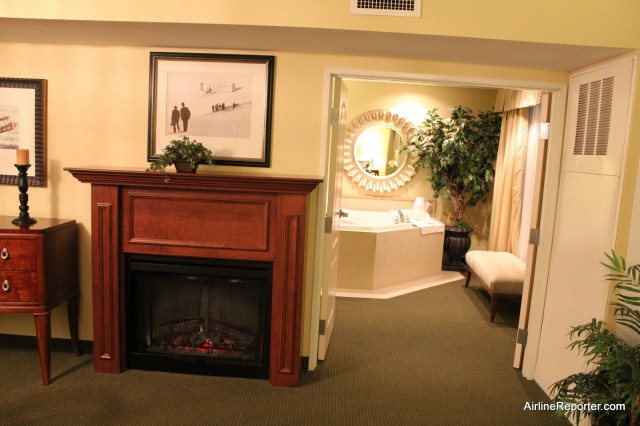
There is a fire place (fake, but still gives the ambiance) in the living room and bedroom. This is looking into one of the two double doors going into the bedroom. Also notice the aviation themed-art.
To make sure that I wasn’t only looking out the window the whole time, I brought my girlfriend Shannon with me to handle reviewing the decor inside the room.
“When I first walked into the room, my first thought was that it was beautiful in every detail,” Shannon explained to me. “Then as I discovered the view directly overlooking Paine Field, the giant whirlpool tub that was positioned toward that amazing view, the incredibly spacious bathrooms (there were two in the Presidential Suite), and the firmness-adjustable king-size bed, I was awed by the luxury. The full fridge, stove range, dishwasher, counter space and full silverware and glassware sets, as well as a wood dining table, all added to the exquisiteness of the room by offering functional amenities that are hard to find away from home.”
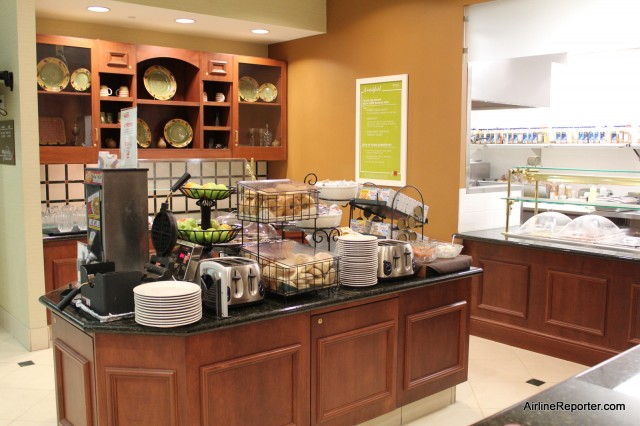
There is much more than just cereal and toast at this breakfast.
There is also the option for breakfast the next morning. I wasn’t really in the mood to get out of the nice warm bed, but luckily Shannon was willing to head down and check things out. “When I walked down to the lobby for breakfast, I wasn’t sure what to expect,” Shannon recounted to me. “Many hotels boast their breakfasts, but often disappoint. However, when I was greeted by a smiling young woman who showed me the options for self-serve (including fresh juices, muffins and pastries, a variety of cereals, a self-serve waffle maker, bagels, and plenty of fruit), my doubts were quickly abated. I selected the gourmet breakfast, an omelet with your choice of fillings and a selection of cheese, with sausage, bacon and hash-browns on the side. Definitely a great way to start the day.” Don’t worry, she also brought me up coffee, juice and a waffle with strawberries to enjoy. The breakfast is not part of the room and costs $10.95 and is served from 6am to 10am (11am on Sat and Sun).
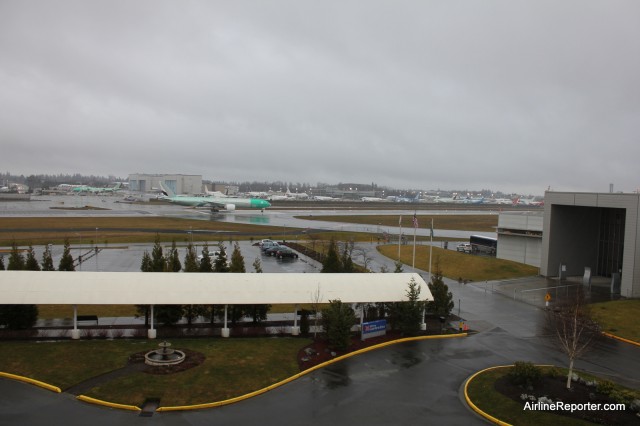
An Emirates Boeing 777-300ER prepares to take off a Paine Field. Taken from the room. That is the Future of Flight on the right.
The hotel opened at Paine Field on October 5th 2005 and offers 102 rooms and 13 suites. They estimate that about 90% of guests are connected to Boeing or one of their subcontractors somehow. This means that their busiest times are weekdays, which normally leaves plenty of rooms open on weekends for you AvGeeks to visit Seattle.
For guests, there is a free shuttle that will take you up to five miles of the hotel (you can walk to the Future of Flight, but this would be handy to check out the Flying Heritage Collection and Historic Flight Foundation) and they will also take you to the Alderwood Mall and Everett train station (which are outside the 5 miles).
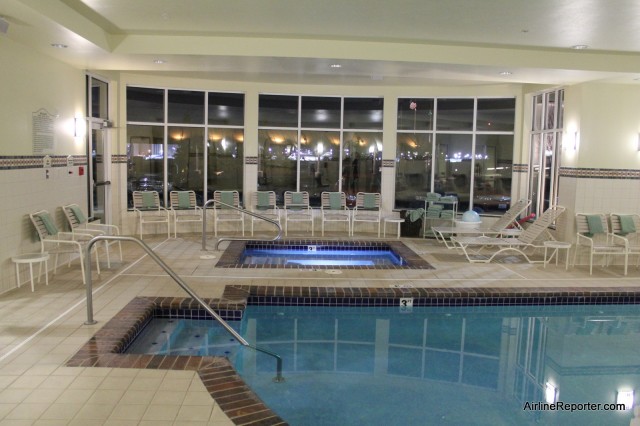
The hotel has a small pool and hot tub. Also a well-appointed gym.
Shannon and I argued over what our room must cost. We were both way off (we guessed much higher). Get this: a night in the Presidential Suite ranges from only $159-$250 per night depending on the date. Now, I am definitely not a person of means, but that is totally affordable, even for a staycation. Heck. I am at Paine Field all the time, but was quite giddy with staying at the hotel and watching airplanes take off and land from my room (and a bubble bath).
This is a great hotel for a non AvGeek, but a must-see if you are coming into Seattle to check out some of our great offerings or even a local looking for some AvGeek excitement.
Maybe you have already stayed? I also know Aviation Geek Fest 2013 is coming up soon and the hotel is still offering a special #AGF13 rate. So, if you have stayed or will stay, drop a line or two in the comments to share your thoughts — the hotel will be listening.
ALL 38 PHOTOS FROM MY HOTEL STAY
 |
This story written by…David Parker Brown, Editor & Founder.
David started AirlineReporter.com in the summer of 2008, but has had a passion for aviation since he was a kid. Born and raised in the Seattle area (where he is currently based) has surely had an influence and he couldn’t imagine living anywhere else in the world.
@AirlineReporter | Flickr | YouTube |
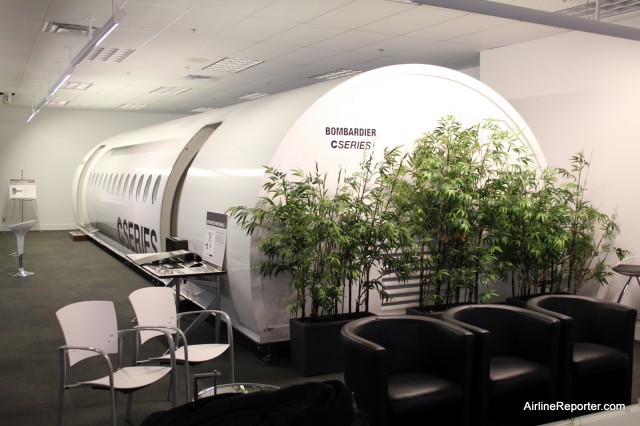
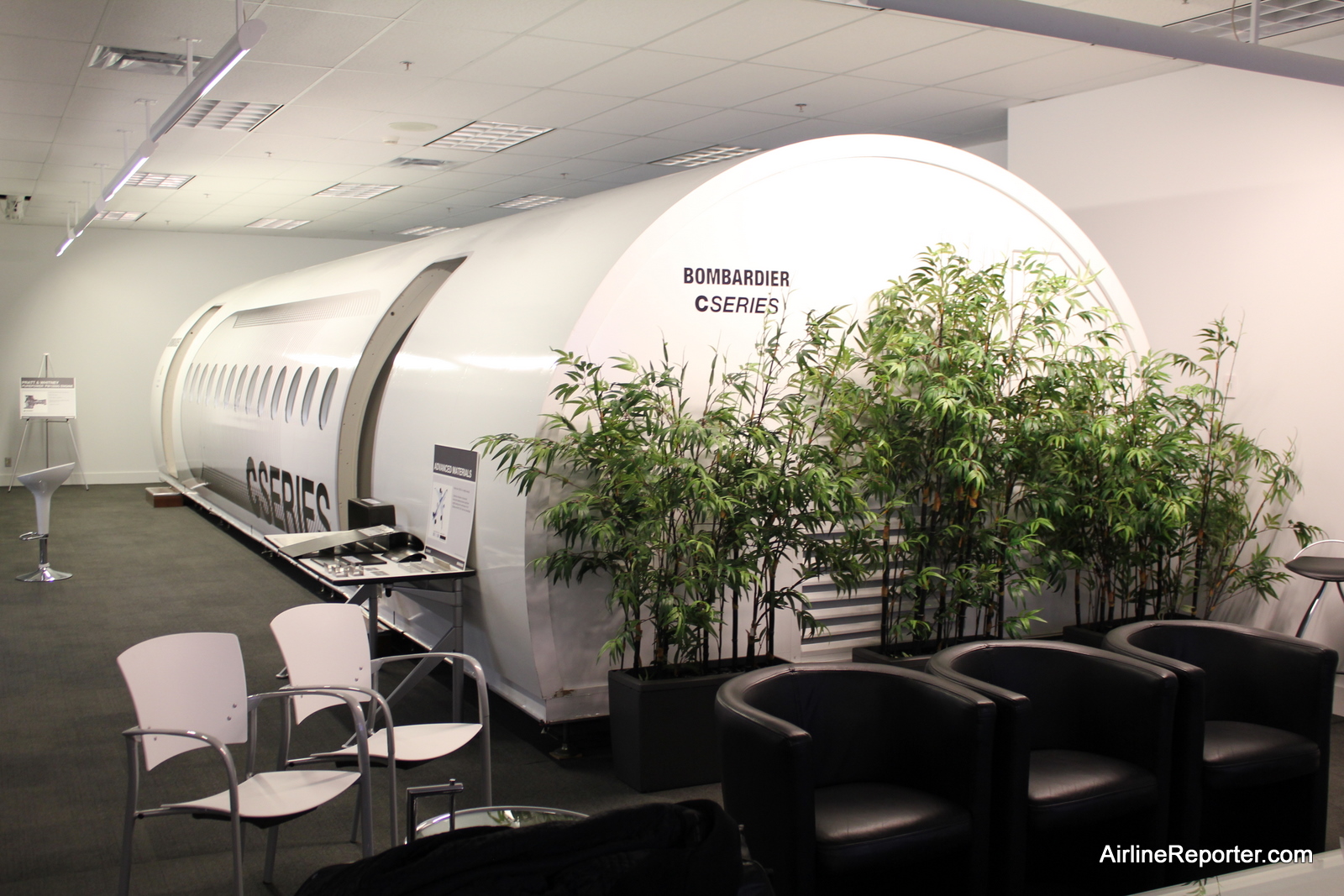
Bombardier's Cseries located in Montreal, Quebec -- tres bon!
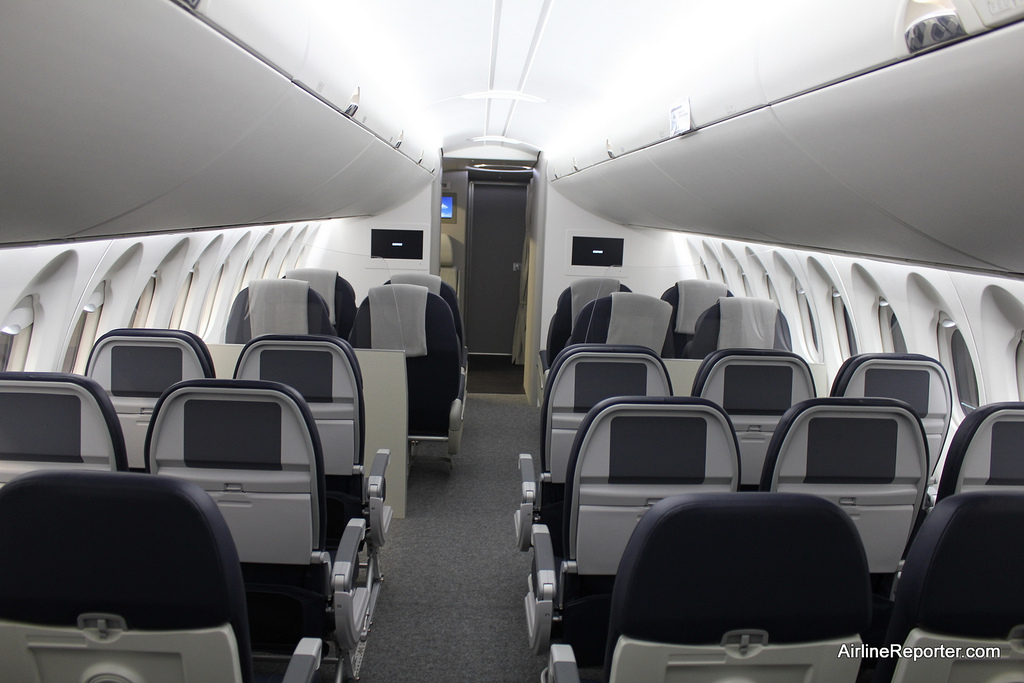
After spending the day with Bombardier recently to learn about their new CSeries, the biggest thing I pulled away that you, the passenger will care the most about is SPACE — lots of it. This is the interior that many passengers have been begging for and they are finally going to get it. All the time , I hear people asking for wider seats, more room, etc. But really, what airline is going to take a Boeing 737 or Airbus A320 and go from six seats across to five? (hint: none). The CSeries is designed to provide that extra space that passengers want, but not the additional weight that costs the airlines more money. Bombardier has built enough width into their new CSeries to give passengers extra room, but not enough for airlines to fit in additional seats.
The cabin of the CSeries is set up in a 2-3 layout for economy and 2-2 layout for first class. Personally, I have always loved this layout on the DC-9/MD-80/Boeing 717 aircraft. If you are flying with someone, it gives you the chance for you two to sit together on the two side and not be bothered by a third person. A big downside of those older aircraft was the noise level in the back of the plane from the engines being rear mounted. That won’t be a problem with the CSeries, since the engines are wing-mounted.
Some readers on my Facebook pointed out that having a wider seat is not something new. Piedmont Airlines did it, but it surely has been a long while and really this comes from the design of the aircraft, not from an airline deciding to make the middle seat wider.
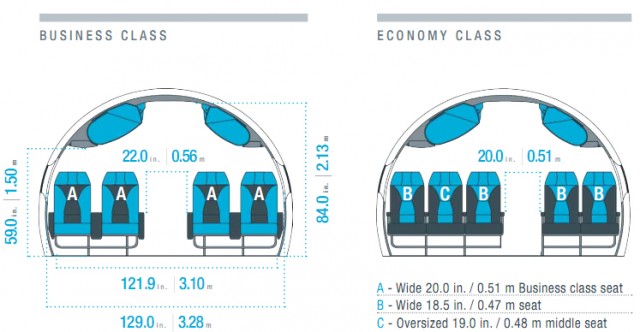
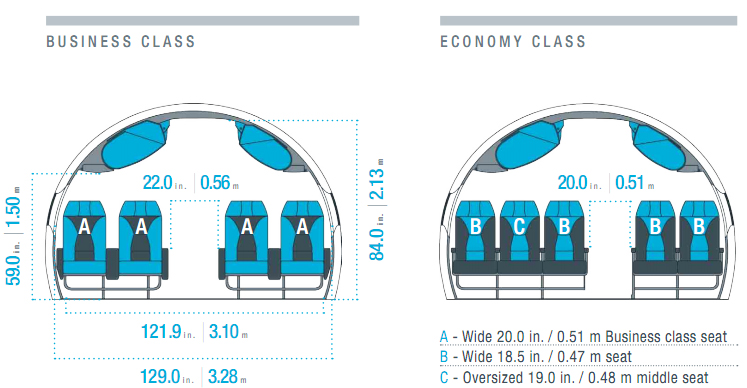
There is plenty of width in the new Bombardier CSeries. Image from Bombardier.
The interior is designed so that most economy seats have 18.5″ width — except the middle seat which is 19″. Now, this just blew my mind… the middle seat is actually 1/2″ wider than the other seats on the plane. How genius is that? Not only that, but a standard 18.5″ width for a short haul seat is great. Many airlines run wide-body, long haul flights with only 18″ or even 17″.
Now, I know what you are all thinking, “Yea right. Bombardier might design the aircraft with space, but airlines will find ways to use that space to fit in as many seats as possible.” Well, do not worry, that will not be the case. First off, there is about half a seat width (from an average aircraft) of extra space built into the plane. If you do the math and an airline puts the aisle to 18″, that would mean each seat would be 15.8″ and that just is not going to happen. Plus, the plane is designed to hold so many passengers with the emergency exits given, so even if an airline made impossibly thin seats, most of them would have to remain empty.
Although seat width will be pretty standard, airlines will have choice with what seat pitch they want to offer. The CSeries mock up in Montreal has the rows set up with different examples from 32″ to 28″. Let me say that at 6’1″, I really hope no airline opts for the 28″ seat pitch on any airplane — ever.
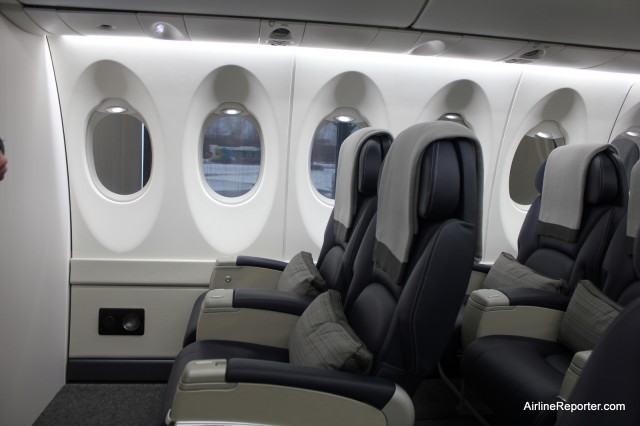
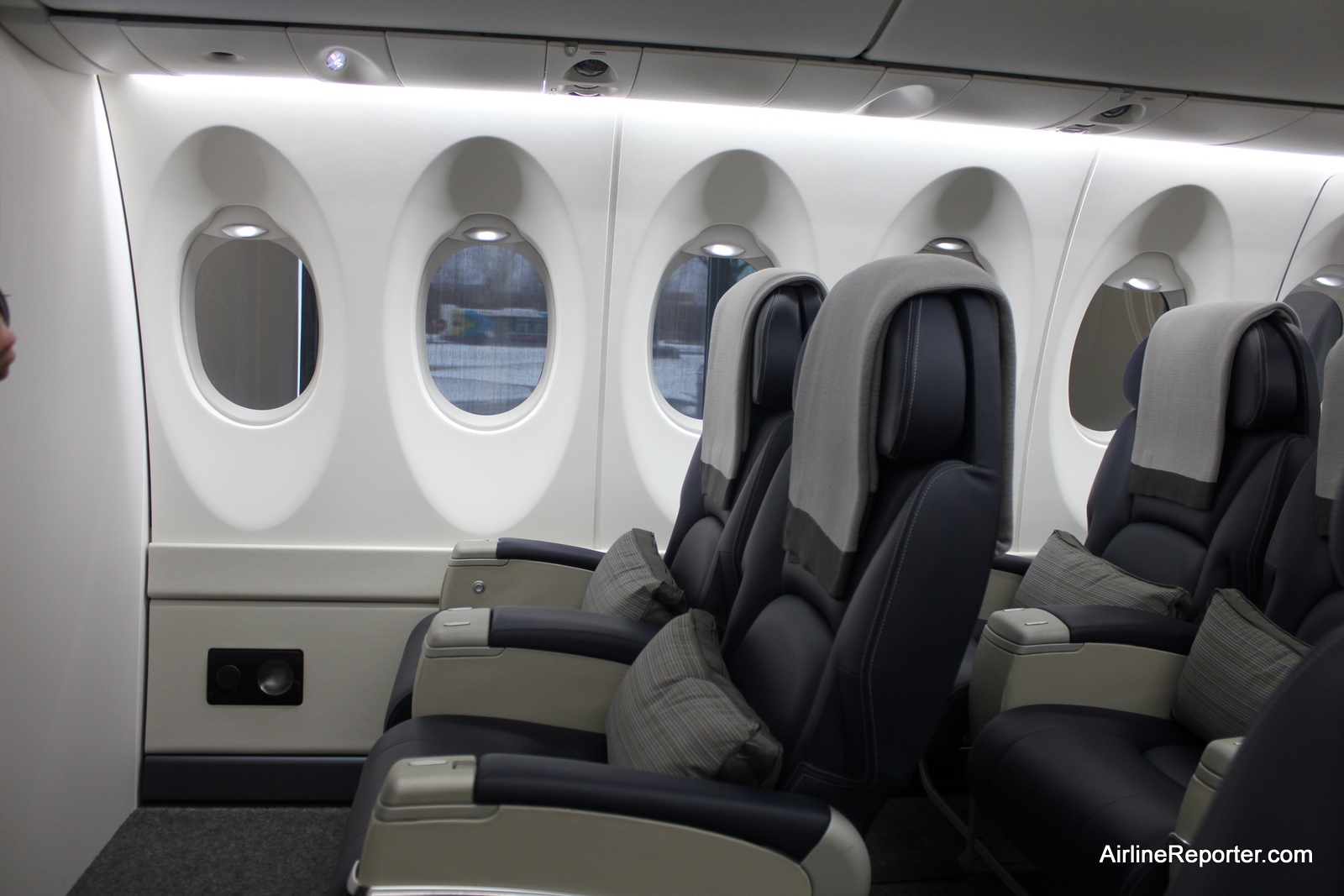
The windows are quite large on the new CSeries, providing more natural light and shoulder room.
The CSeries will sport larger windows than its competition, allowing more natural light and a bit more shoulder room. The CSeries will have windows measuring 11×16″, which are about the size you would find on a Boeing 777.
If you choose a window seat, rest assured, you will actually get a window. How annoying is it to get to your window seat and see a solid wall with no window? Bombardier designed the CSeries so that each row would have at least one window. Not only does this provide great spotting opportunities, it also allows more natural light into the cabin.
At this point, it appears that each window will have a traditional sun shade and not the electronic ones found on the 787 Dreamliner. The reason is this is a smaller aircraft, running shorter hops than the 787 and the extra cost really did not make sense. Like the Dreamliner, the CSeries will also have LED lighting that can change color based on what the airline customer might want.
The aircraft is set to compete directly with the Airbus A318 and A319, the Boeing 737-600 / 737-700, and the Embraer E-195. Bombardier is also hoping those airlines that operate DC-9s and MD-80 aircraft (I am talking to you American and Delta Air Lines) might want to update their fleet with the CSeries.
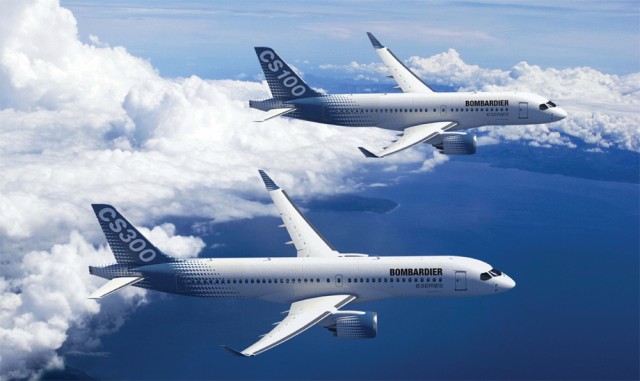
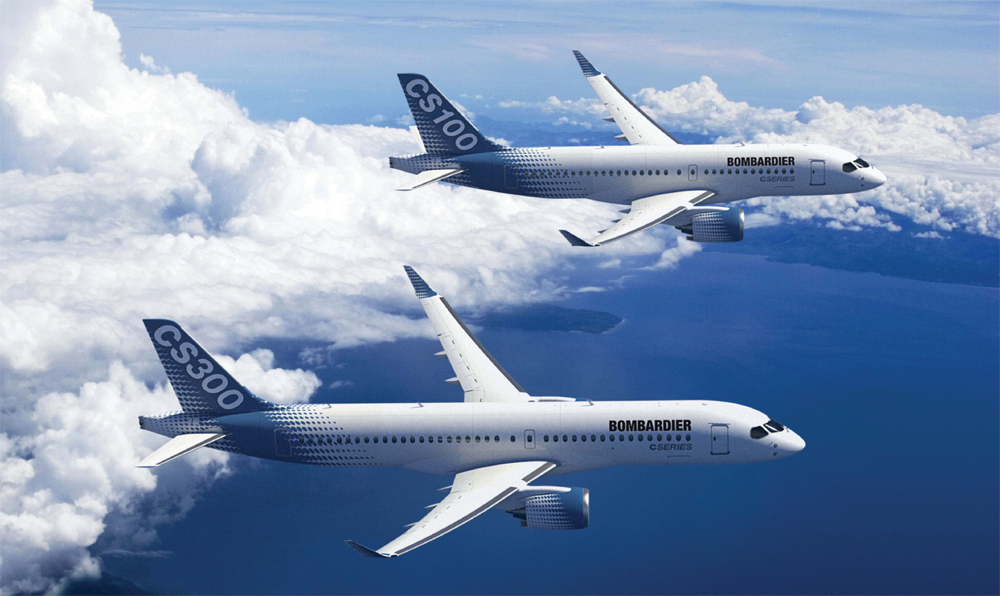
A look at the CSeries 100 and CSeries 300 in this computer mock up from Bombardier.
When designing the CSeries, Bombardier decided to use an aluminum alloy for the fuselage and composite wings. “For the fuselage we performed trade-off analyses, involving airlines in the process, between composite and advanced aluminum design options,” Sebastien Mullot, CSeries Program Director at Bombardier, explained to AirlineReporter.com. “It turned out that the weight gain in the composite option was not as important as in other composite parts (e.g wing) and airlines drew our attention to the fact that this weight gain might be offset by the additional costs that could be incurred on the maintenance side.”
Since the CSeries will be a high-cycle aircraft, there is a much higher chance that the aircraft will be damaged during normal operations. Currently, repairing composite aircraft requires special equipment and procedures, which would have increased operational costs and complexity for airlines. The aluminum alloy used on the CSeries is a aluminum-lithium hybrid that is lighter than traditional aluminum and still can be repaired easily. For now, it seemed to be a perfect fit for what the CSeries will be doing.
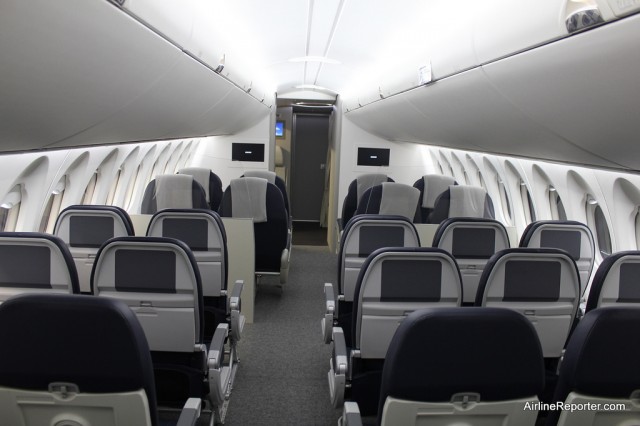
The mock up for the CSeries has different seat pitches for each row. You can see that some have fake entertainment screens as well.
Bombardier is confident that the CSeries will have its first flight before the end of the year. When I asked about potential delays, they stated that they had built-in time for potential delays and unlike other aircraft manufacturers, they have been outsourcing part of their aircraft production for a very long time and are well experienced. They have already been able to work out the kinks and problems from experiences learned with previous aircraft and have not seen the issues that other companies have (ie Boeing and Airbus).
The company hopes that the CSeries will be a complete package for airlines, passengers, crew and the environment. “In an challenging economic environment, airlines have been seeking to grow their average aircraft size in a race to improve their cost efficiency,” Mullot explained. “This aircraft will also be the only single-aisle aircraft to meet 21st century operating requirements: improving flight crew situational awareness, meeting new air traffic control needs and dramatically reducing airlines’ environmental footprint!”
One interesting fact is that we do not know who the launch customer for the CSeries will be. That customer has asked to remain secret and Bombardier is not talking. I am hoping it will be a game changer like Southwest, Ryanair or EasyJet who all operate single aircraft type, but it likely will not be that exciting.
OTHER CSERIES STUFF YOU MUST CHECK OUT:
* All 17 photos of the CSeries mockup in Montreal
* Video of the second mock up by Simpliflying
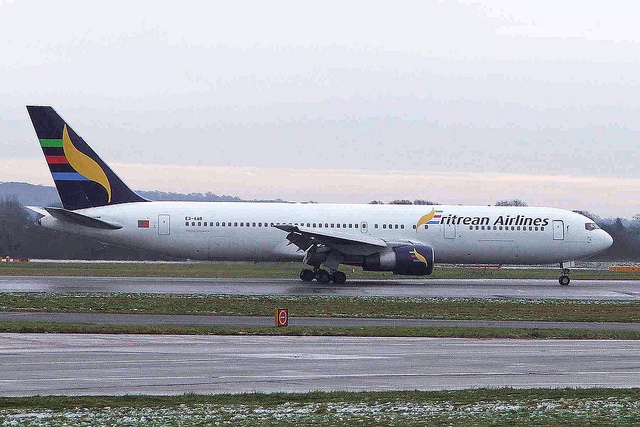
This Eritrean Airlines Boeing 767 obviously has its front door un-latched at the time of landing. Click photo for larger view and check the door handle. Photo by Ken Fielding.
Airline enthusiast Ken Fielding caught an interesting shot while spotting in Manchester (MAN) on December 27, 2004. He took this photo of an Eritrean Airlines Boeing 767-300ER being ferried from Paris-de Gaulle (CDG). At the time, he did not realize the significance of the photo and took a closer look when he recently uploaded it to Flickr. Take a close look near the front of the plane and you will notice that the front door (1R) is unlatched (click on the photo, zoom in and you can easily see the handle in the up position).
It appears that the door was put into that position while at CDG and that the pressurization of the cabin kept the door closed during flight. Fielding reports that since the aircraft was on a ferry flight, there were no passengers on board. Still, that doesn’t give the crew a pass at not completing a simple task of flying safely: make sure all the doors are shut and locked. The crew should have noticed when arming the doors (which they obviously did not do) and/or there should have been an indicator in the cockpit.
I tried to reach out to Eritrean Airlines, but their website is not very helpful for finding contacts and since they are high-lighting stories from 2004, I am guessing it is not the most accurate. The airline went out of business in 2008, but started up again on July 16, 2011 with a pretty slick new livery.
Photo by Ken Fielding