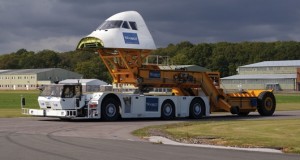
Ricardo's TaxiBot prototype in action.
Normally an airliner is pushed back from the gate with an airplane tug. Once the aircraft is cleared of any obstacles, the tug disconnects and the aircraft moves on its own power down the taxi way and takes off. When there are back ups on the taxi ways, airlines waste fuel and create additional pollution into the atmosphere.
According to research done by Airbus and Israel Aerospace Industries, taxiing at airports will cost about $7billion per year by 2012, will release about 18 metric tones of CO2 per year, and create about $350million per year in debris damage.
Things might change in the future. Ricardo, an engineering company, has successfully created a new tug called “TaxiBot” that connects to an airplane’s wheels, and pulls the aircraft around the airport. The TaxiBot uses the plane’s breaks, but uses its own power, allowing the jet to save fuel.
Ricardo CEO Dave Shemmans said, “We are extremely pleased to have been able to play such a central role in the development of this innovative concept which could dramatically reduce the CO2 emissions of commercial aviation while improving air quality and reducing noise pollution in the vicinity of the world’s major airports.”
Since the TaxiBot has shown its potential, Airbus and ground support equipment provider TLD have agree to help in the next stages of development. The TaxiBot currently requires a driver, but in future designs, it will be operated by the pilot of the plane.
follow via | web | twitter | email | rss |
Source: Ricardo via Gadling
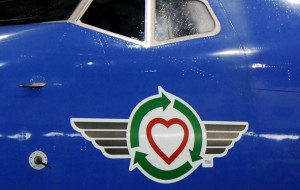
Southwest Airline's green logo
No, Southwest isn’t re-painting their exteriors green, but they are going green with their interiors. The airline is testing a Boeing 737-700 with innovative ideas to reduce weight and to use recycled material.
To start, there are new seats that are about 5lbs lights than their predecessors. This cuts down weight, which cuts down on fuel, which reduces the aircraft’s carbon footprint. It also has carpet that is made of 100% recycled materials and can be replaced in sections, instead of needing to replace the whole aircraft’s carpet, reducing waste.
Materials are not the only change. The aircraft is also kicking off Southwest’s new recycling program, where more items used on the plane will be recycled.
More and more airlines are going green, which is a good thing. However others are trying to reduce weight, to cut costs, to increase profit. Then they say they are doing it to cut down on carbon emissions and as a bonus they can say they are saving the environment. However, Southwest is going a step further, saying this goes past the testing phase and goes fleet-wide.
I talked to Marilee Mcinis, who does Public Relations for Southwest and she stated, “The usage results and customer feedback will help us make a decision on how best to move forward with these materials. We are testing for durability, comfort, etc., so we want to make sure we pick the best product available to meet all of our standards. This is a true test, so we don’t have a particular end date in mind.”
follow us via | web | twitter | email | rss |
Source & Image: InteriorDesign.net
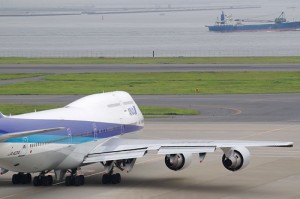
ANA 747-400D(JA401A) which can hold up to 565 passengers
SAVE THE WHALES! It is easier than you might think. You don’t have to donate money, go out and protest, nor send a letter to your congressman. All you need to do, according to All Nippon Airways (ANA), is use the bathroom before you board your flight.
Confused? ANA is stating that if just half their passengers would use the facilities before taking flight, it would save 4.2 tons of carbon dioxide per month.
All joking aside, they might have something here. The more weight on an aircraft, the more fuel it will burn and the more carbon dioxide will be put into the atmosphere. One of their Boeing 747-400D (high density seating) can hold over 560 people. Take 560 x (bathroom times) = a lot of weight.
Now, this is not all that ANA is doing to help out. They have also started using recycled paper cups, plastic bottles, and eliminating glass. They are also showing an eFlight (the “e” standing for “environment” not “electronic”) film to all passengers that states, “This flight is a so-called ‘eFlight.’ The idea behind the operation is to think about the Earth in the sky above. Fuel reduction by lightening the weight of the aircraft will lead to restrain the carbon dioxide emission, which is one of the causes of global warming. Thank you for your understanding.”
Either way, if this saves ANA a few bucks in gas and maybe a whale or two, it works for me. Besides, it is best to go before flight anyhow, so you can avoid using an airplane’s tiny bathroom.
Image: woinary
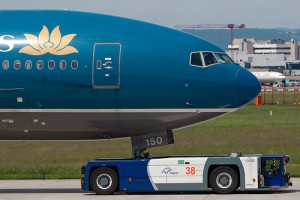
Vietnam Airlines Boeing 777 being towed at Frankfurt
American Airlines, Continental Airlines, Delta Air Lines, United Airlines, US Airways, Southwest Airlines, Alaska Airlines, and UPS have agreed to use up to 1.5million gallons of synthetic diesel made from plant waste per year. The fuel would be used to fuel their ground service equipment at Los Angeles International Airport.
Rentech Inc. will be supplying the alternative fuel starting in 2012, made mostly from urban yard waste and clippings.
Most people only think about aircraft causing much of the pollution in air travel, but there are thousands of support vehicles at each airport that also cause harmful emissions. Rentech is currently in talks with other airlines and airports to increase the fuel’s usage.
Image: Thomas Becker

A Boeing 767-300 will employ fuel-saving measures and GPS navigation on a trans-Atlantic flight.
American Airlines Flight 63 from Paris to Miami on Thursday will be the first trans-Atlantic flight to test several fuel-economy measures and GPS navigation.
Strategies to save fuel and reduce carbon emissions, which American and other airlines have been testing individually for awhile now, include one-engine taxi and gradual (as opposed to incremental) take-off and landing.
The Boeing 767-300 will also use GPS technology for a more direct route than typical jetliner highways, again saving fuel and reducing emissions.
And with the Flight 447 tragedy fresh in our minds, it’s important to note that GPS will eventually be able to track planes’ locations far beyond the accuracy of radar.
Source: Los Angeles Times
Photo: Fotos de aviones – Aviocion.Tv