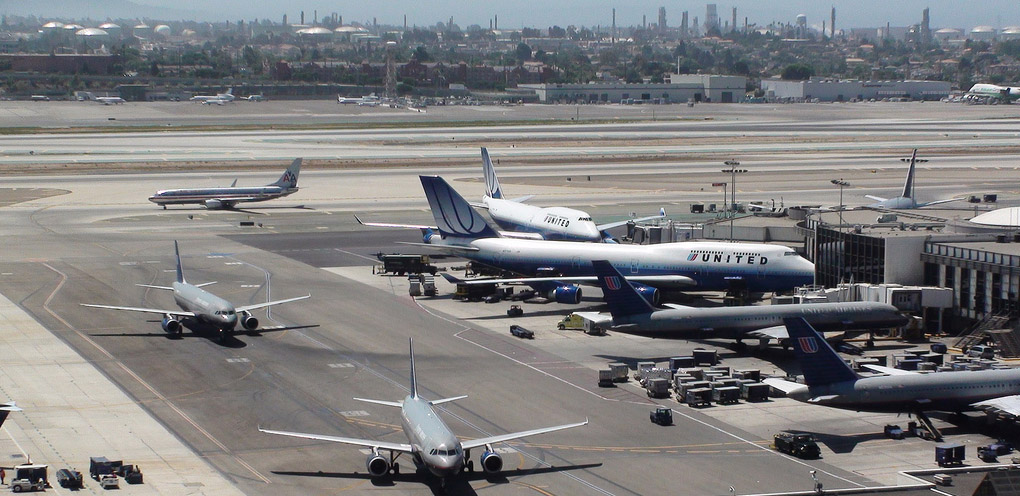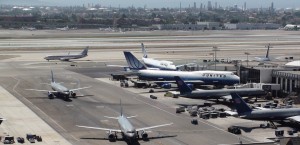
Planes at LAX. Photo by David Parker Brown
The US Department of Transportation announced more regulation on the airline business this week and it has me a bit confused. The airline industry is already one of the most regulated industries in the US and some of these new rules just seem silly. Let’s take a look at them one by one:
Lost Bag Means Bag Fee Refund
I actually like the concept of this — it makes sense to me. If I am paying an airline money to handle my bag, it makes sense that I be refunded that fee if the bag is lost at no fault of my own. However, I am not to keen on the government forcing airlines to do this.
Tarmac Delay Rule to Include International Flights
Even though I love flying, I hate being stuck on the tarmac. I can sit on a plane for 15 hours while flying and be fine since I am making progress. However just sitting on the tarmac going no where just bites. The DOT already has regulated domestic flights cannot be sitting on the tarmac for more than three hours and now extends that to international flights. I am already not a fan of the domestic three hour tarmac rule and even more against international flights.
Not all airports can handle international flights the same. If a flight needs to be diverted to an airport that normally doesn’t handle international flights, it is going to take time to get the proper personnel there.
Now that airlines could face huge fines with international flights to the US, they will be more likely to cancel them. Unlike many domestic flights, which have multiple flights per day, many international flights will only have a few flights per week. That means you could be stranded in another country for days versus being stranded on the tarmac in the US for a few hours.
More Money for Bumped Passengers
Over booking flights always makes sense on paper, but is super annoying when you are the person that gets bumped.
When an airline knows that on average there will be a certain percentage of people that won’t show up for a flight, so they oversell, that makes good business sense. Good business sense doesn’t always means good customer service. The fees will be increased from $400 to $650 for short delays and $800 to $1,300 for longer ones.
It does annoy me that many airlines do not seem to do the right thing when it comes to bumping passengers and quite a few have been fined. Out of all the rules imposed by the DOT, this is the one actually angers me the least.
Disclose All Fees
This seems to duplicate what airlines already do. Maybe I have missed something, but every airline I have ever booked with clearly states on their website what they charge for. Sure some might be a little more tricky than others, but many businesses operate the same way. Have you ever tried to buy a car and get additional fees? Of course.
What is really bothersome is the government is looking to regulate how airlines show their fees. Why does the government feel the need to force airlines to do this, but not other industries?
Add Taxes and Government Fees to Advertised Fares
This one makes the least sense. What other industry is required by the government to include taxes and government fees to their advertised prices?
Most states have tax and people know they will pay tax. Can I walk into a dollar store with $1 and buy something? Nope, where I live I will need $1.09 and I know that. I think this goes to show that the airline business is treated unfairly and “consumer protection” groups are going too far to discriminate against airlines. I just wish the government wouldn’t play along.
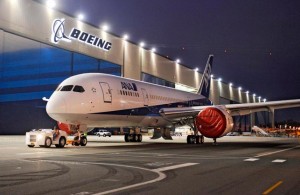
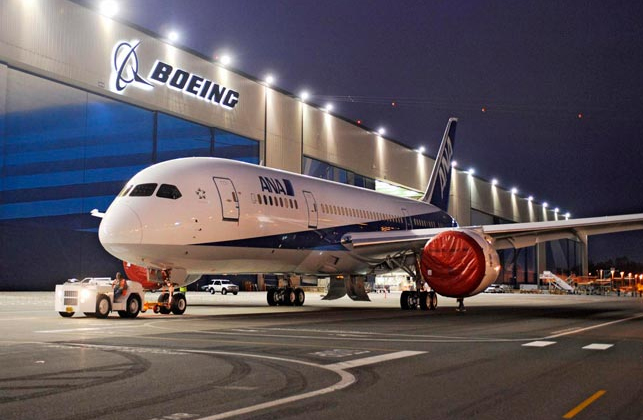
Boeing 787 Dreamliner in ANA livery at Everett Field. Photo by Boeing.
INTRODUCTION
Although the Boeing 787 Dreamliner looks similar to previous aircraft, it uses the next generation of technology and materials. Designing, building and then training for such a complex aircraft is no easy task. How does an airline go about preparing to take delivery of a brand new aircraft?
All Nippon Airways (ANA) will be the first airline to take delivery of the 787 and I recently had the opportunity to sit down with Mr. Takeo Kikuchi, ANA’s General Manager of the USA Engineering Office, and with Nao Gunji, ANA’s Communications Coordinator, to learn more about how they are preparing for the Dreamliner.
Today this story will give some background on the Dreamliner and the training that ANA has completed for the 787. Tomorrow, I will post about ANA’s input on developing the 787 and what happens after they take delivery.
I felt honored to have the opportunity to speak with Mr. Kikuchi. He started working in the airline business in 1980 as a mechanic and did heavy maintenance on classic Boeing 747s in Japan. Subsequently he was responsible for overseeing hydraulic systems on, allowing him to expand his engineering experience. He then worked in public relations for about three years before moving to Seattle in 2007 to lead the local ANA engineering office at Boeing.
Mr. Kikuchi’s main responsibility is to communicate to Boeing the needs of his airline and ensure ANA receives the best quality plane possible. ’œANA’s drive is to purchase a reliable, convenient and usable airplane,’ he explained.
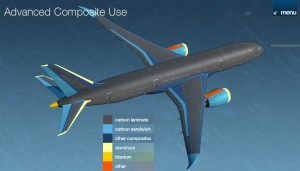
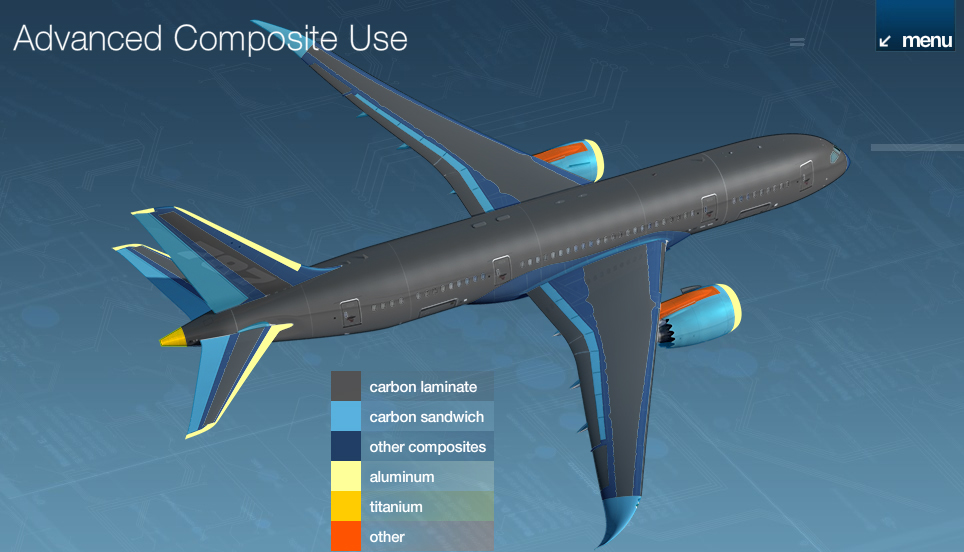
Graphic showing the different materials used in the Boeing 787 Dreamliner. From Boeing.com.
787 AIRCRAFT MATERIALS
The type of materials used is one way the 787 is unique from other aircraft (what makes the 787 different). Currently most aircraft are built using large aluminum panels and are riveted to a metal frame. In contrast, the 787 is constructed using large sections of mostly carbon composite materials that do not need to be riveted. Although the new material makes for a stronger and lighter aircraft, it can provide some challenges.
One of those challenges is how to repair the aircraft. To repair an aluminum aircraft, ANA puts a temporary patch on the affected area and then flies the damaged plane to their maintenance facility in Japan for a permanent repair. With carbon fiber, it is not as easy and will be more difficult to complete a temporary repair before flying to a repair facility. ANA is currently working with Boeing on perfecting the best way to make short-term repairs to the Dreamliner.
One advantage of a carbon fiber repair is the long term benefits. With an aluminum repair, an airplane will have additional squares of aluminum riveted onto the fuselage, causing additional weight and lowering aerodynamics ’“ raising fuel costs. After 787 composite repairs, the change of the aircraft weight and aerodynamics will be minimal, saving money over the lifetime of the airframe.
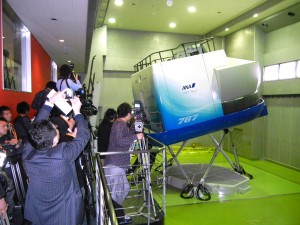
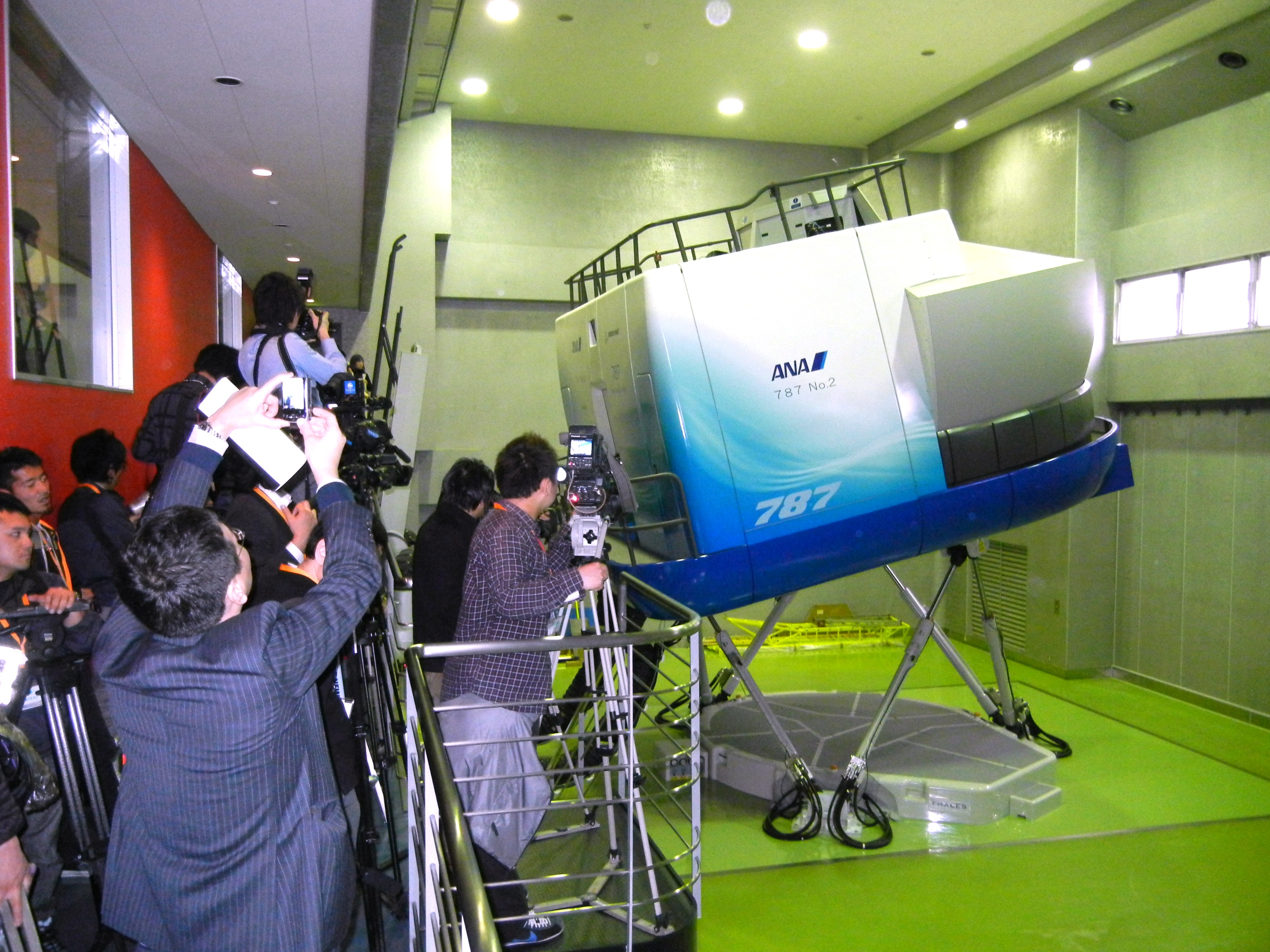
Japanese reporters getting a look at one of the two 787 full flight simulators in action at the Boeing/ANA training campus in Tokyo on March 7. Photo by Boeing.
ANA TRAINING
Although there are many forms of training, nothing beats hands-on experience. Mechanics have started with computerized training, but at some point will be flown from Japan to Paine Field in Everett, WA where the Dreamliner is built. To date, there have been over 100 ANA mechanics, who visit in groups of 10-12, who have been flown to Seattle to train on the Boeing 787 Dreamliner.
Even though there have been ANA pilots who have flown the Dreamliner, not all the pilots will have that chance before the airline takes delivery. The Japanese Civil Aviation Bureau (JCAB) approved Dreamliner simulators at the ANA/Boeing training campus in December 2010. ANA will start 787 pilot training as early as this month.
ANA has invested a lot of time, money and their future into the Boeing 787 Dreamliner and Boeing knows how important their relationship with ANA is. “I can’t say enough about Boeing’s special relationship on 787 crew training with ANA over the past four-plus years, ’ Sherry Carbary Vice President, Flight Services, Boeing Commercial Airplanes said. ’œTheir attention to detail was outstanding and made us better for it.’
After speaking with Mr. Kikuchi, I had a quick tour of the Boeing factory and the 787 production line (sorry, no photos). Now, I am no stranger to the factory, but this was much different tour being that I was guided by an airline representative and hearing their perspective.
While getting a tour of one of their 787 Dreamliners in production, we saw a group of ANA mechanics getting a quick look at the aircraft. Mr. Kikuchi told us that the mechanics would be given a scenario concerning a problem and they would learn how to solve it. It is one thing to talk about the 787 in a conference room versus being out with on the aircraft and seeing the mechanics in action.
Talking to ANA About the 787 Dreamliner:
PART 1 | PART 2 | BOTH
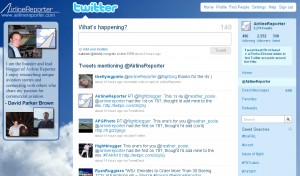
My Twitter page, where all the action happens!
I know I talk about Twitter on my blog quite a bit. I get a mixed-bag reaction from people about what Twitter is and how it works. I use it a lot and link to quite a few interesting stories and photos that I do not share on my blog or on my Facebook.
For those who haven’t stepped into the world of Twitter or maybe you have, but got confused with all the Twitter talk, let me try to help. If you have absolutely no interest in Twitter or learning about it, go ahead and skip this blog.
So what is Twitter? Well, it depends on who you are and what you use it for. If you have a personal Twitter, you probably are going to use it differently than a business one. I use my Twitter to #1 share interesting stories I find that I might not blog about #2 Let you know real-time what I am doing, if I am doing an aviation-related event #3 Connect with airlines, others who write in aviation, and my readers in a way I cannot do with other mediums. If you use Facebook, Twitter is a lot like your status updates. If you don’t use Facebook, Twitter is like a blog and instant messaging that mated and had kids. If you don’t know what blogs or instant messages are, I don’t think I can help :).
The fun part is, unlike blogs or Facebook status updates, you only have 140 characters to make your point, so long-winded folks need not apply.
If you have tried out Twitter you might quickly get confused with all the @ and #’s you see everywhere. It took me a while to get used to it, but after a little practice, it works. I will just keep this simple as if you are just trying to read my and other people’s Twitter feeds.
THE @ SYMBOL:
This is used before a user name to talk about or to someone. I am @AirlineReporter on Twitter. Let’s say you see me Tweet: “hey @danwebbage, I enjoyed meeting you the other day.” That means I am talking to Dan Webb on his Twitter account. He is able to see any message that someone mentions him in and even though I am talking to him, you can still see the message. Let’s say you found this cool airline story and want to share it with me. You could be like, “@AirlineReporter I found this cool, story, what do you think? www.coolstory.com?”
THE # SYMBOL:
The hash sign represents a topic. So let’s take the Farnborough Air Show happening soon as an example. Anyone talking about that topic will put a #FARN10, so if you want to see what anyone is saying about it, you can look it up. For example, recently I did the Virgin America new flight from San Fransisco to Toronto. Anyone who was talking about that experience used #VXToronto.
THE RT:
You probably see “RT” a lot too. This stands for “Re-Tweet” and is when someone copies someone else’s origional message. Let’s say Mary Kirby (@RunwayGirl) just wrote something on her blog and Tweets about it. “Hey check out my cool new blog on in-flight entertainment.” If I like what she is saying and want my readers to see what she is saying, I can RT or repeat what she is saying. It would then look like this, “RT: @RunwayGirl Hey check out my cool new blog on in-flight entertainment.” So you know the original message was done by Mary, but I repeated it. Now if someone then RT’s my Tweet, it can get complicated and look like this, “RT: @AirlineReporter RT: @RunwayGirl Hey check out my cool new blog on in-flight entertainment. ” Someone doing the RT can also make comments. Remember that cool story you Tweeted to me earlier? Let’s say I want to share that with my readers and I RT it with a comment, like this, “Awesome! RT @YouTwitterName: @AirlineReporter I found this cool, story, what do you think? www.coolstory.com?” Don’t worry if it is starting to sound confusing. With a little playing around, you will get the hang of it!
You do not need to create an account to read Twitter, but it sure helps. By creating an account, you are able to add people that interest you onto your friend’s list (that is my friend’s list) and see what they are Tweeting. When you get a little practice you can create groups. Like I created a group of airlines on Twitter that I will look at to see what they are Tweeting about. If you do create an account, it can be totally anonymous, all of Twitter can be anonymous if you want. You decide what information you let people know about.
It is ok if it is confusing at first. It took me a few months to get the hang of it and longer than that before I even know what the #-tag was for. After a while you get used to it and really use it as a resource to see what is going on in the world and connect to people and companies in ways you never have before. You can read about your Aunt Frannie feeding her cat and even hear about awesome travel deals, all in one spot. And I will tell you what…if you run into trouble or have any questions, go ahead and ask me and I will see if I can help you out!
Ok, if you will excuse me, I need to Tweet about this blog now!
To learn more try these out:
* About Twitter page
* The wiki article on Twitter really helps
* Video showing how using Twitter for personal use works
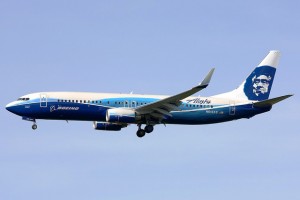
Alaska Airlines 737-800 with special Boeing livery (N512AS)
Alaska Airlines, Boeing, Portland International Airport, Seattle-Tacoma International Airport, Spokane International Airport and Washington State University are working together to promote aviation biofuel development in the Pacific Northwest. The regional assessment is called the Sustainable Aviation Fuels Northwest (SAFN).
The group hopes to examine all phases of developing an aviation biofuel industry and the funding is being split between the involved parties. SAFN will be looking at local biomass sources that can be found in the Pacific Northwest.
“By transitioning to a more fuel-efficient fleet and adopting technology to follow more direct flight paths, Alaska Airlines has made significant strides in minimizing the environmental impact of our flying in the communities we serve,” said Alaska Air Group Chairman and CEO Bill Ayer. “Through this initiative, we are joining other key stakeholders in our region to explore the development of alternatives to jet fuel that could further reduce our carbon footprint.”
The project is starting this month and is expected to take about six months. Air travel currently generates approximately 2 percent of man-made carbon emissions, and the industry has set aggressive goals to lower its carbon footprint, which includes the use of aviation biofuel when it becomes available.
This is only one of several regional biofuel projects that Boeing is currently working with. Curious to find out what Boeing hopes to achieve in this project, I spoke with Terrance Scott, who is with Boeing Environmental Communications. He explained there are four ways to help airlines curb their carbon emissions. The first is product development, where Boeing creates new, more fuel efficient aircraft, like the Boeing 787 and the Boeing 747-8. The second is to retrofit currently flying aircraft with performance packages, winglets and other items. Third is to change the way airlines fly and operate aircraft in order to be more efficient. The last way is the type of fuel used to power the aircraft.
Boeing has helped or will be helping to set up similar regional groups in the Middle East, China, Australia and Mexico. The hope is to create a regional portfolio of fuel sources to create aviation biofuel. Scott told me that Boeing wants to motivate people to find answers, but is not looking to get into the biofuels business themselves. “Boeing doesn’t want to get into the fuel business, but we want to serve as a catalyst.” Their plan is to bring people together, to start talking and working on creating sources for biofuel.
The use of biofuels have already been successfully tested. Boeing has worked with Air New Zealand and Continental to show airlines can successfully use biofuels. Now that biofuel has been proven to be a good alternative to legacy jet fuel, the shift is being made to find a sustainable, economically feasible fuel source. They want to make sure that a fuel source won’t compete with any food source (ie corn and E85).
Most likely any biofuel will cost more than jetfuel today. Would passengers be willing to pay a little bit more to fly green? I think there are some that would, but I am not sure if there would be enough.
http://safug.org/
Image: Axel J
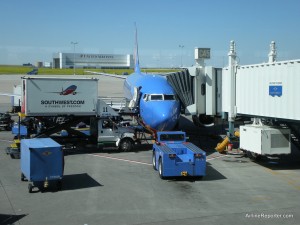
Southwest Airlines Boeing 737-300 (N655WN) sitting at Denver International Airport, waiting to take me to Tampa.
Airline: Southwest Airlines
Trip: Seattle (SEA) to Denver (DEN) to Tampa (TPA)
Planes: Boeing 737-300 (N655WN) and Boeing 737-700 (N747SA)
Seats: 20F & 24A, in the back but both windows
Back on the road again. This time it was to head east to visit my father for Father’s Day. I got tickets on Southwest Airlines leaving on Thursday June 17th. I haven’t flown Southwest in quite sometime and I forgot the importance of checking in as soon as possible.
I am sure most of you know, but Southwest does not do assigned seats. Instead when you check in, up to 24 hours before take off, you are assigned a letter (A,B or C) and a number (1-60). People are boarded by group and number where A1 goes first and C60 pretty much gets the worse seat in the house.
During check in time, I was working on covering the Boeing 787 ZA005’s first flight, so I was rightfully distracted. I could have checked in at 12:35pm, but didn’t get to it until 4:00pm. Dang it, B28. At least I didn’t get the much dreaded C group.
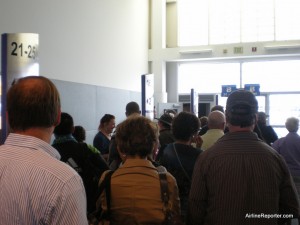
Passengers in Seattle seemed to have a harder time getting the Southwest boarding process than those in Denver or Tampa
Some people LOVE the check-in game, seeing what the best letter/number combination they can get, but if you aren’t into the game and care about where you sit, you can pay a bit more to secure a seat.
You can purchase a Business Select ticket, which gets you a boarding pass in the A1-A15 range, a free drink (is free, really free if you pay more?), additional rewards credit and by-pass security lines at participating airports. If that is too rich for your blood, you can also do Early Bird check-in and pay $10 extra. Southwest will automatically check you in 12hrs before the general population, securing you a better seat. I say a “better seat” not a “guaranteed good seat” because there is no knowing what you might get. Southwest does not limit the number of people that can sign up for Early Bird check-in, so hypothetically if a lot of people pay the extra $10, you could still end up in the B-group (oh the horror). But to most the $10 is worth not having to remember to check in and making sure you don’t end up in the middle seat.
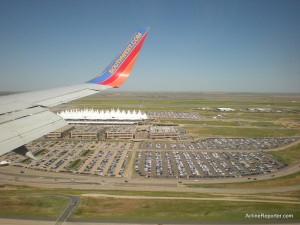
I love those winglet shots. While landing at DEN
My father is in love with Southwest and that is pretty much all he flies. His goal is to still get the lowest number possible. Even though he doesn’t get Business Select, he sure gets the Early Bird special every time. When I told him I didn’t get the Early Bird check in and had B29 I felt he was almost going to disown me (ok, not really).
He admits it doesn’t really make sense, but he just needs the lower number. He feels special having a lower number and is embarrassed to get in the B-group. I don’t think he has ever been in the C-group. I often wonder if he did get in the C-group if he would actually take the flight or just cancel. The $10 is well worth it to him and I assume to others as well.
Through my years of flying on Southwest, the process of getting people in their A, B or C groups has changed quite a bit. Back in the day passengers wouldn’t be given numbers, just A, B or C plastic cards. People would line up hours before the flight. And I mean hours. It was like people camping out for the newest gadget or the hottest movie, just crazy (and I normally love camping in my VW, but not this sort of camping). Now Southwest boarding areas have poles that tell you where you should stand based on your number and TV screens that tell you when those numbers are for A, B or C.

While coming into Tampa we hit some lightening. It was super impressive to see from the air, but hard to get photos.
After experiencing this a few times, I have it down, but the first time I saw this new system, I was quite confused. For some reason passengers in Seattle seemed to have more problems with it than in Tampa. Even at all three airports, there were quite a few people that really had a hard time figuring it out, but we all managed to board the plane in a timely manner.
Some people really have an entitlement of their placement in line and I guess I can understand that. However, I am pretty laid back, but I seem to upset people if I have B15, yet I am standing where B17 should. I am actually letting people go in front of me, but that isn’t ok because I am messing with the system. Almost every Southwest flight there seems to be some passenger whose duty it is to make sure people are lined up perfectly.
It seems a lot of people really love the way Southwest boards the plane. Although it is not a horrible method, I enjoy having my assigned seat. I want to know I have a window seat and I will be sitting next to my travel partner. If I get my ticket late, I know I might be in the center seat and I can prepare for that. If I have a middle seat at the front of the plane, I might check my bag, since I don’t want to risk not having the room. With Southwest, no matter what your boarding assignment might be, there is no guarantee for where I will be sitting and I don’t like that.
Even though I feel I am being jipped in some way, it all worked out. Even though with all four legs I had bad seating numbers (from B15 to B49) I was always able to sit next to my girlfriend and I got a window seat. I spoke with Brad Hawkins, a Southwest communications person, over the phone to see if Southwest was looking at ever going to assigned seats. He told me that they never say never, but when they last asked passengers what they wanted 2:1 wanted to keep the open seating, but quite a few voiced concerns about the boarding process. That is when Southwest started their pole boarding, making it a little more organized.
Boarding in this method, also provides them with additional revenue, which lets them keep prices lower and not charge the fees we see popping up with other airlines. It would also cost Southwest additional money, to set up a seat assignment system, against raising fares. No matter what you opinion is, it looks like open seating will be around for quite some time.
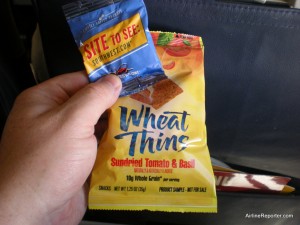
It is not just peanuts anymore. Those tomato wheat thins were amazing.
After going through the line up process, passengers started to back up in the jetway. The captain from the SEA-DEN leg came out and was talking to us. He ended up talking to me about what turbulence we could expect from SEA to DEN and why. It was pretty awesome he was out there. Those sort of things are what make the Southwest employees well known for their customer service and I always wonder why more airlines don’t encourage the pilot/customer interaction that Southwest pilots seem to have (plus I always love the ties they wear).
So, not only do I like to get a window seat, but one where I can easily get those winglet photos. You know those ones right? Photos with the airline’s logo/name on the winglet with other stuff in the background. They are extremely common, but dang it, I like to take them.

Not 100% sure where this was, but this is one of the reasons I make sure I have the window seat.
The gate location of the plane from SEA to DEN was hidden and I wasn’t able to check out what model it was (well duh on a 737, but what hundred?). When I got on the plane, I could easily tell it was an older Boeing 737. The seats looked brand new, it was very clean, but the aged bins, stark white walls and old lights and air vents gave it away. Sure enough it was a classic Boeing 737-300.
On both legs to Tampa, flight attendants told passengers the flight would be completely full and make sure to share. They made multiple statements to the fact that no one will be sitting with an empty seat, so be sure not to try to save it (each announcement was done in a friendly and fun manner). However, both the flights had quite a few empty seats (lucky to get empty middle seat from DEN to TPA, but in VERY last row). Maybe the flight was booked, but not all passengers made it or maybe it is a good motivator for people to share and get seated as soon as possible. Either way, not a big deal, but I have found when other airlines say it will be a 100% full flight, it is.
Unfortunately none of my flights had wireless internet. Southwest is currently installing Row44 on to their entire fleet. If I have internet access, I could care less what seating letter/number I have, but I will have to wait a little bit longer, but it will be happening.
Not that long ago Southwest was known as the “no-frills” airline. Yet now, they seem to be the “frills airline.” When others are charging for checked bags, carry-ons, getting an exit row, etc Southwest is doing what they always have been doing, providing cheap and friendly transportation to destinations around the United States. They have a very loyal following (including my father) and I think they really build a strong and positive relationship with most passengers. I look forward to flying with them again, but I will remember to check in a bit earlier next time or maybe even shell out the extra $10.
Additional photos of the trip.