Noses of a Boeing 747 and 727 – Photo: Caleb Howell | Flickr CC
This guest post was written by Andrew Vane (@pipelinedrew) for AirlineReporter.
Recently I saw that someone posted pictures of old Northwest 727s and DC-10s in North Carolina and I became curious. This is my home turf and I was not aware of any tri-holers “enjoying” their retirement years nearby.
I quickly started looking up Google Earth images and was able to confirm that, sure enough, there was what was left of some vintage aircraft stored in an out-of-the-way airfield somewhere in my home state. Now, how to get out there to see them.
Laurinburg-Maxton Airport (KMEB) is nestled in the pine barrens of the south-central part of North Carolina, off of US Highway 74 about halfway between Charlotte and Wilmington. Originally a U.S. Army Air base for glider training during World War II, this small airport currently is the home to the U.S. Army Golden Knights parachute team, has a nice local Fixed Base Operator (FBO) for civil air service, and also holds something not often seen in the eastern U.S.; a commercial airliner salvage yard.
When you normally think of aircraft storage, the first airports that come to mind are Victorville, California and Tucson, Arizona. Now add KMEB to that list.

An Alaska Airlines aviator bear – Photo: Alaska Airlines
With only a week remaining until Christmas, are you one of the millions still searching for gifts at the last minute? Or is family pestering you for gift ideas? Or do you not care it is Christmas and still want to get some cool airline-related swag?
Why not grab the perfect AvGeek present for that special someone in your life? All of the major carriers and aircraft manufacturers have online stores where you can shop to your heart’s content.
Don’t forget that you can also shop for yourself! The AirlineReporter.com Staff also welcomes AvGeek gifts of any kind.

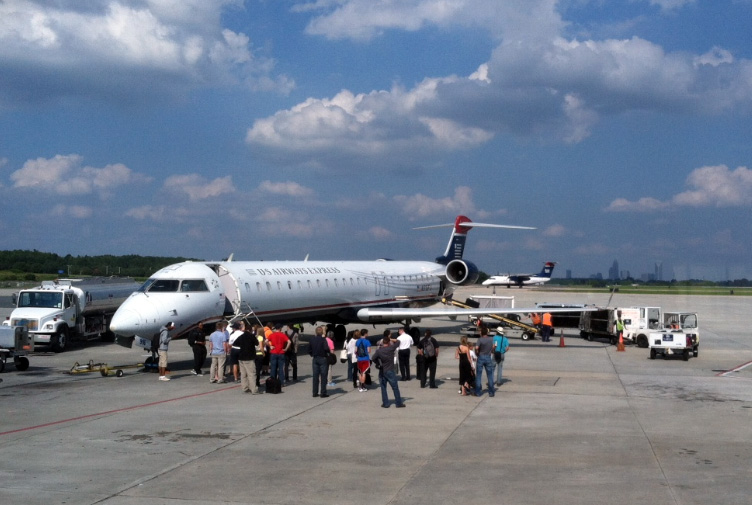
People picking up their bags. Photo by Andrew Vane.
This Story was Written by Andrew Vane for AirlineReporter.com:
Although not filled with the glory of a wide-body international flight typically experienced by others, any opportunity to fly commercially always brings a smile to my face. Getting to fly, no matter the distance or aircraft, is what being an #AvGeek is all about! To quote a childrens book titled ’œRailroad Toad’ by Susan Schade and John Buller (that I used to read to my children): ’œGive me a ticket to anywhere, the farther the better I don’t care!’
Well, that opportunity rolled around again for me. This time, I got to fly for business from my home city of Charlotte, North Carolina to the capital of Pennsylvania, Harrisburg. Up one afternoon and back the next is all I had time for with this trip.
To give you some background on Charlotte-Douglas International Airport (CLT), in 2012 it was the eighth-busiest airport in the US and had more domestic flights than New York’s LaGuardia and Kennedy combined. As a major hub to US Airways (soon to become American Airlines), the airport has grown from three small crisscrossing runways in the 1960’s to four long runways capable of handling an A340-600 or Boeing 777. CLT officials are also planning to give the longest runway a 2,000 foot extension at some point in the future. Hmmmm. My last fortune cookie said ’œI see big things in your future’ so perhaps someday an A380 will grace CLT.
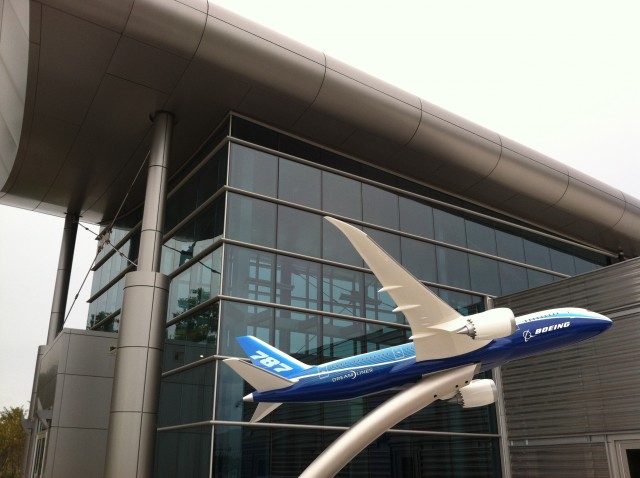
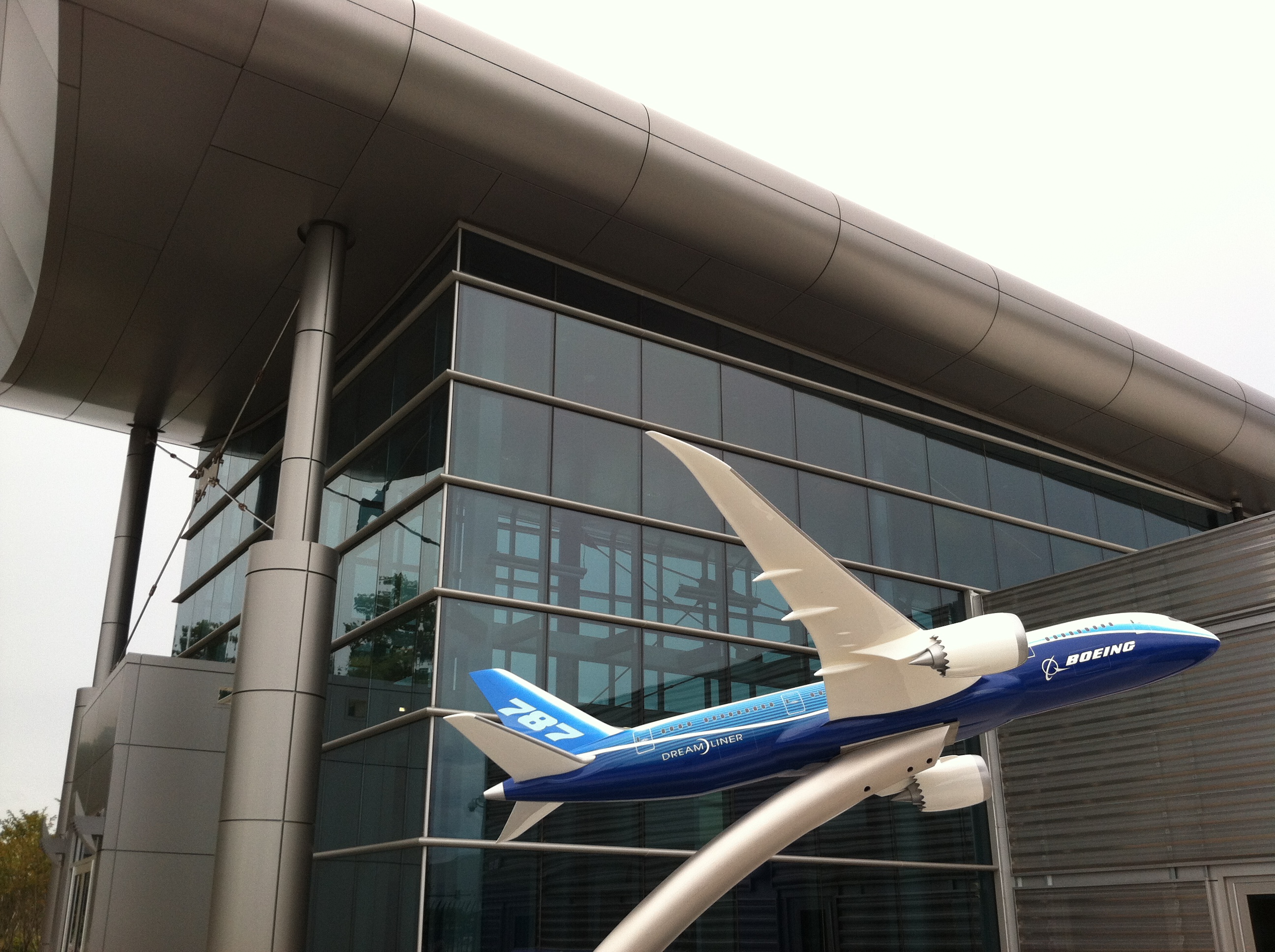
A model of the Boeing 787 outside the Visitor Center in South Carolina. Check out the wing-like roof.
This is a guest post written by Drew Vane for AirlineReporter.com:
I recently visited a Boeing Factory. No, I’m not talking about Renton or Everett, but in South Carolina.
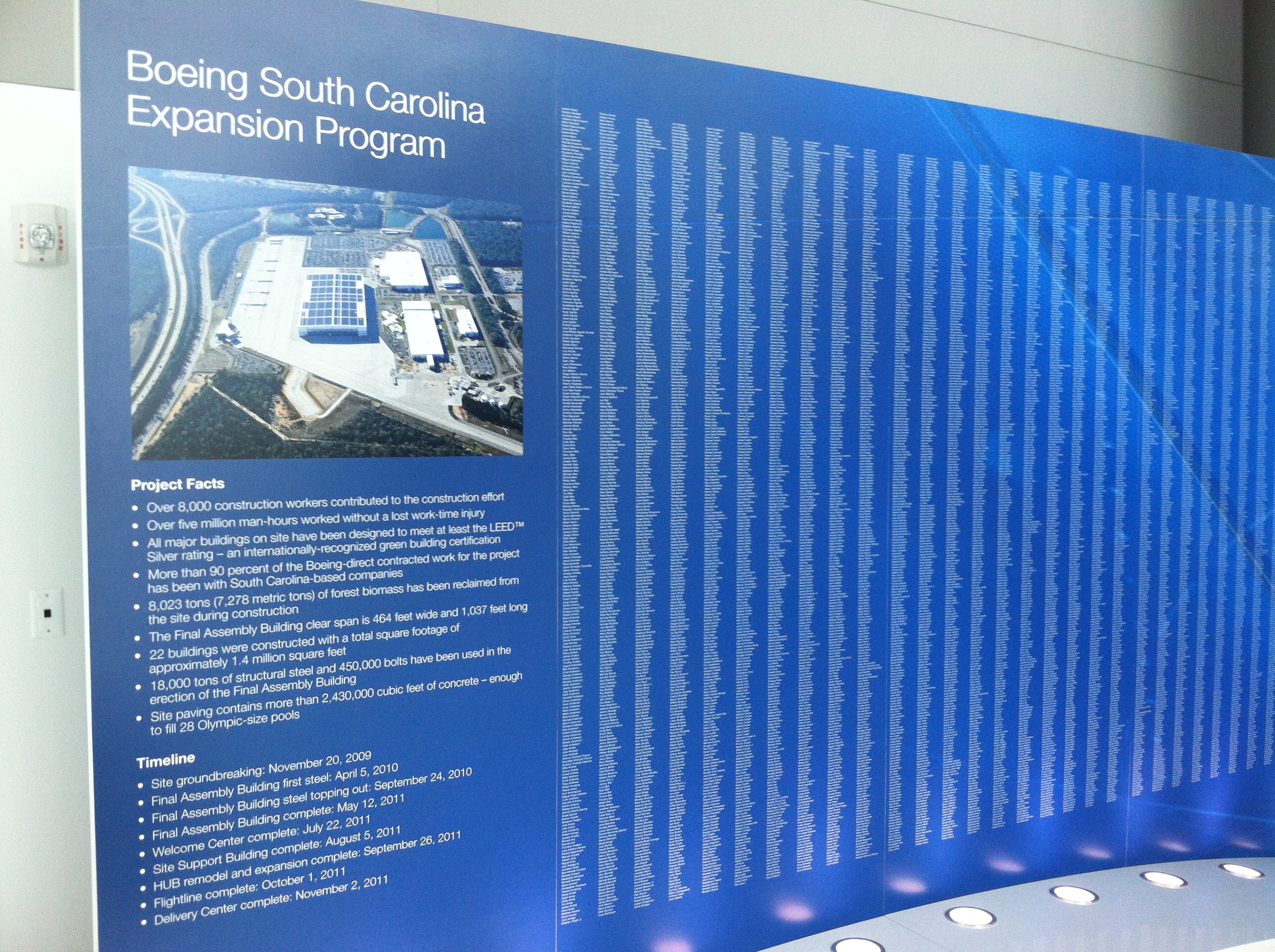
Covering almost 11 football fields and completed in mid 2011, Boeing’s ’œother’ factory for manufacturing the new 787 Dreamliner is located in North Charleston, South Carolina on property bordering Charleston International Airport and Joint Base Charleston. I had the opportunity to stop by during a business trip recently and let me tell you, this facility is impressive. According to Boeing’s web site, ’œBoeing South Carolina fabricates, assembles and installs systems for aft (rear) fuselage sections of the 787 Dreamliner and joins and integrates mid-body sections from other partners.’
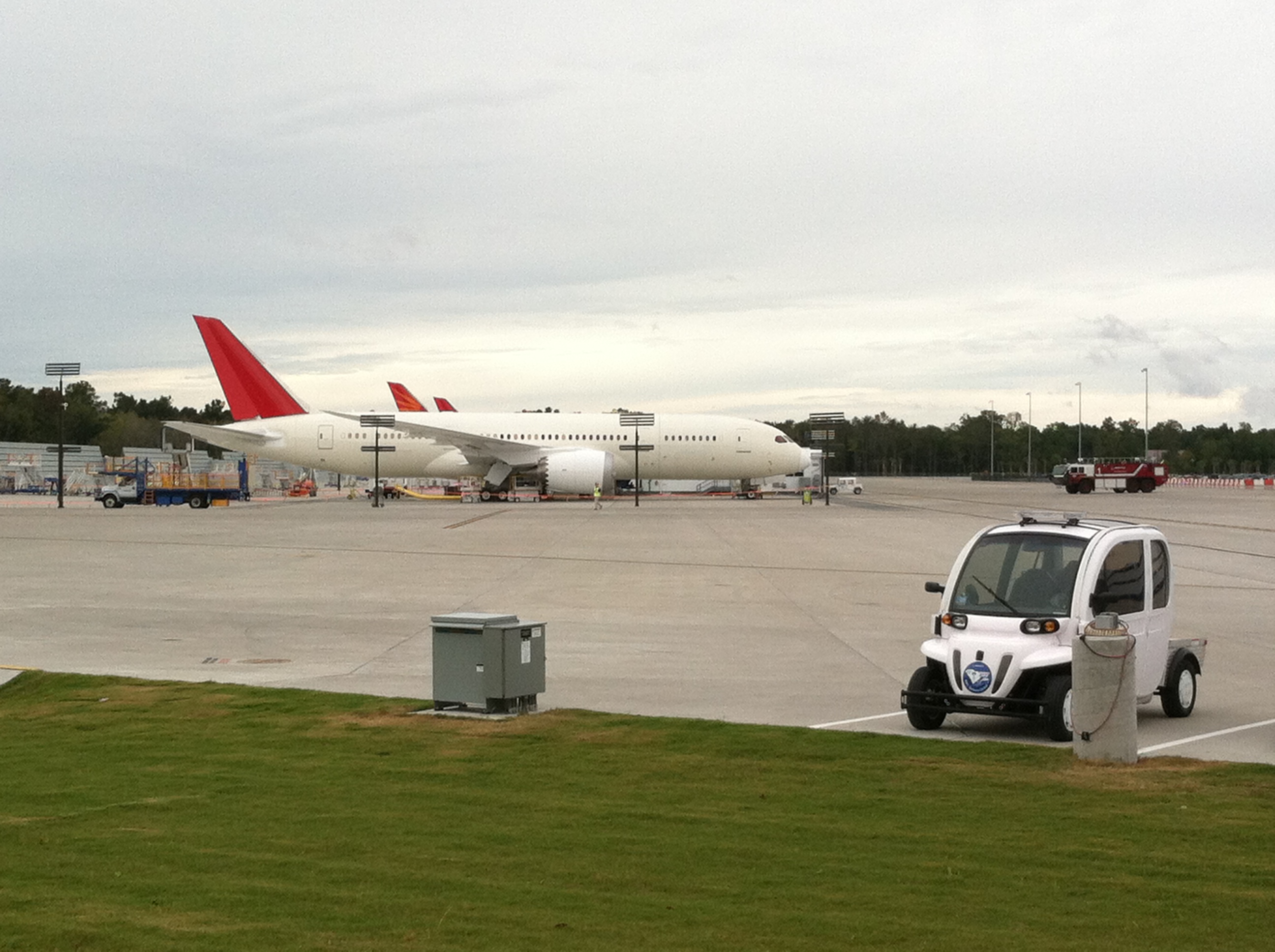
These partners include companies located in India and Japan. While I wasn’t able to tour the facility during my trip, I did take a short visit to the visitor’s facility and grabbed some pics of the lineup near the fence line. I just happened to miss the second 787 Dreamliner to depart for India by only one day. I also missed the departure of the Dreamlifter with its precious cargo bound for Seattle, but I hope to catch one in the future.
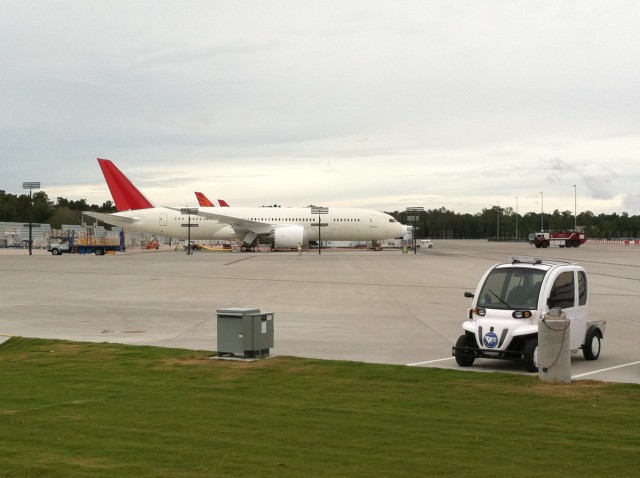
Some 787s on the tarmac at Boeing’s South Carolina facility. Image by Drew Vane.
Since green is the name of the game these days, Boeing designed this facility to be as environmentally friendly as possible. The final assembly building was fitted with solar panels that are capable of generating enough electricity to power 250 homes with a peak energy output equal to 200,000 13-watt watt bulbs. In addition, Boeing has a zero waste program where recycling and reuse is the norm, creating zero waste to landfills from the facility as a whole. Quite impressive for such a large manufacturing facility.
The visitor’s center unfortunately is for those with permission to enter the site. I had hoped to see a retail store, room full of Boeing paraphernalia and models for sale. It is too bad that the store is behind the fence, far from public eyes. The visitor center is more a front gate for those seeking security badges or meeting Boeing employees. They did have a very nice facility with a roof in the form of a 400-ft long wing, an outside small display with the history of Boeing, and a large scale model of the 787.
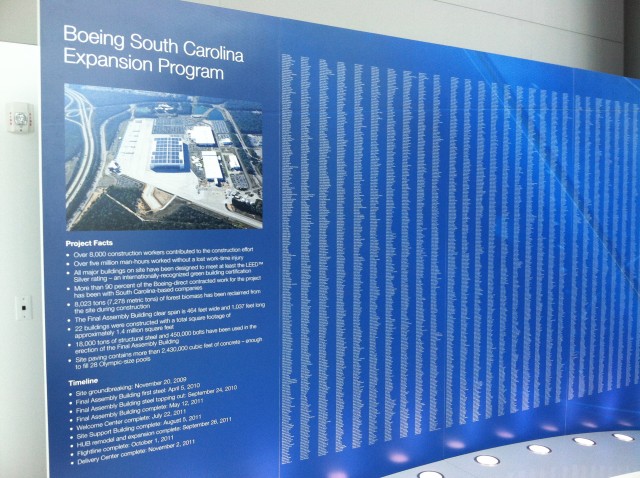
Boeing workers who built the facility
A very courteous Boeing employee was kind enough to talk with me as he was leaving for the day. Boeing’s Charleston facility is the only location currently in the world where the 787 tail assembly is manufactured. Boeing ships the tails to Everett where they’re assembled. Similar to Everett, all the parts are shipped here to Charleston for assembly. At the present time, Boeing’s manufacturing is only capable of producing one 787 per month. But, they hope to eventually ramp that up to one every six days, similar to the Everett Washington facility.
From public areas, I did spot some red tails (not the movie) in the lineup area and took a drive over, stopping outside the fence to snap a pic of the lineup. What an impressive sight! I was excited just to be in the same state as these fine aircraft. I cannot wait until my next visit.

An MD-11 in KLM livery at Amsterdam (AMS).
This is a guest story by Drew Vane on the classic MD-11.
In July of this year, KLM started retiring their fleet of MD-11s with plans to replace them with more fuel efficient aircraft. “Phasing out the MD11 forms part of KLM’s ongoing fleet renewal programme,” a KLM spokesperson explained to AirlineReporter.com. “The last of KLM’s ten MD11s is expected to leave the fleet by the end of 2014.” For the long term, KLM plans to replace the MD-11s with 787-9s, but until then, they will Boeing 777s and Airbus A330s.
In my last article, I highlighted the DC-9 and its impending departure from the commercial skies. I’d thought its time was coming to a close, but Delta surprised me by extending the DC-9’s usage an additional year, but it looks like KLM won’t be delaying their MD-11 retirements.

The flight deck of a KLM MD-11 (PH-KCB). Photo by Dave H.
Once KLM phases out the MD-11, there will be no other commercial airline flying this widebody tri-jet for scheduled passenger service. It’s anticipated that only few cargo and charter airlines will use the MD-11 in their fleet before disappearing from the sky forever.
The MD-11 came about when the aviation engineers at McDonnell Douglas decided an upgrade to the DC-10 was warranted. Instead of inventing a new aircraft, McDonnell Douglas took an already existing popular wide-body aircraft, whose biggest user and launch customer was American Airlines, and made it better.
The DC-10 was plagued with poor media attention due to some catastrophic failures in the 70’s and 80’s, including the worst commercial air disaster in US history, the loss of American Airlines Flight 191. With that flight, a DC-10 rolled over following takeoff and crashed in Chicago on May 25, 1979 which resulted in 270 deaths.

KLM MD-11 at AMS with Northwest DC-10s in the background. Image taken in 2001 by Ken Fielding.
New technological advances had a major impact on what led to the DC-10 Super 60 project, what would eventually become the MD-11. Boeing’s website best describes what exactly made the MD-11 better than its predecessor. Specifically it states that the MD-11 has ’œadvances in aerodynamics, propulsion, aircraft systems, cockpit avionics and interior design.’ What does all the mean? Well, a leaner and meaner version of the DC-10. Here is a summary of the modifications:
- Advanced Cockpit: Fly-by-wire technology, CRT displays, dual flight management system computer (eliminates need for a flight engineer), hydraulic fuses to prevent loss of control in catastrophic conditions, central fault display system, GPS, and Cat III automatic landing capability for extremely bad weather.
- Composite Materials: Usage of light weight composites reduced overall weight and allowed for a fuselage 40 feet longer than the DC-10.
- Aerodynamic design: Added winglets produce 2.5% more efficiency in drag as well as wing and tail improvements.
- More efficient engines: More efficient aircraft engines were developed by Pratt & Whitney, GE and Rolls Royce. New engine types resulted in greater thrust as less fuel usage and longer range.
The table below highlights how these improvements directly related to a longer range and more efficient aircraft. To make things apples to apples, I’ve chosen versions that were the best of each aircraft type.
|
DC-10-30
|
MD-11 ER
|
| Cockpit Crew |
3
|
2
|
| Passengers (3-class) |
255
|
293
|
| Passengers (2-class) |
285
|
323
|
| Maximum Range (full load) |
6,600 mi
|
7,240 mi
|
| Maximum Cruise Speed |
Mach 0.88
|
Mach 0.88
|
| Maximum Takeoff Weight |
572,000 lbs
|
630,500 lbs
|
| Maximum Fuel |
36,650 gallons
|
38, 615 gallons
|
| Engines – Thrust |
PW4462 – 62,000 lbf
|
PW JT9D-59A – 53,000 lbf
|
| Fuselage Length |
170 ft
|
192 ft
|
| Wingspan |
165 ft
|
169 ft
|
So, what we have is a longer range aircraft that is capable of carrying more passengers with less crew and a state-of-the-art cockpit.
If you want to catch a ride on one of these ’œMighty Dogs’ after KLM retires their 9 remaining aircraft, short of buying your own, you’ll have to fly on a charter flight or ship yourself via Fedex, UPS, Eva Cargo or Lufthansa Cargo.