Advertisement

Buy Wholesale products for your airline business on DHgate.com

Syndications


Advertisement

Helicopter training school in Gloucestershire. Take helicopter lessons to earn your PPL-H licence. Train for a career running a helicopter charter company.

Boeing and ANA Conduct First 787 Dreamliner Biofuel Flight

Boeing fills up ANA's 787 Dreamliner with biofuel. Photo from Boeing.

Boeing fills up ANA's 787 Dreamliner with biofuel. Photo from Boeing.

Earlier in the week, Boeing and All Nippon Airways (ANA) made aviation history by flying a 787 Dreamliner using a biofuel blend. There were no passengers on board this delivery flight from Evertt’s Paine Field (KPAE) to Haneda Airport (HND), but there was fuel that was primarly made from used cooking oil that emitted an estimated 10% less CO2 emissions.

“The 787 is the most environmentally progressive jetliner flying today, combining fuel efficiency and comfort with reduced carbon emissions,” said Billy Glover, Commercial Airplanes Vice President of Environment and Aviation Policy.

This is also the first biofuel flight to occur over the pacific ocean.

“Our historic flight using sustainable biofuels across the Pacific Ocean highlights how innovative technology can be used to support our industry’s goal of carbon-neutral growth beyond 2020,” Osamu Shinobe, ANA senior executive vice president, said.

Although biofuel on airlines is still not a cost effective fuel, with new research and technologies I feel that we will start to see the use of this alternative fuel used more and more, not only on airliners, but also in airport operations.

Other stories on biofuels and airlines:
Alaska and United Use Biofuel on Scheduled Flights
* Lufthansa is First Airline to Use Biofuel on Schedule Flights
* Boeing, Alaska Airlines and Others Work Towards Using Sustainable Biofuels
* Back in January 2009, Boeing Gives Prediction That Biofuel Flights Will Be Arriving Soon

Boeing 787 Dreamliner Comparison: JAL vs ANA

Let's get ready to rumble! Whose 787 is better? JAL's or ANA's?

Let's get ready to rumble! Whose 787 is better? JAL's or ANA's?

What’s better than one Dreamliner? Two of course. I have been lucky enough to be on 787 Dreamliners for two different airlines: All Nippon Airlines (ANA) and Japan Airlines (JAL). I have had many people ask me how they were different and figured the answer was good enough for a blog write up.

Now, before I move forward, I want to put a few things out there. First, I have been on ANA’s 787s multiple times and was even able to fly on one. I have only been on JAL’s for a short time while on the ground. The biggest difficulty to compare is that ANA’s Dreamers were set up in a domestic configuration, whereas JAL’s was in an international. Because of this I do not feel it fair to compare everything (like business class seats), but I think there is enough to compare and contrast in this friendly competition.

I have broken down each 787 into different categories and awarded a winner in each:

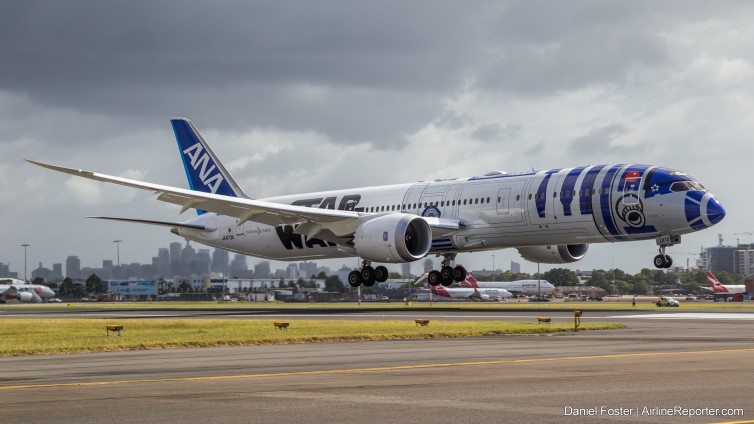
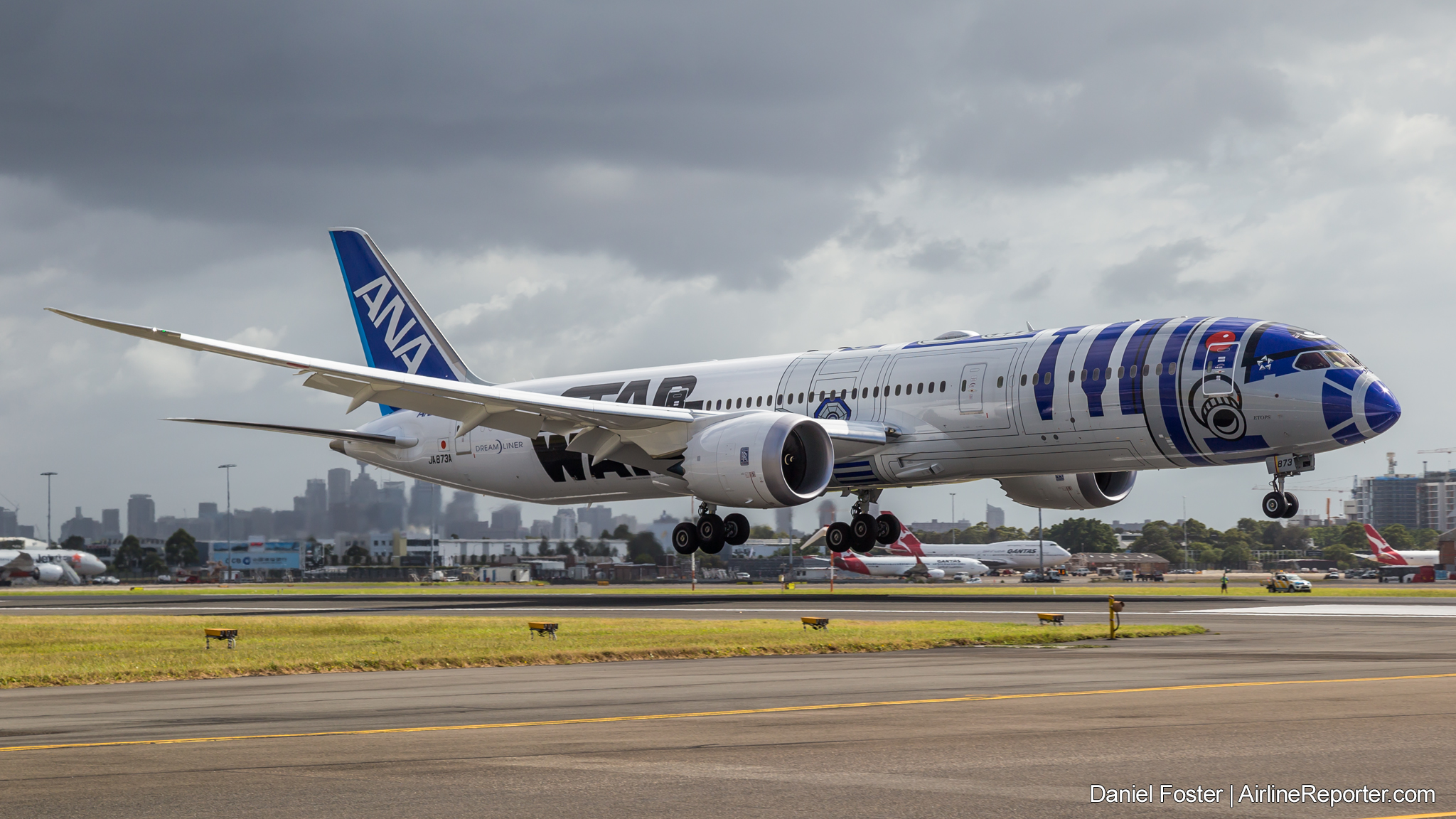
ANA came out with a special delivery livery for their first two 787 Dreamliners. JAL recently came out with a new livery, but there is nothing special for the 787.

JAL recently came out with a new livery, but there is nothing special on the livery for their first 787 like ANA had.

Delivery Livery: ANA

ANA went all out for their first two Boeing 787s with a special livery. The large “787″ makes it clear that this is a Dreamliner, even to those non AvGeeks. Even though JAL’s new livery is starting to grow on me, it just can’t complete.

JAL's entry way is on the left and ANA's is on the right to their 787s.

JAL's entry way is on the left and ANA's is on the right to its 787s.

Entrance Bar: ANA

When first walking into the 787 there is a large entry way that can be set up as a bar during flight. Although both were impressive, I think that ANA having the wine holders out in the open really made it win this one.

Even though my favorite color is blue, overall, I like the atmosphere of JAL's 787 cabin (on the left) versus ANA's.

Even though my favorite color is blue, overall, I like the atmosphere of JAL's 787 cabin (on the left) versus ANA's.

Overall Cabin Atmosphere: JAL

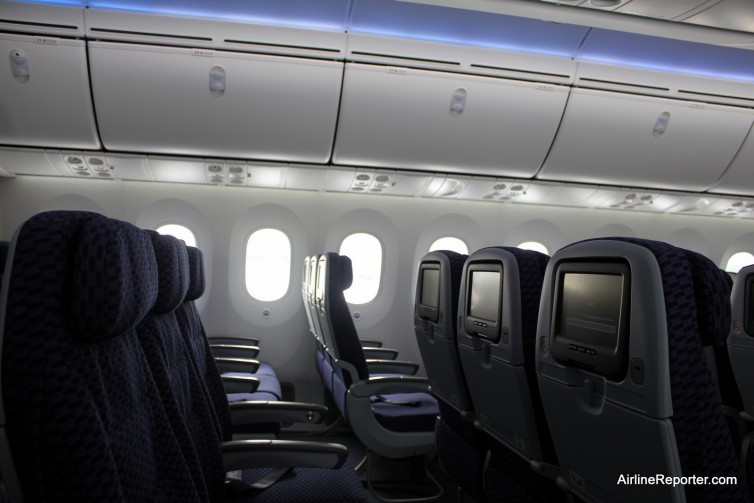
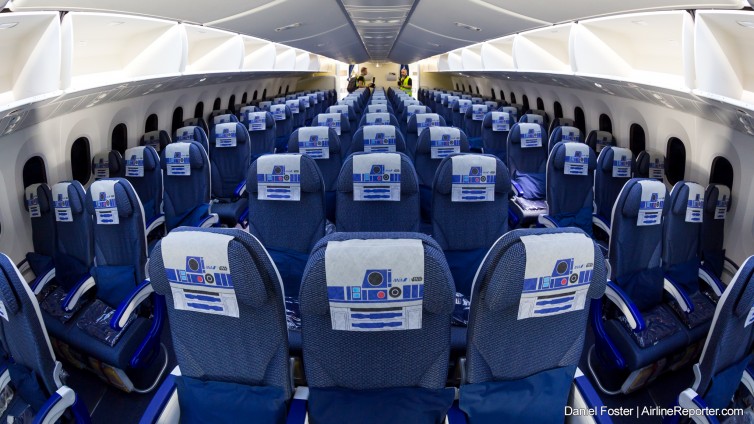
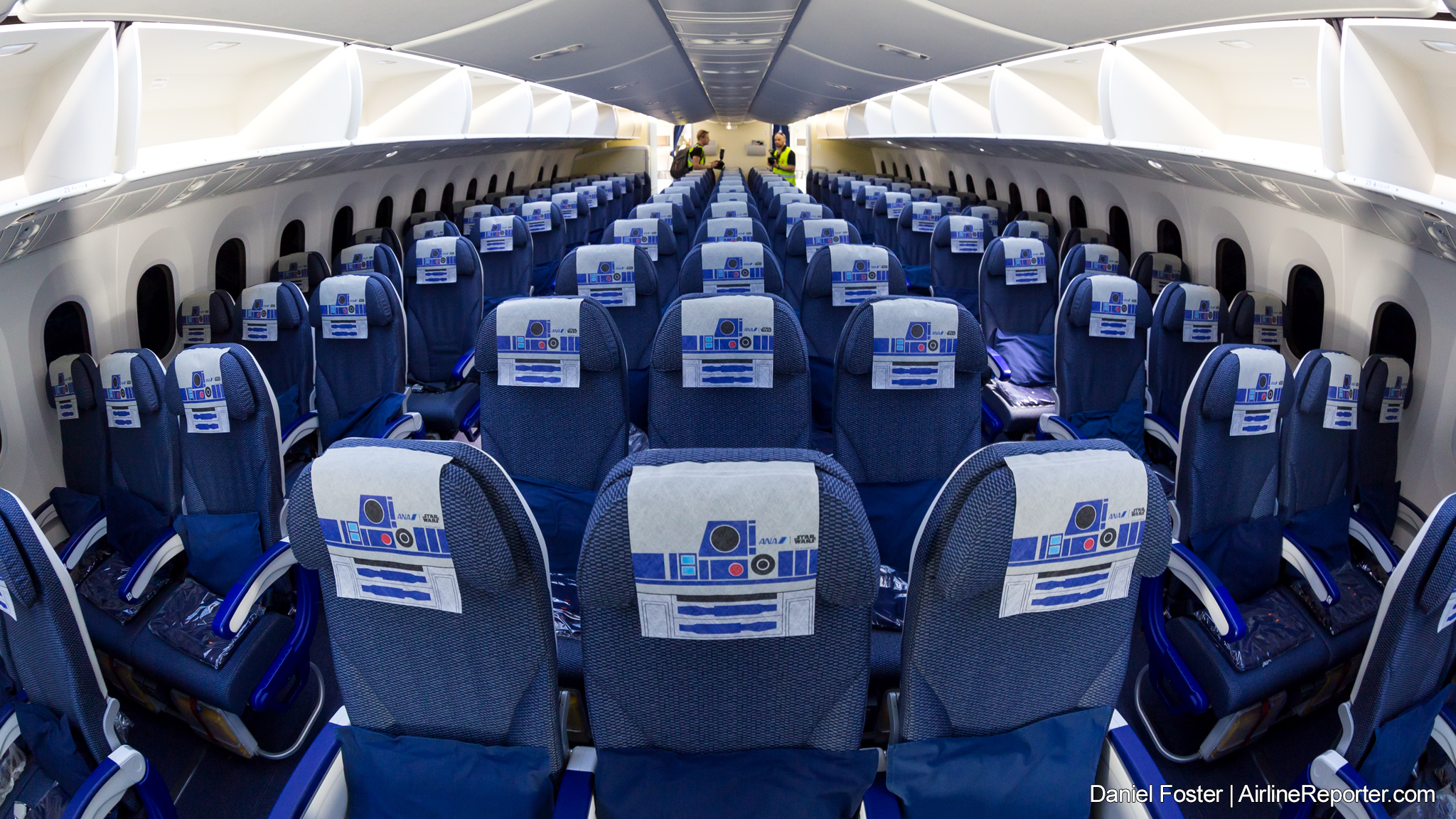
I really cannot put my finger on it, but JAL’s cabin overall just felt better. This is not to say that ANA’s felt bad, but I think maybe the fact that the economy seats have a lined fabric and the soothing colors just made me feel more comfortable in the JAL 787 versus the ANA. Although, someone else who was at the JAL 787 delivery, who also had been on ANA’s aircraft commented that he liked ANA’s interior atmosphere better.

JAL's lavatories aren't bad (on the left), but you can't beat a lavatory with a window in it that ANA has.

JAL's lavatories aren't bad (on the left), but you can't beat a lavatory with a window in it that ANA has.

Lavatory: ANA

Both airlines offer nifty features in their lavatories, but this one went to ANA for choosing to put a window in one of their lavatories. The window actually provides some pretty amazing views of the 787 wing while in-flight and has the only sunshade in the cabin.

JAL (left) went for more width on each economy seat, where ANA (right) gave more arm room for the folks stuck in the middle.

JAL (left) went for more width on each economy seat, where ANA (right) gave more arm room for the folks stuck in the middle.

Economy Class Width: Both

This one is really about where you sit. Even though the 787 Dreamliner can be configured with nine seats across, both JAL and ANA went with eight. Where ANA put in a double arm-rest into the very middle of the cabin, JAL went with a single armrest in the middle, but spread the width to all the seats. If I were sitting in a middle seat, then ANA wins, but if I am sitting anywhere else, JAL is the winner.

What is more important? Having a larger screen on JAL's 787 (left) or the remote in the seat-back on ANA's (right)?

What is more important? Having a larger screen on JAL's 787 (left) or the remote in the seat-back on ANA's (right)?

In Flight Entertainment Screen: JAL

This is literally for the screen and seat-back only. I was able to spend a few minutes on the ANA 787 to play with the system, but really was not enough time to make any conclusions. I was not able to play with JAL’s.

Just looking at the larger and cleaner looking screen in the JAL 787 wins this one. Although ANA’s screen is a bit smaller, I really like the fact that the remote is in the seat versus in the armrest.

Can you tell which one is which? The one of the left is JAL's and the one on the right is ANA's.

Can you tell which one is which? The one of the left is JAL's and the one on the right is ANA's.

Flight Deck: Both

This almost reminds me of Highlights magazine when I was a child and had two photos and had to try to find the differences. Look hard, there are not going to be too many. The 787 cockpit is a beautiful work of engineering and both of them win.

Conclusion

So if I had to pick only one 787 Dreamliner to fly on right now, which one would it be? Ha! That is like asking which child is your favorite. JAL, ANA and Boeing have done a great job with the new interiors and passengers will enjoy flying on either.

Those who are loyal to either JAL or ANA are probably not going to be swayed to change airlines based on differences in their 787 configurations.

An Inside Look at Boeing’s 787 Dreamliner Flight Simulator

The enterance to the Boeing Flight Services in Seattle, WA. Photo by Jeremy Dwyer-Lindgren / NYCAviation.com

The enterance to the Boeing Flight Services in Seattle, WA. Photo by Jeremy Dwyer-Lindgren / NYCAviation.com

Boeing Flight Services (BFS) offers eight locations around the world that provides pilot, maintenance, composite and cabin crew training.  Around the world, Boeing offers 80 flight simulators (eight are for the 787). The locations for the 787 training facilities are located in London, Singapore, Shanghai, Tokyo and of course Seattle. We recently had the opportunity to take a behind the scenes look at the pilot training part of the BFS facility located south of Seattle,WA.

Currently, Boeing has orders for 873 787 Dreamliners. For each new aircraft that gets delivered, there need to be pilots, technicians and flight crew that require training.   Boeing works with their airline customers to provide a customized training package.  They can choose to have their entire staff trained, or just a handful of trainers who return to the carrier armed with all the knowledge they need.

The room we were in had four simulators. Two for the 787, one for the 737 and one for the 767. Notice how they are painted in different Boeing liveries. Photo by David Parker Brown / AirlineReporter.com

The room we were in had four simulators. Two for the 787, one for the 737 and one for the 767. Notice how they are painted in different Boeing liveries. Photo by David Parker Brown / AirlineReporter.com

How long it takes for a new pilot to be trained on the 787 depends on their previous experience. Since the 777 and 787 cockpits are so similar, it only takes pilots five days to be trained on the Dreamliner. A pilot who has flown other Boeing products (like the 767 or 737), it can take 13 days and if a pilot has never flown a Boeing product, it takes 20 days.

The section of the facility we visited held four simulators: two for the 787, one for the 737 and one for the 767. Before getting into full simulator, pilots will start out on a desktop simulation, which students are able to view a 3-D virtual 787 to learn about the aircraft before taking the controls.

Inside the Boeing 787 flight simulator. Photo by Jeremy Dwyer-Lindgren / NYCAviation.com.

Inside the Boeing 787 flight simulator. Photo by Jeremy Dwyer-Lindgren / NYCAviation.com.

Next, pilots move to the flight training device that looks like a desk-mounted simulator and lets the flight crew become familiar with the instruments and airplane systems better before hitting the fully operation simulator.

Before each flight in the full simulator, pilots will sit down with their Boeing instructor to go over the details and expectations of the flight. Boeing flight instructors, on average, have 15,700 total time and at minimum, they are required to have at least 5,000 hours with 1,000 of those in training.

The flight instructor's chair inside the Dreamliner flight sim. Photo by Jeremy Dwyer-Lindgren / NYCAviation.com.

The flight instructor's chair inside the Dreamliner flight sim. Photo by Jeremy Dwyer-Lindgren / NYCAviation.com.

Pilots normally fly for four hours in the simulator and afterwards, trainers will go step-by-step with the pilots using playback from the simulator.

When entering the simulator, the first thing that stands out is the large chair in the middle of everything.  The chair appears more at home on the bridge of the Starship Enterprise than the simulator we’re standing in. The chair, affectionately called “Captain Kirk’s Seat”, is where the instructor is direct and manage the simulation along with being able to see the same visualization that the pilots are.

In flight over Japan in the 787 flight simulator. Photo by Jeremy Dwyer-Lindgren / NYCAviation.com.

In flight over Japan in the 787 flight simulator. Photo by Jeremy Dwyer-Lindgren / NYCAviation.com.

Due to the number of media on the tour the full motion capability was switched off, but that did not stop from making the experience enjoyable. Flight instructor Captain Greg Beard pressed a few buttons on the trainer chair and everyone was whisked away at the speed of light to Narita International Airport in Tokyo. Capt. Beard sat in the co-pilot seat as he smoothly took off the Dreamliner to take a tour around Tokyo.

Being in a few 787 cockpits (not during flight), it is easy to say that the simulator is very accurate to the actual Dreamliner.  Beard confirmed this by explaining that all the same software and options on the actual aircraft are in the simulator – actually there are more. The simulator can be programed to have either the GEnx engines or RR Trent 1000 (there are few differences in the flight deck of the two). The simulator can also be used for the future 787-9 model as well.

A view of the HUD (heads up display) while sitting at Seattle-Tacoma International Airport. Photo by Jeremy Dwyer-Lindgren / NYCAviation.com.

A view of the HUD (heads up display) while sitting at Seattle-Tacoma International Airport. Photo by Jeremy Dwyer-Lindgren / NYCAviation.com.

Although the Boeing 787 is a complex machine, it has been built to make flying as easy as possible. It is not cheap to purchase your own 787 simulators. They are manufactured by Thales, cost about $15-$18million each.

SEE ALL 43 PHOTOS OF THE BOEING 787 DREAMLINER FLIGHT SIMULATOR

This story was a joint effort by AirlineReporter.com and NYCAviation.com.

Follow Along: The Delivery of JAL’s First (and possibly second) Boeing 787 Dreamliner


HI RES IMAGE (click for larger). JAL's Boeing 787 Dreamliner taking off at Paine Field. Photo by Boeing.

HI RES IMAGE (click for larger). JAL's Boeing 787 Dreamliner taking off at Paine Field. Photo by Boeing.

Today, Japan Airlines (JAL) has officially taken delivery of their first Boeing 787 Dreamliner (JA822J). There are also strong rumors that JAL might take (or has already taken) delivery of their second aircraft (JA825J) as well.

Although the official paperwork has been signed, Boeing and JAL will not celebrate the delivery until tomorrow morning. There are some smaller media events today (ie tour of the 787 flight simulator), but the main event will start at about 9:30am PT on Monday and last until Noon. You are invited to follow along with the delivery adventure via Twitter; be sure to follow #JAL787, @AirlineReporter, @FlightBlogger and of course @BoeingAirplanes.

UPDATE: Boeing confirmed that they delivered two 787 Dreamliners to JAL on the 25th.

Japan Airlines to Take Delivery of Their First 787 Dreamliner on March 25th + Photos of the Interior

JAL Boeing 787 Dreamliner at Paine Field. Photo by Boeing.

HI RES IMAGE (click for larger). JAL Boeing 787 Dreamliner at Paine Field. Photo by Boeing.

Japan Airlines (JAL) announced today that they plan to take official delivery of their first 787 Dreamliner this Sunday, March 25th, with a delivery ceremony to follow on the 26th. The aircraft is then scheduled to take off from Paine Field at about 4pm local time on Monday to head to Narita in Tokyo with JAL pilots at the controls.

The airline plans to start operating their first Dreamliner on their new Boston to Tokyo route, currently scheduled to start on April 22, 2012. JAL has also announced the intention of starting 787 service between San Diego and Tokyo later in the year.

HI RES IMAGE (click for larger). Executive Class cabin on JAL's first Boeing 787 Dreamliner. Photo by Boeing.

HI RES IMAGE (click for larger). Executive Class cabin on JAL's first Boeing 787 Dreamliner. Photo by Boeing.

JAL becomes the second airline to take delivery of a 787, but this aircraft will represent a few firsts: It will be the first one to be delivered with GEnx engines, the first to be commercially fly a route to the US and the first to be used on a brand new route (ANA’s 787s have replaced other aircraft on routes that already existed).

The first aircraft is configured in a two class layout, with 42 seats in business class and 144 seats in economy.

HI RES IMAGE (click for larger). The economy cabin inside JAL's first Boeing 787 Dreamliner. Photo by Boeing.

HI RES IMAGE (click for larger). The economy cabin inside JAL's first Boeing 787 Dreamliner. Photo by Boeing.

The business (or executive) class seats are in a 2-2-2 layout and provide about 60″ of seat pitch and a bit over 21″ of width. The seat will recline to about 171 degrees. The Economy class is configured in a 2-4-2 layout and will provide 31″ seat pitch and 18.5″ seat width.

HI RES IMAGE (click for larger). JAL's Boeing 787 Dreamliner taking off at Paine Field. Photo by Boeing.

HI RES IMAGE (click for larger). JAL's Boeing 787 Dreamliner taking off at Paine Field. Photo by Boeing.

JAL’s new in-flight entertainment system, called SKY MANGA, will also debut on the aircraft. The interior has a very different looking atmosphere than ANA’s Dreamliner cabin.